
Fact-checked by the The Finance Tree editorial team
Nearly 65% of Americans report feeling anxious about their finances every single month — and a shocking number of them have tried at least two different budgeting systems in the past year alone, only to abandon both. The frustration is real: you download a sleek app, connect your accounts, and two weeks later you’re ignoring its notifications like an ex’s texts. Or you try cash stuffing vs budgeting apps and find yourself with a wallet full of crumpled envelopes and no idea where $47 went. Neither system feels like it was built for your actual life.
The financial wellness crisis is deepening. According to a Federal Reserve Report on Economic Well-Being, 37% of U.S. adults would struggle to cover an unexpected $400 expense. Meanwhile, the global personal finance app market surpassed $1.5 billion in revenue in 2024, yet budgeting failure rates remain stubbornly high — some studies suggest that over 80% of people who start a new budget abandon it within 90 days. The TikTok-driven cash stuffing trend has amassed over 1.2 billion views on the platform, pulling millions away from screens and back toward physical cash. Something isn’t working, and the stakes are getting higher every year.
This guide cuts through the noise. You’ll get a rigorous, data-backed breakdown of cash stuffing and digital budgeting apps — how each method works, where each one fails, what the research actually says about behavior change, and exactly which type of person thrives with each approach. By the end, you’ll know precisely which system — or combination — gives you the best shot at financial success in 2026.
Key Takeaways
- Cash stuffing users report spending 12-18% less on discretionary categories within the first 60 days of starting the system, according to behavioral finance research.
- The top 5 budgeting apps collectively have over 30 million active users, yet fewer than 20% of users engage with their app more than once per week after the first month.
- People who handle physical cash overspend by an average of 12-15% less than those who pay primarily by card, a finding replicated across multiple studies including MIT Sloan research from 2023.
- Digital budgeting apps save users an average of $1,200-$3,500 per year when used consistently for at least 6 months, per user surveys from leading platforms.
- Cash stuffing requires zero subscription fees, while premium budgeting apps cost between $5.99 and $14.99 per month — up to $179.88 per year.
- A hybrid approach — using physical envelopes for 3-5 high-risk spending categories and an app for tracking fixed expenses — reduces budgeting abandonment by roughly 35% compared to using either method alone.
In This Guide
- What Is Cash Stuffing and How Does It Work?
- What Are Digital Budgeting Apps and How Do They Work?
- The Psychology Behind Each Method
- Cost Comparison: Cash Stuffing vs Budgeting Apps
- Where Cash Stuffing Wins
- Where Digital Budgeting Apps Win
- Common Pitfalls of Each System
- Who Should Use Which Method?
- The Hybrid Approach: Getting the Best of Both Worlds
What Is Cash Stuffing and How Does It Work?
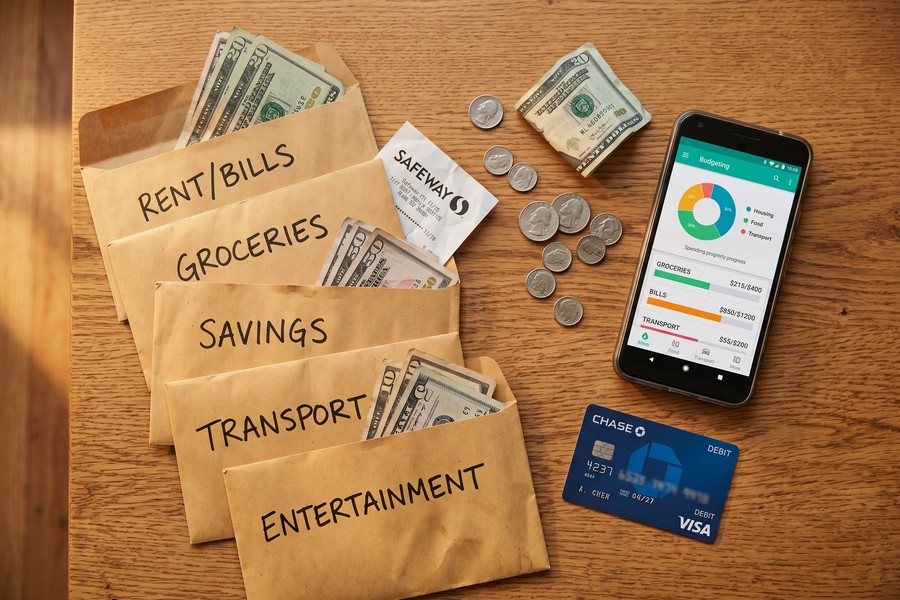
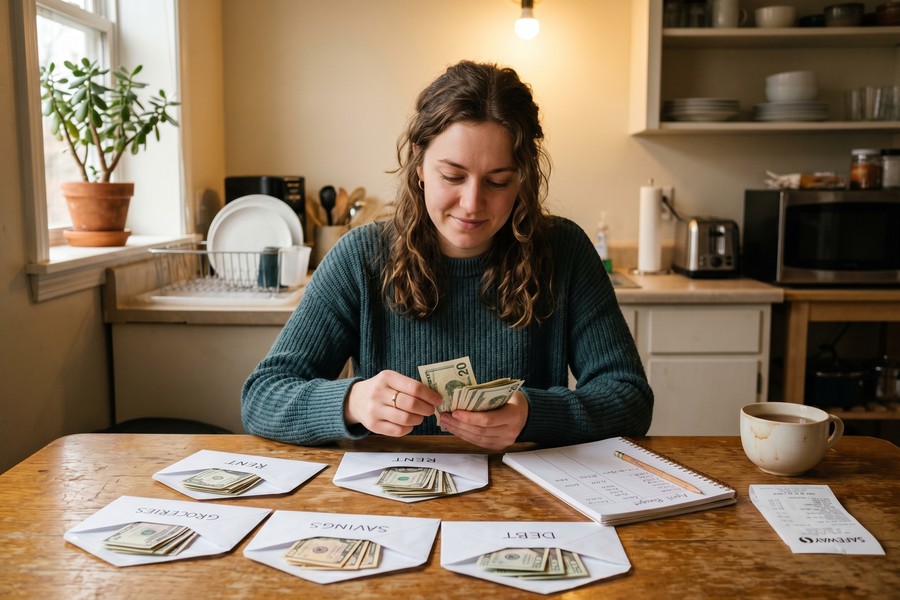
Cash stuffing is a modern rebranding of the classic envelope budgeting system, popularized in the early 20th century and famously championed by financial educator Dave Ramsey. The concept is simple: you withdraw your paycheck in cash, divide it into labeled envelopes — groceries, gas, dining out, entertainment — and spend only what’s in each envelope. When the envelope is empty, spending in that category stops.
What separates the 2025-2026 version from your grandmother’s method is the aesthetic and community dimension. Influencers on TikTok and Instagram have turned cash stuffing into a highly visual ritual, complete with color-coded binders, decorative cash envelopes, and satisfying “stuffing” videos. The hashtag #cashstuffing has accumulated over 1.2 billion views. For millions of younger budgeters, it’s their first real engagement with intentional spending.
For a deeper mechanical walkthrough of how the envelope system operates at a household level, see our guide on how to use the envelope budgeting method to control overspending.
The Basic Setup Process
Getting started takes roughly 2-3 hours on your first payday. You calculate your monthly take-home income, list every spending category, and assign dollar amounts to each. Most practitioners use 8-15 envelope categories. Common ones include groceries ($300-$600/month), gas ($100-$200/month), dining out ($100-$300/month), personal care, and entertainment.
You visit the bank or ATM, withdraw the total cash amount, and physically distribute it. Some stuffers use decorative zippered pouches; others prefer a simple accordion folder. The key is that the money is tangible, visible, and finite.
Variations and Modern Adaptations
Not everyone withdraws 100% of their budget in cash. A popular adaptation is partial cash stuffing, where only variable, temptation-heavy categories — dining, shopping, entertainment — are managed in envelopes. Fixed expenses like rent, utilities, and subscriptions remain as auto-debits. This hybrid approach is increasingly common and reduces the friction of the full cash system.
Digital envelope apps like Goodbudget and Mvelopes attempt to mimic the envelope system electronically. However, purists argue these apps lose the core psychological benefit — the physical pain of handing over real money. More on that in the psychology section below.
What Are Digital Budgeting Apps and How Do They Work?
Digital budgeting apps connect to your bank accounts, credit cards, and investment accounts via secure APIs (application programming interfaces), then automatically categorize every transaction. The best apps pull data in near-real time, flag unusual spending, send alerts when you approach category limits, and generate monthly reports that would take hours to compile manually.
The market is crowded and evolving rapidly. In 2026, the leading contenders include YNAB (You Need a Budget), Copilot, Monarch Money, Rocket Money, and PocketGuard. Each takes a different philosophical approach to budgeting — from zero-based budgeting (YNAB) to automated savings (Plum) to bill negotiation (Rocket Money).
How the Best Apps Work in Practice
After linking your accounts — a process that takes 10-20 minutes — the app begins importing your transaction history, often pulling in 90 days of past data. You set spending targets by category. The app then tracks every purchase automatically. Many apps use machine learning to improve categorization accuracy over time, reaching 90-95% accuracy for most users within 30 days.
Advanced features include subscription tracking, net worth dashboards, debt payoff calculators, and shared budgeting for couples. YNAB’s philosophy of “giving every dollar a job” mirrors zero-based budgeting principles and has a devoted following — the company reports that new users save an average of $600 in the first two months and more than $6,000 in the first year.
YNAB users save an average of $600 in their first two months and over $6,000 in their first year of consistent use, according to the company’s internal user data published in 2024.
The App Landscape in 2026
The budgeting app space has consolidated significantly since 2022, when Mint — once the largest free budgeting platform — was shut down by Intuit in early 2024, forcing its 3.6 million users to migrate elsewhere. This created a significant reshuffling of the market. Monarch Money and Copilot gained substantial user bases as a result.
AI-powered features are now standard in premium apps. In 2025-2026, apps like Copilot and Monarch Money use large language models to answer natural-language questions about your finances (“How much did I spend on takeout in March?”), flag upcoming cash flow problems, and suggest specific savings opportunities. The technology gap between free and paid apps has never been wider.
| App | Monthly Cost | Key Feature | Best For |
|---|---|---|---|
| YNAB | $14.99/mo | Zero-based budgeting | Debt payoff, serious budgeters |
| Monarch Money | $9.99/mo | Collaborative budgeting | Couples, comprehensive tracking |
| Copilot | $8.99/mo | AI-powered insights | iPhone users, visual thinkers |
| Rocket Money | $4-$12/mo | Bill negotiation | Subscription bloat, overspending |
| PocketGuard | $7.99/mo | “In My Pocket” feature | Beginners, simple tracking |
| Goodbudget | Free/$8/mo | Digital envelopes | Envelope method fans going digital |
The Psychology Behind Each Method
The debate over cash stuffing vs budgeting apps isn’t just about features — it’s fundamentally a question of behavioral psychology. How humans relate to money is deeply emotional, not rational. The method that wins in practice is the one that exploits our psychological quirks in our favor.
Behavioral economists have studied how payment method affects spending for decades. The results are striking and consistent. Research published in the Journal of Consumer Research consistently shows that credit and debit card transactions reduce the “pain of paying” — the negative emotional response we feel when handing over money. Physical cash amplifies that pain, making every purchase feel more real.
The Pain of Paying: Why Cash Works on Your Brain
Drazen Prelec and Duncan Simester at MIT demonstrated that people are willing to pay up to twice as much for the same item when paying by credit card versus cash. This isn’t a small margin — it’s a fundamental rewiring of perceived value. When you physically hand over a $20 bill, your brain registers the loss. When you tap your phone, the loss barely registers at all.
Cash stuffing exploits this “pain of paying” feature deliberately. Every grocery run becomes a tangible transaction. You see the envelope thinning. You feel the stack of twenties shrinking. This creates a feedback loop that no app notification can fully replicate — at least not yet.
“The physical act of handling cash activates loss-aversion centers in the brain that digital payments simply bypass. For people who struggle with impulse spending, no technology has yet replicated the psychological brake that physical money provides.”
How Apps Leverage Behavioral Design
Digital budgeting apps take a different psychological approach. Rather than amplifying the pain of spending, they use behavioral nudges — notifications, progress bars, streaks, and social accountability — to keep users engaged. The best apps are designed with gamification principles: you “win” by staying under budget, and losing streaks are visible and uncomfortable.
The weakness is notification fatigue. When an app sends you a “You’ve spent $230 of your $250 dining budget” alert, the friction is low — you can swipe it away in 0.3 seconds with no consequence. Over time, most users begin to ignore these nudges entirely. Research from the Nielsen Norman Group found that the average app notification open rate drops below 5% after 30 days of use.
Apps also suffer from the “out of sight, out of mind” problem. Your budget lives inside a phone that also hosts Instagram, Netflix, and every other dopamine trigger in your life. The envelope on your kitchen counter doesn’t compete for attention the same way.
Studies show people spend 12-18% more when using credit or debit cards compared to cash for the same purchases — a gap that compounds significantly over 12 months of discretionary spending.
Cost Comparison: Cash Stuffing vs Budgeting Apps
When comparing cash stuffing vs budgeting apps purely on cost, the envelope method has an obvious advantage. Physical cash stuffing has no subscription fee, no premium tier, and no annual renewal. Your only costs are the envelopes themselves (roughly $5-$15 for a quality binder system) and potentially a few ATM withdrawal fees if you don’t bank with a fee-free institution.
Digital apps, by contrast, range from free (with limited features) to $179.88 per year for YNAB’s annual plan. Over a 5-year period, a YNAB subscription costs nearly $900. That’s not nothing — especially if the app doesn’t actually change your behavior.
Hidden Costs of Cash Stuffing
Cash stuffing has its own less-obvious costs. You lose the float benefit of credit card rewards. The average American who uses a 2% cash-back card and pays it off monthly earns $300-$600 per year in rewards. Cash stuffers who switch entirely to physical cash forfeit those rewards permanently.
Cash is also not earning any interest while sitting in an envelope. At current high-yield savings account rates of 4-5% APY, keeping $1,000 in cash envelopes for a month costs you roughly $4-$5 in foregone interest. Across a full year, for a household managing $2,000-$3,000 in monthly cash envelopes, the opportunity cost could reach $100-$180 annually.
Storing significant amounts of cash at home creates security and theft risks. If your cash envelope binder is lost, stolen, or destroyed in a fire, that money is uninsured and unrecoverable — unlike bank account balances, which are FDIC-insured up to $250,000.
The True Cost of App Subscriptions
The app subscription cost calculation gets more complex when you factor in ROI. YNAB claims its average user saves $6,000 in year one. If that figure is accurate for your household, paying $179.88 per year is a remarkable return on investment. The caveat: that average is heavily influenced by users who engage deeply and consistently. Casual users who log in twice a month don’t see those results.
Speaking of subscription costs creeping into your budget, it’s worth doing a regular subscription audit to find and cancel services you forgot you paid for — including budgeting apps you’re no longer using actively.
| Cost Factor | Cash Stuffing | Digital Budgeting App |
|---|---|---|
| Setup Cost | $5-$25 (binder/envelopes) | $0 (free trial usually available) |
| Annual Subscription | $0 | $72-$179.88/year |
| ATM/Bank Fees | $0-$60/year | $0 |
| Lost Rewards | $300-$600/year | $0 (can still use cards) |
| Lost Interest (opportunity cost) | $100-$180/year | $0 |
| Potential Annual Savings | Variable (behavior-dependent) | $1,200-$6,000 (per app claims, consistent users) |
Where Cash Stuffing Wins
The envelope method genuinely excels in specific, well-documented scenarios. For people who have tried and abandoned multiple apps, or who have a diagnosed or self-identified problem with impulse spending, the tactile reality of cash creates a behavior-change mechanism that no app has yet replicated at scale.
Cash stuffing also wins on simplicity and accessibility. You do not need a smartphone, a bank account with API integration, or any technical literacy whatsoever. This makes it particularly powerful for individuals who are unbanked or underbanked — a population the FDIC estimates at approximately 4.5% of U.S. households as of 2023.
Discretionary Spending Control
Where cash stuffing most dramatically outperforms apps is in controlling discretionary, variable spending categories. Groceries, dining, entertainment, clothing, and personal care are the categories where most households hemorrhage money. The physical constraint of an envelope — you literally cannot spend more than what’s in it — eliminates the cognitive flexibility that allows overspending to happen.
Apps allow you to overspend and simply show you a red number afterward. Cash envelopes don’t allow overspending at all. That’s not a subtle difference — it’s a structural one. For someone trying to stop living paycheck to paycheck, that hard constraint can be the difference between progress and stagnation.
Financial Beginners and Those Rebuilding
For people just starting their financial journey — or those rebuilding after a setback — cash stuffing provides a concrete, visual, immediately understandable system. There’s no learning curve, no software to master, and no dashboard to interpret. You have money, you put it in envelopes, you spend from the envelopes. The clarity is powerful.
It’s also deeply motivating to see envelopes fill up over time for savings goals. Sinking funds — envelopes dedicated to future irregular expenses like car repairs, Christmas gifts, or vacations — are a natural extension of cash stuffing. For a full breakdown of this strategy, see our guide on sinking funds and how to save for big expenses without stress.
The original envelope budgeting system dates to at least the 1920s in the United States, when cash was the primary form of everyday payment and household budget management was a formal domestic skill taught in home economics curricula.
Where Digital Budgeting Apps Win
Digital budgeting apps dominate in complexity, automation, and long-term financial planning. For households with multiple income streams, investment accounts, retirement contributions, debt payoff strategies, and shared finances between partners, no cash binder comes close to the organizational power of a well-configured app.
The automation advantage is enormous. A good app tracks every transaction across every account, 24 hours a day, 7 days a week, with zero manual effort after initial setup. A cash stuffing practitioner must manually log every envelope transaction — or accept living without a complete financial picture. For busy households, that manual overhead is often the breaking point.
Fixed Expenses and Bill Tracking
Cash stuffing is fundamentally incompatible with the way modern fixed expenses work. Your rent, mortgage, utilities, insurance, car payment, and most subscription services are paid digitally. Trying to manage these through cash requires an extra layer of manual conversion — withdraw cash, pay yourself back from an envelope, track the payment — that creates significant friction without meaningful benefit.
Apps handle fixed expenses seamlessly. They see your Netflix charge, your electric bill, your gym membership, and your car insurance payment automatically. Speaking of tracking your full financial picture, apps that show your complete balance sheet are a natural companion to tracking your net worth over time — a practice that research shows dramatically improves long-term financial outcomes.
Couples, Families, and Shared Finances
Managing shared finances through cash stuffing requires both partners to be physically present for all purchases, or to maintain separate envelope sets — neither of which works cleanly in a two-income household. Digital apps like Monarch Money and YNAB offer shared accounts where both partners see all transactions in real time. Disagreements about spending become data-driven conversations rather than blame-and-shame cycles.
Apps also excel at long-term goal tracking. Building toward a $20,000 emergency fund, a $50,000 down payment, or a specific retirement milestone is far easier to visualize and track digitally. Progress bars, projected timelines, and “what-if” scenarios are native to well-designed apps — impossible to replicate with physical envelopes alone.
“Digital budgeting tools have fundamentally changed what’s possible for households with complex financial lives. The ability to see your entire financial picture — income, spending, debt, investments — in one place and make data-driven decisions used to require a professional financial advisor. Now it’s available for $10 a month.”
Tax Season and Record-Keeping
If you’re self-employed, freelance, or have any tax-deductible expenses, digital apps provide transaction histories that can save dozens of hours at tax time. Categorized spending data feeds directly into tax preparation. Cash transactions, by contrast, leave no digital trail — which is a feature for privacy but a significant liability for accurate record-keeping.
For self-employed individuals who deduct home office expenses or track business-related costs, a digital app that categorizes those expenses year-round is essentially mandatory for maximizing deductions without extraordinary manual effort.
The global personal finance software market was valued at $1.57 billion in 2023 and is projected to reach $3.18 billion by 2030, growing at a CAGR of 10.6% — reflecting massive and accelerating consumer demand for digital financial tools.
Common Pitfalls of Each System
Understanding where each system breaks down is just as important as knowing where each excels. Both cash stuffing and digital budgeting apps have well-documented failure modes that trip up even well-intentioned users.
Why Cash Stuffing Fails
The most common failure point for cash stuffing is envelope raiding — borrowing from one category to cover an overage in another. “I’ll just take $20 from the dining envelope to cover this unexpected grocery run” seems harmless once. But it happens repeatedly, the categories blur, and the system loses its integrity within weeks.
The second major failure is the online shopping problem. A significant and growing portion of consumer spending happens online or via contactless payment. Cash simply cannot be used for Amazon purchases, app store transactions, streaming service renewals, or any digital payment. Managing these categories requires workarounds — gift cards, prepaid debit cards, or manual tracking — that add friction and complexity that many users abandon quickly.
To prevent envelope raiding, write the current balance on the outside of each envelope every time you make a withdrawal. The visual record of deductions makes borrowing between envelopes feel more deliberate — and research shows that small friction like this reduces impulsive transfers by up to 40%.
Why Digital Budgeting Apps Fail
The dominant failure mode for apps is passive tracking without behavior change. Many users configure their app, watch their spending data populate beautifully, and feel productive — without actually changing any spending habits. Watching a dashboard show you overspent on dining for the fourth consecutive month isn’t the same as stopping the overspending.
App abandonment is also a serious structural problem. Mint — once the most popular free budgeting tool in the U.S. — was used actively by fewer than 25% of its registered users at the time of its shutdown in early 2024. Most users had signed up, connected accounts, and drifted away within 60-90 days. The apps didn’t fail technically; they failed to sustain behavioral engagement.
Miscategorization is another persistent frustration. Despite machine learning improvements, apps still regularly misfile transactions — particularly at merchants with ambiguous names, split purchases, or cash withdrawals. Correcting these errors manually is tedious, and users who skip the corrections end up with inaccurate spending pictures that undermine the core value proposition.
Linking all your financial accounts to a third-party budgeting app introduces data security considerations. Always verify that any app you use employs bank-level 256-bit encryption and read-only access to your accounts. Never use an app that requests your full banking login credentials without an intermediary like Plaid or MX Technologies.
Who Should Use Which Method?
There is no universally superior budgeting system. The right choice depends on your specific financial profile, behavioral tendencies, and life circumstances. Here’s a data-informed framework for matching the method to the person.
Cash Stuffing Is Likely Your Best Starting Point If:
- You have a history of overspending on discretionary categories despite knowing your budget limits.
- You’ve tried 2+ budgeting apps and abandoned them within 90 days.
- You’re rebuilding finances after a major setback — divorce, job loss, medical debt, or debt management plan.
- You’re a visual, tactile learner who benefits from physical, hands-on systems.
- Your spending is primarily local and cash-based (farmers markets, local services, in-person retail).
- You’re working on distinguishing wants from needs and building intentional spending habits from scratch.
Digital Budgeting Apps Are Likely Your Best Starting Point If:
- You have a complex financial life: multiple accounts, investment portfolios, side income, or shared finances with a partner.
- The majority of your spending is digital — online shopping, subscription services, contactless payments.
- You travel frequently or have irregular income that makes fixed cash withdrawal amounts impractical.
- You value long-term financial planning, investment tracking, and net worth monitoring in addition to monthly budgeting.
- You’re disciplined enough to review app data regularly and take corrective action — not just passively track.
| Scenario | Better Method | Key Reason |
|---|---|---|
| Chronic impulse spender | Cash stuffing | Hard constraint prevents overspending |
| Dual-income couple | Digital app | Shared real-time visibility |
| Recent debt payoff start | Cash stuffing or hybrid | Psychological ownership of every dollar |
| Freelancer/self-employed | Digital app | Irregular income tracking, tax records |
| Complete budgeting beginner | Cash stuffing | No learning curve, immediate results |
| Financial planner building wealth | Digital app | Investment tracking, long-term projections |
| Unbanked/underbanked individual | Cash stuffing | No account or tech required |
The Hybrid Approach: Getting the Best of Both Worlds
The smartest framing of cash stuffing vs budgeting apps isn’t “which one wins” — it’s “how can each method compensate for the other’s weaknesses?” A growing body of personal finance practitioners and researchers advocate for a deliberate hybrid approach that assigns each method to the categories it handles best.
The model works like this: use a digital budgeting app to manage and automate fixed expenses (mortgage, utilities, subscriptions, debt payments, investments). Then use physical cash envelopes for 3-5 high-risk discretionary categories where you personally tend to overspend. This approach captures the automation and comprehensiveness of apps while retaining the psychological braking power of cash where it matters most.
Building Your Hybrid System in Practice
Start by identifying your “leaky” categories — the 3-5 budget lines where you consistently overspend month after month. For most households, these are groceries, dining out, entertainment, clothing, and personal care. Assign these to physical envelopes and withdraw the budgeted cash at the start of each pay period.
Everything else — rent or mortgage, car payment, insurance, utilities, subscriptions, savings transfers, and investments — stays in your bank account and gets tracked via your chosen app. Your app provides the bird’s-eye view; your envelopes provide the street-level discipline where you need it most.
“The most financially successful clients I work with aren’t ideologically committed to one budgeting system. They’ve found the combination of tools and habits that matches their personality, their life, and their specific weaknesses. A hybrid cash-and-app system consistently outperforms either method used in isolation.”
Tracking the Hybrid System
The one complexity of a hybrid system is ensuring your digital app accurately reflects cash spending. Most apps allow you to manually enter cash transactions. Set a weekly “cash reconciliation” habit — every Sunday, log your envelope balances and record any cash transactions from the week. This takes 10-15 minutes and keeps your overall financial picture accurate.
Some users prefer to track only the digital portion in their app and manage envelopes independently. This works if you’re disciplined about the envelopes, but you lose the integrated picture. For those with long-term financial goals in their 30s and beyond, having a complete picture of all spending is worth the extra 15 minutes per week.
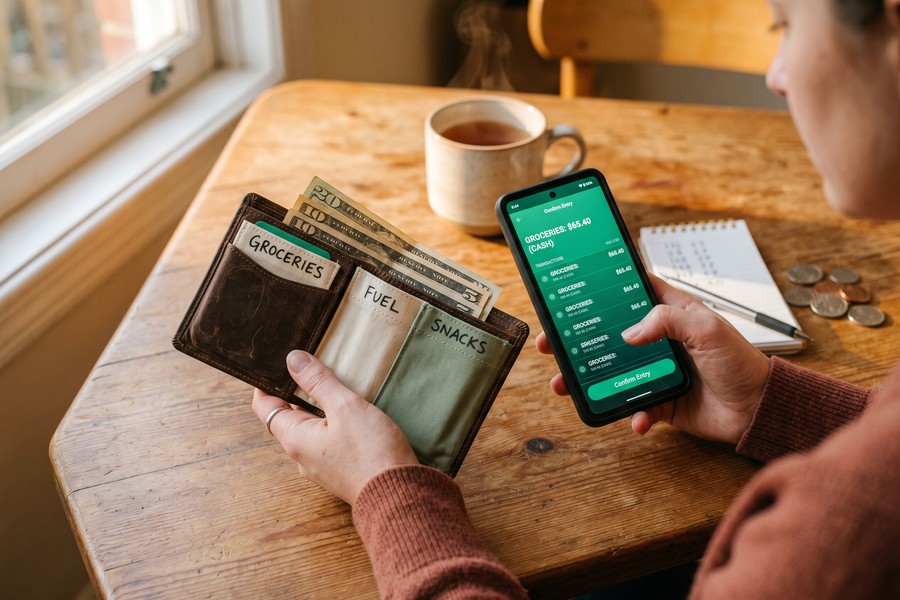
A 2023 consumer survey found that 41% of people who successfully maintained a budget for 12+ months used some combination of physical tracking and digital tools — compared to only 24% who used a digital app exclusively and 19% who used only cash-based methods.
Real-World Example: How Maya Cut $4,800 in Annual Spending with a Hybrid System
Maya, a 31-year-old marketing coordinator from Austin, Texas, had a household income of $68,000 per year and a problem that felt embarrassingly familiar: despite earning a solid income, she was saving less than $200 per month and had $8,400 in credit card debt spread across three cards. She’d tried Mint (abandoned after 6 weeks), a spreadsheet (lasted 3 days), and a brief attempt at full cash stuffing that fell apart the moment she needed to pay for a DoorDash order. She was stuck.
In January 2025, Maya built a hybrid system. She set up a Monarch Money account ($9.99/month) to track all fixed expenses: her $1,100 rent, $340 car payment, $180 in utility averages, $127 in subscriptions, and her minimum debt payments totaling $280/month. She configured automatic transfers of $300/month to a high-yield savings account and $100/month to a dedicated debt payoff fund. Then she identified her three “problem categories” from her transaction history: groceries ($580/month actual vs. $350 budgeted), dining out ($390/month actual vs. $150 budgeted), and personal care/shopping ($280/month actual vs. $100 budgeted). These three categories alone represented $505/month in overspending — $6,060 per year.
She started withdrawing cash every other Friday for those three categories only: $175 for groceries, $75 for dining out, and $50 for personal care. When the envelopes were empty, spending stopped. It was uncomfortable the first two weeks. She ran out of dining cash by day 10 of the first pay period and had to cook every remaining meal. But the discomfort worked. By month three, she had cut grocery spending to $380/month, dining to $130/month, and personal care to $85/month — a combined monthly savings of $395, or $4,740 annually.
By December 2025, Maya had paid off $4,200 of her credit card debt, built a $2,100 emergency fund, and was saving $500/month consistently — more than double her starting rate. Her total financial turnaround: $6,300 in net position improvement in 12 months. The Monarch Money subscription cost her $119.88 for the year. The ROI on that investment was over 50:1. She credits the hybrid system — not any single method — for making it sustainable long enough to actually work.
Your Action Plan
-
Audit Your Last 90 Days of Spending
Before choosing any system, pull your bank and credit card statements for the past 90 days and categorize every transaction. Identify your top 5 spending categories and compare actual spending to what you thought you were spending. Most people are shocked — discretionary categories average 30-40% over self-reported estimates. This data determines whether you need the hard constraint of cash envelopes, the comprehensive tracking of an app, or a hybrid approach.
-
Identify Your “Leaky” Categories
Circle the 2-5 categories where you most consistently overspend. These are your candidates for cash envelopes, regardless of what other system you use. Common culprits include groceries, dining out, entertainment, clothing, and Amazon/online purchases. Be honest — this is diagnostic, not judgmental.
-
Choose Your Digital Tool (Even If You Plan to Cash Stuff)
Even committed cash stuffers benefit from a digital overview of fixed expenses. At minimum, create a free account with PocketGuard or Goodbudget to track your non-cash spending. If you have a complex financial life — multiple accounts, shared finances, or investment tracking needs — invest in a premium app like YNAB ($14.99/mo) or Monarch Money ($9.99/mo). The cost is easily justified if you engage consistently.
-
Set Up Your Envelope System for Discretionary Categories
Purchase a simple accordion folder or cash envelope binder ($5-$20 at any office supply store). Label one envelope for each of your identified “leaky” categories. On your next payday, withdraw the budgeted cash amounts in a combination of $20s, $10s, and $5s. Write the category name and starting balance on the front of each envelope. Keep the binder somewhere you’ll see it daily — kitchen counter, purse, or desk.
-
Automate Your Fixed Expenses and Savings First
Before your paycheck can tempt you, automate everything non-discretionary. Set auto-pay for rent/mortgage, utilities, insurance, and minimum debt payments. Set an automatic savings transfer on the same day as your paycheck deposit — even $50-$100 to start. What’s left after automation and envelope allocation is truly available for spending. This “pay yourself first” structure is foundational to any successful budgeting system.
-
Schedule a Weekly 15-Minute Budget Check-In
Pick a consistent day — Sunday evening works well for most people — to spend 15 minutes with your system. Check your envelope balances, log any cash transactions in your app, review the week’s digital spending, and flag any upcoming irregular expenses. This weekly ritual is the single most powerful habit that separates people who sustain budgeting systems from those who abandon them. Treat it as a non-negotiable appointment with your future financial self.
-
Build Your First Sinking Funds
Once your monthly budget is stable — typically after 60-90 days — add dedicated savings envelopes or digital categories for irregular future expenses: car maintenance ($50-$100/month), holiday gifts ($50-$75/month), medical co-pays, and vacations. These sinking funds prevent the budget-busting “surprise” expenses that derail most systems. A $600 car repair shouldn’t be a crisis if you’ve been saving $50/month for it.
-
Reassess and Adjust at 90 Days
At the 90-day mark, evaluate honestly: Which parts of your system are you using? Which parts are you ignoring? If the app feels burdensome, simplify it or drop to a free tier. If you’re raiding envelopes regularly, either adjust the budgeted amounts (maybe they’re unrealistic) or investigate your spending triggers. No system is set-and-forget. Adjusting your approach based on real behavior data is a feature, not a failure.
Frequently Asked Questions
Is cash stuffing actually effective, or is it just a TikTok trend?
Cash stuffing is backed by decades of behavioral economics research, not just social media trends. The core mechanism — physical cash amplifying the “pain of paying” — is well-documented in academic literature, including research from MIT, Cornell, and Carnegie Mellon. The TikTok popularity has introduced the system to a new generation, but the underlying psychology is solid. That said, it’s not universally effective: people who primarily spend online or have complex financial lives may find the system too limiting.
Can I use cash stuffing if most of my spending is online?
It’s challenging but not impossible. The most practical workaround is using prepaid Visa or Mastercard gift cards as “digital envelopes” for online spending categories. Load the exact budgeted amount onto a prepaid card for Amazon or dining apps, and treat it like a cash envelope — when it’s empty, the category is closed. This approach adds some friction (loading cards, tracking balances) but preserves the hard constraint that makes cash stuffing effective.
Which budgeting app is best for beginners in 2026?
For absolute beginners, PocketGuard is the most intuitive starting point — its core “In My Pocket” feature tells you exactly how much you can safely spend today after bills and savings are accounted for. For people who are ready to engage more deeply with zero-based budgeting principles, YNAB is the gold standard, though it has a steeper learning curve. Goodbudget is the best option for beginners who want to try digital envelope budgeting before committing to physical cash.
How do I prevent raiding cash envelopes?
The most effective prevention strategy is a personal rule that treats envelope raiding like a formal transaction — it must be written down, the borrowed amount recorded, and “paid back” in the next pay period before new spending is allocated. Many cash stuffers also use sealed envelopes or zipper pouches that require a deliberate physical action to open, adding a moment of friction that interrupts impulse raiding. The goal is making the boundary feel real, not punitive.
Are budgeting apps safe? What happens to my banking data?
Reputable budgeting apps use read-only bank connections — they can see your transactions but cannot move money. They connect through intermediaries like Plaid or MX Technologies, which use 256-bit bank-level encryption. Your full login credentials are never stored by the app itself. That said, any third-party data sharing carries some risk. Always use two-factor authentication on your bank accounts, and periodically review which apps have access to your financial data through your bank’s security settings.
How much cash should I put in each envelope?
Start with your actual spending data from the last 90 days, not an idealized budget. If you’ve been spending $450 on groceries, budgeting $200 will cause immediate failure. A realistic starting point is your current actual spend, then reduce each category by 10-15% per month until you reach your target. Drastic cuts fail; gradual reduction builds sustainable habits. Revisit and adjust every 2-3 pay periods as you gather real behavioral data.
What happened to Mint, and what should former Mint users do now?
Intuit shut down Mint in January 2024, redirecting users to Credit Karma (which it also owns). However, Credit Karma’s budgeting features are significantly less robust than what Mint offered. Most former Mint power users have migrated to Monarch Money or YNAB, both of which offer Mint data import tools. If you were a passive Mint user who mainly checked in occasionally, Rocket Money or PocketGuard are solid, lower-effort alternatives.
Can cash stuffing work for people with irregular income?
It can, but it requires a modified approach. Rather than allocating a fixed monthly cash amount, irregular earners should base their envelope amounts on a “baseline income” — the minimum you can reliably expect in any given month. In months where income exceeds the baseline, the surplus goes to savings first, then to priority envelopes for the following month. This conservative approach prevents the overspending that happens when a good month is treated as a new normal.
How do I get my partner on board with budgeting — whether cash or app?
The research is clear: budgeting systems that are imposed on a reluctant partner fail quickly. The most effective approach is a joint “money date” — a structured, low-stakes conversation where both partners review actual spending data together and agree on category limits collaboratively. Apps like Monarch Money and YNAB are specifically designed for shared use and make joint reviews natural. For cash stuffing, both partners stuffing together on payday creates shared ownership of the system. Framing the conversation around shared goals — a vacation, a home, early retirement — rather than restrictions tends to get better buy-in.
How often should I revisit and adjust my budget categories?
At minimum, do a formal review every 3 months. Life changes — seasonal expenses, income changes, new subscriptions, or shifting priorities — make a static budget increasingly inaccurate over time. A common mistake is sticking rigidly to a budget that no longer reflects reality, then feeling like a failure when the numbers don’t work. Your budget is a living document, not a verdict. Adjust it freely based on data, and treat each revision as a sign of engagement, not failure.
Sources
- Federal Reserve — Report on the Economic Well-Being of U.S. Households (2023)
- National Institutes of Health / Journal of Consumer Research — Pain of Paying Research
- FDIC — 2023 FDIC National Survey of Unbanked and Underbanked Households
- Pew Research Center — Americans Having Trouble Paying Bills (2023)
- Consumer Financial Protection Bureau — Tips for Managing Your Money
- Harvard Business Review — The Pain of Paying in Cash May Help You Spend Less
- MarketWatch — The Mint App Is Shutting Down: Here’s What To Do Now
- Statista — Personal Finance Software Market Size Worldwide
- NerdWallet — Best Budgeting Apps of 2026
- The Balance Money — How the Envelope Budgeting System Works
- YNAB — The Four Rules of You Need A Budget
- Investopedia — Zero-Based Budgeting: What It Is and How to Use It
- Business Insider — Cash Stuffing: Pros, Cons, and Who It Works For
- U.S. News & World Report — What Is Cash Stuffing?
- The Wall Street Journal — Mint Is Gone: Which Budgeting App Should You Use Now?