Fact-checked by the The Finance Tree editorial team
Quick Answer
Store loyalty programs savings are real — but only when used strategically. The average U.S. household belongs to 16.6 loyalty programs yet actively uses fewer than half. As of July 2025, the most effective approach is stacking loyalty points with cashback credit cards and sale pricing, which can reduce grocery and retail spending by 10–25% annually.
Store loyalty programs savings come from a system, not from simply scanning a keychain card. According to Bond Brand Loyalty’s annual Loyalty Report, the average American belongs to 16.6 loyalty programs but actively engages with fewer than 8 — leaving significant savings on the table. Programs from retailers like Kroger, Target, CVS, and Walgreens are engineered to reward consistent shoppers with points, personalized coupons, and tiered discounts that compound over time.
With inflation still pressing household budgets in 2025, maximizing every dollar at checkout matters more than ever. This guide explains exactly how loyalty programs work, which ones offer the best return, and how to stack rewards to extract the most value without spending more than you planned.
Key Takeaways
- The average U.S. household belongs to 16.6 loyalty programs but actively uses fewer than half, leaving rewards unredeemed (Bond Brand Loyalty).
- Loyalty program members spend 12–18% more per visit than non-members — meaning programs are designed to increase your spending, not just reward it (Harvard Business Review).
- CVS ExtraCare members save an average of $37 per year in ExtraBucks alone, before counting card-linked sale prices (CVS Health).
- Stacking a loyalty program discount with a cashback credit card can yield an effective savings rate of 8–15% on a single grocery transaction (Consumer Reports).
- Unredeemed loyalty points in the U.S. represent an estimated $100 billion in unused value annually (Business of Apps Loyalty Statistics).
In This Guide
- How Do Store Loyalty Programs Actually Work?
- Which Store Loyalty Programs Offer the Best Savings?
- How Do You Stack Loyalty Rewards for Maximum Savings?
- What Loyalty Program Pitfalls Should You Avoid?
- How Do Store Loyalty Programs Savings Fit Into Your Budget?
- What Is the Data Privacy Tradeoff With Loyalty Programs?
How Do Store Loyalty Programs Actually Work?
Store loyalty programs reward repeat purchases through points, cashback, or exclusive discounts that are tied to a member account. Retailers use purchase history to send personalized offers, which increases the relevance of each deal — and the likelihood you will redeem it.
Points-Based vs. Discount-Based Programs
Programs fall into two broad categories. Points-based programs — like those run by Kroger, Safeway, and Walgreens — assign a point value to each dollar spent, which is later redeemed for discounts or free products. Discount-based programs, like Amazon Prime’s grocery pricing tier, apply savings automatically at checkout without a separate redemption step.
Tiered programs, used by Sephora’s Beauty Insider and Starbucks Rewards, unlock higher-value benefits as you spend more. According to Harvard Business Review research on loyalty program design, tiered structures are effective at increasing customer lifetime value — but only benefit the consumer when the tier is reached through spending you would have done anyway.
How Personalized Coupons Work
Retailers like Kroger use machine learning to generate personalized digital coupons based on your purchase history. These offers are often loaded directly to your loyalty card and applied automatically at checkout. The savings can be substantial — Kroger’s loyalty program regularly offers 10–15% off specific categories for targeted shoppers, according to Consumer Reports’ loyalty program analysis.
Kroger’s loyalty program, known as Kroger Plus, uses purchase data from over 60 million households to generate personalized fuel points and digital coupons — making it one of the largest retail data operations in the United States.
Which Store Loyalty Programs Offer the Best Savings?
The best loyalty programs combine automatic price reductions, redeemable points, and stackable digital coupons. Grocery, pharmacy, and big-box retailers offer the strongest return for everyday shoppers.
Top Programs by Category
Below is a comparison of the most widely used programs, based on their reward rates, redemption flexibility, and additional stacking potential.
| Program | Effective Reward Rate | Best Feature | Annual Value Estimate |
|---|---|---|---|
| Kroger Plus | 1–4% in fuel points + digital coupons | Personalized coupons, fuel savings | $200–$500/year |
| CVS ExtraCare | 2% back in ExtraBucks | Pharmacy rewards + ExtraBucks | $37–$150/year |
| Walgreens myWalgreens | 1–5% Walgreens Cash | Health and wellness bonus categories | $50–$200/year |
| Target Circle | 1% earnings + targeted offers | 1% automatic + bonus category deals | $75–$250/year |
| Amazon Prime | 5% back with Prime Visa | Whole Foods 5% + free shipping | $150–$600/year |
| Sephora Beauty Insider | 1 point per $1 (Insider tier) | Tiered birthday gifts, early access | $50–$300/year |
Annual value estimates assume typical household spending patterns and consistent program engagement. Shoppers who use digital coupons weekly and redeem points promptly see results at the higher end of these ranges.
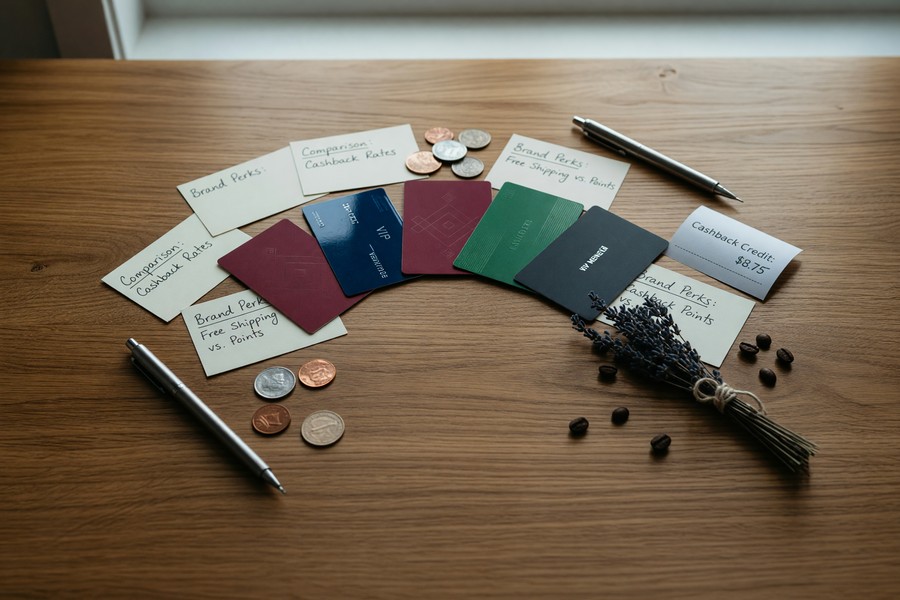
Americans hold an estimated $100 billion in unredeemed loyalty points, according to Business of Apps loyalty statistics. That is money earned but never collected.
How Do You Stack Loyalty Rewards for Maximum Savings?
Stacking rewards — combining a loyalty program discount with a cashback credit card and a current sale price — is the single most effective strategy for store loyalty programs savings. Done correctly, it can reduce the effective price of a purchase by 15–25%.
The Three-Layer Stack
The most powerful approach uses three simultaneous savings layers on a single purchase:
- Layer 1 — Sale price: Wait for the item to be on the store’s weekly ad discount (often 20–40% off).
- Layer 2 — Digital coupon: Load a manufacturer or store loyalty coupon to your account before checkout.
- Layer 3 — Cashback card: Pay with a cashback credit card that earns 3–6% on grocery or pharmacy purchases.
For example, a $10 item on sale for $7 with a $1 digital coupon, paid with a card earning 5% cashback, costs an effective $5.70 — a 43% reduction from the original price. Pairing this with the right cashback or rewards credit card amplifies the outcome significantly.
Fuel Points as a Hidden Savings Tool
Many grocery chains — including Kroger, Giant Eagle, and Safeway — convert loyalty points into fuel discounts. Kroger Plus members can earn up to $1.00 off per gallon on fuel purchases when they hit spending thresholds. For a household filling a 15-gallon tank weekly, that represents up to $780 in annual fuel savings, according to Kroger’s published reward structure.
“The consumers who get the most out of loyalty programs are the ones who treat them like a second budget line. They track what they have earned, plan redemptions around high-value moments, and never let points expire unused.”
If you are working to build a monthly budget that actually works, fuel point savings should be captured as a real line item — not ignored as a bonus.
What Loyalty Program Pitfalls Should You Avoid?
Loyalty programs are designed to increase spending, not just reward it. The biggest pitfall is buying items you would not have purchased simply because a loyalty discount makes them feel like a deal.
Overspending to Earn Rewards
Loyalty-triggered overspending is well-documented. Harvard Business Review found that loyalty members spend 12–18% more per visit than non-members on average. Much of that increase is driven by “bonus point” promotions that encourage purchasing outside your regular shopping list.
The fix is simple: write your list before opening the app. Check for relevant deals only after your list is set — not the other way around. This discipline is closely related to strategies for stopping impulse buying, which loyalty interfaces are specifically engineered to trigger.
Letting Points Expire
Most loyalty programs impose expiration windows. CVS ExtraBucks expire within 30 days of issuance. Walgreens Cash rewards expire after 3 months of account inactivity. Setting a calendar reminder to check your balances monthly prevents losing earned value. The $100 billion in unredeemed U.S. loyalty points cited by Business of Apps is largely attributable to expired and forgotten rewards.
Set a recurring monthly calendar alert titled “Check Loyalty Balances.” Review your CVS ExtraBucks, Walgreens Cash, Kroger fuel points, and any other active programs. Redeem anything expiring within 30 days — even on a small purchase — rather than letting it lapse.
How Do Store Loyalty Programs Savings Fit Into Your Budget?
Store loyalty programs savings work best when treated as a concrete budget category, not a pleasant surprise. Households that actively track loyalty earnings reduce grocery and pharmacy costs by an estimated 10–15% annually, according to Consumer Reports.
Integrating Loyalty Savings Into a Zero-Based Budget
In a zero-based budget framework, loyalty savings reduce your projected grocery outflow. If your monthly grocery budget is $600 and you consistently save $60–$90 through loyalty programs and stacking, that freed-up capital should be redirected — to an emergency fund, debt paydown, or savings account.
Logging loyalty redemptions alongside regular spending also reveals patterns. Shoppers who track both spending and savings are significantly more likely to stay within their grocery budgets, according to Bureau of Labor Statistics Consumer Expenditure Survey data on household financial management behaviors.
Using Loyalty Savings to Offset Inflation
Grocery prices rose 1.8% year-over-year as of early 2025, according to BLS Consumer Price Index data. Strategic loyalty program use — especially stacking — effectively neutralizes a significant portion of that increase for active participants. For a household spending $800 per month on groceries, a consistent 10% loyalty savings rate saves $960 annually.

What Is the Data Privacy Tradeoff With Loyalty Programs?
Loyalty programs collect detailed purchase data in exchange for discounts. This is not hidden — it is the core business model. Understanding what you are trading is essential before enrolling.
What Retailers Collect
When you use a loyalty card, retailers like Kroger, Target, and CVS record every item purchased, the time and location of each transaction, payment method, and coupon use. This data is used to personalize offers — but it is also sold to or shared with third-party data brokers, per each retailer’s privacy policy. The Federal Trade Commission’s report on commercial surveillance identifies grocery loyalty programs as among the most data-intensive consumer tracking systems in retail.
How to Limit Exposure
You can limit data sharing without forgoing savings. Use a dedicated email address for loyalty accounts. Opt out of third-party data sharing where the program allows it — many programs are required to offer this option under state privacy laws like the California Consumer Privacy Act (CCPA). The tradeoff between savings and data exposure is a personal one, but awareness of it is essential for informed use of store loyalty programs savings strategies.
Frequently Asked Questions
Are store loyalty programs actually worth it?
Yes — when used strategically. Households that actively use grocery and pharmacy loyalty programs save an estimated 10–15% annually on those categories. The key is combining loyalty discounts with sale prices and cashback credit cards rather than relying on points alone.
Which grocery store loyalty program saves the most money?
Kroger Plus consistently ranks among the top programs for grocery savings due to its combination of personalized digital coupons, fuel points, and automatic card-linked discounts. Amazon Prime also delivers strong value — particularly the 5% back at Whole Foods for Prime Visa cardholders.
Can you use loyalty programs at multiple stores?
Yes. There is no limit to how many loyalty programs you can join. Most personal finance experts recommend focusing on 2–4 programs tied to stores you shop regularly, rather than spreading attention across too many programs to manage effectively.
Do loyalty points expire?
Most do. CVS ExtraBucks expire within 30 days, and Walgreens Cash rewards expire after 3 months of account inactivity. Kroger fuel points typically expire at the end of the month following the month they were earned. Check each program’s terms and set calendar reminders to prevent losing rewards.
Is it safe to use store loyalty programs?
Loyalty programs are generally safe to use, but they involve a significant data tradeoff. Retailers collect and often sell detailed purchase histories to third parties. Using a separate email address and opting out of third-party data sharing — where allowed by programs under laws like CCPA — reduces your exposure without eliminating savings.
How do I avoid overspending because of loyalty deals?
Write your shopping list before checking for loyalty offers or bonus point promotions. Only apply loyalty deals to items already on your list. This single discipline prevents the 12–18% spending increase researchers at Harvard Business Review attribute to loyalty program psychology.
Can loyalty programs help with medical or pharmacy costs?
Yes. CVS ExtraCare and Walgreens myWalgreens both include pharmacy rewards. These can offset out-of-pocket costs on over-the-counter medications and health products. For larger medical expenses, separate strategies apply — see our guide on how to negotiate medical bills and lower your healthcare costs.
Target Circle, Target’s free loyalty program, does not require a Target RedCard to earn rewards. Members receive 1% back automatically on every purchase plus access to exclusive percentage-off deals that are not available to non-members at checkout.
Sources
- Bond Brand Loyalty — The Loyalty Report (Annual)
- Harvard Business Review — Do Loyalty Programs Really Create Loyalty?
- Consumer Reports — How to Save Money With Store Loyalty Programs
- Business of Apps — Loyalty Program Statistics
- Federal Trade Commission — Commercial Surveillance Report
- Bureau of Labor Statistics — Consumer Price Index (CPI)
- Bureau of Labor Statistics — Consumer Expenditure Survey
- CVS Health — ExtraCare Program Overview