
Fact-checked by the The Finance Tree editorial team
Living on one income is already a financial tightrope walk — but the absence of an emergency fund single income households desperately need turns that tightrope into a high wire over a canyon. According to a 2024 Bankrate survey, 57% of Americans cannot cover a $1,000 emergency expense from savings. For single-income families, that number is even grimmer, with many reporting that any unexpected bill immediately triggers credit card debt or borrowing from family.
The scope of the problem is staggering. The Federal Reserve’s 2023 Report on the Economic Well-Being of U.S. Households found that nearly 37% of adults would struggle to cover an unexpected $400 expense. Single-earner households face compounding vulnerability: one job loss, one medical event, or one major car repair can unravel months of careful budgeting. Without a financial buffer, families are just one crisis away from high-interest debt or worse.
This guide gives you a concrete, step-by-step roadmap to build a full six-month emergency fund on a single income — in under 24 months. You will get real savings targets based on household expenses, specific strategies to free up cash without gutting your quality of life, and a timeline you can actually stick to. No vague advice. No “just spend less coffee money” platitudes. Just a proven framework built for real families working with one paycheck.
Key Takeaways
- A six-month emergency fund for the average single-income household requires saving approximately $18,000–$24,000, based on median monthly expenses of $3,000–$4,000.
- Saving just $750–$1,000 per month — roughly 15–20% of a $60,000 annual income — allows you to hit a six-month fund in under two years.
- High-yield savings accounts (HYSAs) currently offer 4.5–5.0% APY, meaning a $12,000 balance earns roughly $540–$600 per year in interest alone.
- 57% of Americans cannot cover a $1,000 emergency from savings, making an emergency fund one of the highest-ROI financial moves available.
- Automating savings on payday increases the likelihood of consistent saving by up to 73%, according to behavioral finance research.
- Single-income households that complete a subscription audit typically find $85–$200 in monthly recurring charges they no longer use or need.
In This Guide
- Why Single-Income Households Need a Bigger Safety Net
- How Much You Actually Need to Save
- Setting a Realistic 24-Month Timeline
- Finding Hidden Cash in Your Current Budget
- Where to Keep Your Emergency Fund
- Automating Your Way to Financial Safety
- Boosting Income Without a Second Job
- Staying on Track When Life Gets Hard
- Protecting Your Fund from Yourself
Why Single-Income Households Need a Bigger Safety Net
A two-income household losing one job still has a 50% revenue stream. A single-income household losing its only earner has zero. This is not a subtle distinction — it is a financial cliff edge. The risk is not hypothetical: the U.S. Bureau of Labor Statistics reports that the average duration of unemployment in 2023 was approximately 21 weeks, or just over five months. A three-month fund simply will not survive the average job loss.
Single-income households also tend to carry higher per-capita housing costs. When one salary must cover rent or a mortgage, utilities, groceries, insurance, and childcare, there is little margin for error. A single missed paycheck can cascade into late fees, credit damage, and debt within 30 days.
The Hidden Cost of Having No Buffer
When emergencies strike without a fund in place, the default response is credit cards. The average credit card interest rate in 2024 exceeded 21%, according to the Federal Reserve. Carrying a $5,000 emergency expense on a credit card at 21% APR and paying $200/month takes over 30 months to resolve — and costs more than $1,400 in interest alone.
That interest expense is money that could have been building your fund. Every dollar paid to a credit card company for interest is a dollar that cannot go toward financial security. Breaking this cycle requires building the fund first, so debt is never the default solution.
The average American household carries $6,501 in credit card debt (Experian, 2023). At 21% APR, that costs approximately $1,365 per year in interest — money that could fully fund two months of emergency savings.
Why Standard Advice Falls Short for Single Earners
Most generic financial advice assumes two incomes, flexible discretionary spending, and savings rates of 20% or more. Single-income households often operate with 5–10% discretionary margin after fixed expenses. That does not mean saving is impossible — it means the strategy must be precise, not generic.
The emergency fund single income approach requires a different playbook: lower starting targets, automated micro-savings, and a deliberate mix of expense reduction and income supplementation.
How Much You Actually Need to Save
The standard advice is three to six months of essential living expenses — not income. This is a critical distinction. If your household income is $5,500/month but your essential expenses (housing, utilities, food, insurance, minimum debt payments) are $3,200/month, your six-month target is $19,200, not $33,000.
For single-income households, financial planners often recommend erring toward the six-month end of the spectrum — or even eight months — because there is no backup income stream. The buffer needs to be large enough to handle a full job search, not just a quick transition.
Calculating Your Personal Emergency Fund Target
Start by listing every non-negotiable monthly expense. These are the bills you pay even during a crisis. Do not include dining out, entertainment, subscriptions, or clothing — those are cuttable during an emergency.
| Expense Category | Average Monthly Cost | Essential? |
|---|---|---|
| Rent/Mortgage | $1,500–$2,200 | Yes |
| Utilities | $150–$300 | Yes |
| Groceries | $400–$700 | Yes |
| Health Insurance | $200–$600 | Yes |
| Transportation | $300–$600 | Yes |
| Minimum Debt Payments | $200–$500 | Yes |
| Streaming/Subscriptions | $85–$200 | No |
| Dining Out | $150–$400 | No |
Once you have your monthly essential total, multiply by six. That is your target. For most single-income households earning $50,000–$70,000 annually, the target typically falls between $15,000 and $25,000.
The Consumer Financial Protection Bureau defines an adequate emergency fund as covering three to six months of expenses — but recommends single-income and self-employed households aim for six to twelve months due to higher income volatility.
Adjusting for Dependents and Debt
If you have children or other dependents, add one month of essential expenses per dependent to your base target. A family of four on one income should treat eight months of expenses as the gold standard. Childcare costs alone — averaging $1,230/month nationally according to the Economic Policy Institute — can dwarf most other budget line items.
Similarly, if you carry significant high-interest debt, factor in minimum payments as essential. Missing debt payments during an emergency creates a second crisis on top of the first.
Setting a Realistic 24-Month Timeline
Building $18,000–$24,000 in under two years sounds daunting, but broken into monthly milestones it becomes manageable. At $850/month, you reach $20,400 in exactly 24 months. At $1,000/month, you hit $24,000 in the same period — plus any interest earned in a high-yield savings account.
The key is defining monthly checkpoints. Vague goals like “save more” consistently fail. Specific targets like “$850 transferred on the 1st of every month” succeed because they require no willpower decision in the moment.
Month-by-Month Milestone Map
| Milestone | Target Amount | Timeframe at $850/mo |
|---|---|---|
| Starter Fund | $1,000 | Month 1–2 |
| One Month Expenses | $3,200 | Month 4 |
| Three Months Expenses | $9,600 | Month 11 |
| Four Months Expenses | $12,800 | Month 15 |
| Six Months Expenses | $19,200 | Month 23 |
Celebrate each milestone. Behavioral finance research shows that recognizing progress — even in small ways — significantly increases the likelihood of sustained saving behavior. A $10 dinner to celebrate hitting your three-month milestone is a worthwhile investment in momentum.
“The biggest barrier to emergency saving isn’t income — it’s the absence of a concrete target. When people can see the finish line, even a distant one, they are far more likely to keep running.”
What to Do When You Fall Behind
Life will interrupt your plan. A car repair, a medical bill, or a reduced paycheck will happen. When it does, recalculate — do not restart. If you fall $1,500 behind, find one quarter where you save $500 extra per month to catch up. Do not treat a setback as a failure of the entire plan.
If you are consistently unable to hit your monthly savings target, revisit your expense audit before reducing your goal. The problem is usually the budget, not the target.
Finding Hidden Cash in Your Current Budget
Most single-income households do not need to earn more money — they need to stop leaking the money they already earn. The average household has $200–$400 per month in cuttable recurring expenses that deliver little or no value. Finding those leaks is the fastest way to accelerate emergency fund growth.
The Subscription Audit
Streaming services, gym memberships, app subscriptions, annual software renewals — these accumulate invisibly. A thorough subscription audit to find and cancel forgotten services typically uncovers $85–$200 in monthly charges on autopay that you no longer actively use. That single exercise, done once, can fund two to three months of emergency savings over the course of a year.
Use your bank and credit card statements from the last three months. Highlight every recurring charge. Then ask: did I use this in the last 30 days? Is this essential? Cancel everything that fails both tests.
Set a calendar reminder every six months to repeat your subscription audit. New charges accumulate over time, and services you cancel often try to re-enroll you through app updates or promotional emails.
Reducing Grocery and Food Costs
Food is the most controllable major budget category for most households. The USDA’s monthly food cost reports show that a family of four on a “thrifty” plan spends about $973/month, compared to $1,337 on the “moderate-cost” plan — a difference of $364 per month. Smart grocery strategies can close a significant portion of that gap.
Meal planning is the single most effective grocery cost reducer. Buying with a specific weekly menu in mind eliminates impulse purchases and food waste. Learn how meal planning on a budget can help you feed your family for less — the savings are often $100–$200 per month for a family of four.
Switching to store brands for pantry staples is another fast win. The price gap between name brands and generics is typically 20–30%, and for categories like canned goods, pasta, and cleaning supplies, quality is virtually identical.
Insurance and Recurring Bill Negotiation
Many single-income households pay more than necessary for car insurance, internet, and phone plans — simply because they have never compared rates. A 30-minute comparison exercise on car insurance alone can reveal savings of $400–$800 per year. Our guide on how to save money on car insurance without lowering your coverage walks through exactly how to do this without sacrificing protection.
Internet and phone providers routinely offer lower rates to customers who call and ask, or who threaten to cancel. A 10-minute phone call can produce $15–$30/month in savings on each bill.
When cutting expenses, avoid reducing insurance coverage below what you need. Dropping health, auto, or renters insurance to save $50/month can expose you to a $10,000+ liability that destroys your emergency fund before it is built.

Where to Keep Your Emergency Fund
The account you choose for your emergency fund matters more than most people realize. The wrong account either earns nothing, is too easy to spend, or is so inaccessible it becomes useless in a real emergency. The right account is liquid, separate from checking, and earning meaningful interest.
High-Yield Savings Accounts
A high-yield savings account (HYSA) is the gold standard for emergency funds. As of 2024, top HYSAs at institutions like Marcus by Goldman Sachs, Ally Bank, and SoFi offer 4.5–5.0% APY. On a $15,000 balance, that is $675–$750 per year in passive interest — effectively a free month of modest contributions.
HYSAs are FDIC-insured up to $250,000, making them completely safe. They are not connected to your primary checking account, which adds a psychological barrier against casual spending. And they allow up to six withdrawals per month, providing genuine liquidity for real emergencies.
What to Avoid
| Account Type | Typical APY | Liquidity | Recommended? |
|---|---|---|---|
| High-Yield Savings | 4.5–5.0% | High | Yes — Best choice |
| Money Market Account | 4.0–5.0% | High | Yes — Good alternative |
| Traditional Savings | 0.01–0.06% | High | No — Too low |
| Checking Account | 0% | Too high | No — Too easy to spend |
| CDs (12+ months) | 4.5–5.5% | Low | No — Penalty for early withdrawal |
| Brokerage/Stocks | Variable | Delayed | No — Too volatile |
Never keep your emergency fund in the stock market. A 2022-style market correction can wipe out 20–30% of your balance at the exact moment a job loss or medical crisis forces you to withdraw. Liquidity and stability are non-negotiable for emergency reserves.
Keeping your emergency fund at a different bank than your primary checking account reduces impulsive withdrawals by an estimated 30%, according to behavioral economics research, because the 1–2 day transfer delay creates a natural pause before spending.
Automating Your Way to Financial Safety
Willpower is a finite resource. Relying on it every month to manually transfer money to savings is a losing strategy — especially for single-income households navigating tight budgets and competing financial stressors. Automation eliminates the decision entirely.
The principle is simple: move money to savings the moment it arrives, before you have a chance to spend it. This is the “pay yourself first” method, and it is the single most consistent predictor of successful emergency fund accumulation.
Setting Up the Automatic Transfer
Log into your bank account and schedule a recurring transfer from checking to your HYSA on the same day your paycheck arrives. If you are paid on the 1st and 15th, schedule a transfer for the 2nd and 16th. Even $200 per transfer — $400/month — adds up to $4,800 over 12 months.
Most HYSAs allow you to set up direct deposit split — where a percentage of your paycheck goes directly into the savings account before it ever hits your checking account. This is even more effective because the money never “exists” in your spendable balance. If you are working on stopping the cycle of living paycheck to paycheck, this strategy is foundational. Our guide on how to stop living paycheck to paycheck covers this in more depth.
Behavioral finance research published by the National Bureau of Economic Research found that automating savings increases consistent saving behavior by up to 73% compared to manual, intention-based saving methods.
The “Windfall Rule” for Extra Savings
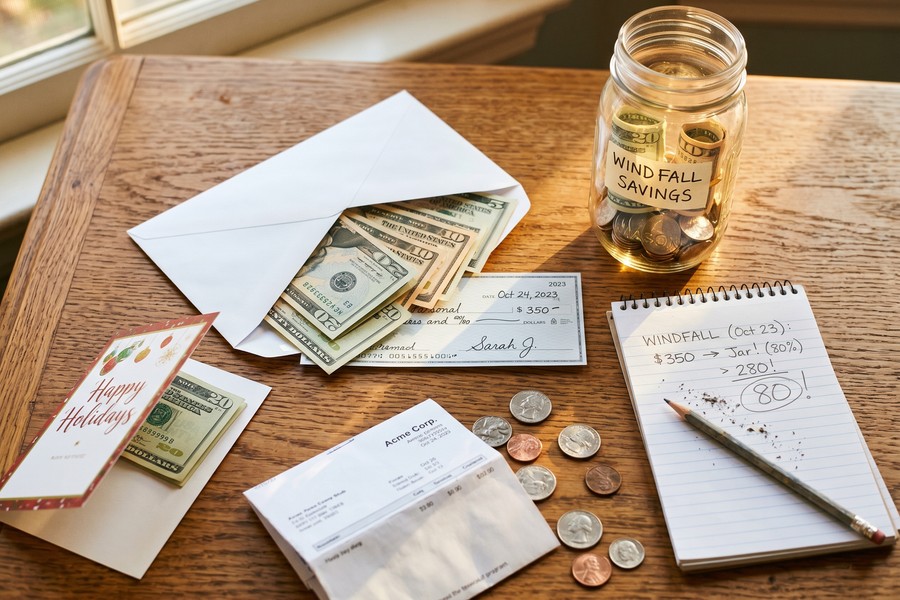
Establish a personal rule for unexpected money: tax refunds, work bonuses, gifts, and side income go 80% to the emergency fund until it is fully funded. The average federal tax refund in 2023 was $2,903. Directing 80% — roughly $2,300 — directly to your emergency fund can compress your timeline by two to three months.
The remaining 20% can be spent however you choose. This prevents the all-or-nothing mentality that causes people to abandon their savings goals when they feel deprived.
Boosting Income Without a Second Job
Cutting expenses has a floor. At some point, you cannot cut any further without compromising health, safety, or quality of life. When that floor is reached, the only lever left is income. For single-income households, adding even $200–$500/month in supplemental income can compress a 24-month savings timeline to 18 months or fewer.
Selling What You Already Own
The fastest, lowest-effort income boost is selling items you already own. The average household has $1,000–$2,000 worth of sellable items: electronics, furniture, clothing, tools, sports equipment, and collectibles. Platforms like Facebook Marketplace, eBay, and Poshmark make selling accessible with no upfront cost.
A single weekend decluttering session can generate a one-time windfall of $300–$800. Applied entirely to your emergency fund, that represents one full month of contributions.
Tax Optimization for Extra Refund Cash
Many single-income households — especially those with children — leave significant tax money on the table by not claiming all eligible credits and deductions. The Child Tax Credit alone provides up to $2,000 per qualifying child. Understanding what the Child Tax Credit is and how to qualify can put thousands of dollars back in your hands each filing season.
Similarly, if you work from home, even part-time, you may be eligible for the home office deduction. Our guide on how to deduct home office expenses if you work from home explains the rules and calculations in plain language.
Leveraged Loyalty Programs
Grocery store loyalty programs, cashback credit cards, and retail rewards programs can generate $20–$80/month in effective savings or cash value with no lifestyle change required. The trick is treating every reward point as a savings vehicle, not a spending invitation. Redirect all cashback earnings and reward redemptions directly to your emergency fund account.
If you shop strategically, using store loyalty programs to actually save money can yield $300–$800 per year in real value — enough to add nearly a full month to your emergency fund annually.
The average American household earns $622 per year in credit card rewards but redeems only 68% of those rewards, leaving $199 in unclaimed value annually, according to a 2023 report by LendingTree.
Staying on Track When Life Gets Hard
Building an emergency fund single income families can rely on is a marathon, not a sprint. Over 18–24 months, something will go wrong. A car breaks down. A child gets sick. A layoff happens. How you respond to these disruptions determines whether you reach your goal or abandon it.
Using Sinking Funds to Protect Your Progress
The most common reason people raid their emergency fund is for predictable large expenses: car registration, annual insurance premiums, school supplies, holiday gifts. These are not emergencies — they are known future expenses with known costs.
A sinking fund is a dedicated savings bucket for each major predictable expense. By saving $50–$100/month for “car maintenance” in its own sub-account, you ensure that a $400 tire replacement never touches your emergency fund. Learn how sinking funds work and how to use them to save for big expenses without derailing your financial progress.
“The emergency fund and the sinking fund are complementary tools, not competitors. Without sinking funds, people constantly raid their emergency fund for non-emergencies. That erodes both the balance and the psychological commitment to the goal.”
Defining What Counts as an Emergency
Before you need the fund, decide what qualifies as an emergency. The definition should be strict: job loss, major medical event, essential home or car repair that prevents you from working. It should not include vacations, Black Friday sales, or a friend’s destination wedding.
Writing this definition down and placing it on the account — as a note in your banking app or a sticky note on your computer — creates a psychological commitment device that helps during impulsive moments.
Protecting Your Fund from Yourself
Building the fund is the first challenge. The second — and often underestimated — challenge is leaving it alone. Research from the FINRA Investor Education Foundation found that nearly 40% of people who build an emergency fund dip into it within the first year for non-emergencies. Prevention requires both psychological and structural barriers.
Structural Barriers That Work
Keeping your HYSA at a different bank than your checking account is the most effective structural barrier. The 1–2 day transfer delay is enough friction to prevent impulsive withdrawals. You want the account accessible in a true emergency, but not instantly swipe-able on a whim.
Some savers go further by using a joint account with a trusted spouse or partner — where both parties must agree before any withdrawal. Others use banks that require phone call confirmation for large transfers. Both approaches have merit for people who recognize impulsive spending as a pattern.
Budget Structures That Prevent Leakage
A strong budget is your first line of defense. Whether you use a zero-based budget, the 50/30/20 method, or the envelope budgeting method to control overspending, the key is that every dollar has a job before the month begins. When money has a designated purpose, it is far less likely to wander into discretionary spending categories.
Tracking your net worth monthly also helps. Watching your emergency fund balance grow — and seeing it reflected in your overall financial position — creates a feedback loop that reinforces saving behavior. Our guide on how to track your net worth and why it matters can help you set up a simple monthly tracking system.
Never link your emergency fund HYSA as an overdraft protection account for your checking. This creates an automatic, invisible drain on your savings every time you overdraw — undermining months of disciplined contributions without you even realizing it.
“Financial security isn’t about perfection — it’s about making the right defaults. When saving is automatic and spending requires effort, even impulsive people can build wealth over time.”

According to FINRA research, households with an emergency fund equivalent to three months of expenses are 63% less likely to carry high-interest credit card debt compared to those with no emergency savings.
Real-World Example: Maria’s 22-Month Emergency Fund Journey
Maria is a 34-year-old administrative coordinator in Columbus, Ohio, earning $58,000 per year ($4,833/month gross, $3,650 take-home after taxes and benefits). She is a single mother of two children, ages 6 and 9. Her essential monthly expenses total $2,900: $1,400 rent, $280 utilities, $580 groceries, $420 car and insurance, and $220 in minimum debt payments. Her six-month emergency fund target was $17,400.
Maria started with $212 in a traditional savings account earning 0.01% APY. She opened a high-yield savings account at Ally Bank (4.75% APY) and scheduled an automatic $650 transfer on the 1st of each month — the day after her biweekly paycheck deposits. She then completed a subscription audit that revealed $147/month in forgotten or unused recurring charges, which she cancelled entirely. She redirected $100 of that toward her emergency fund, bringing her monthly total to $750. She also applied 80% of her $2,800 tax refund ($2,240) as a lump-sum deposit in month four.
By month 12, Maria had saved $11,240 — just over six months ahead of a straight-line projection, thanks to the tax refund lump sum and $380 earned from selling unused household items on Facebook Marketplace. She experienced one genuine setback in month 14 when her car needed a $780 brake repair. Because she had set up a sinking fund for car maintenance ($60/month), she covered $720 of the repair from that account and pulled only $60 from emergency savings — which she replenished within 35 days.
Maria reached her $17,400 goal in month 22 — two months ahead of her original 24-month target. Her HYSA had earned $512 in interest over the 22 months, effectively giving her an extra $512 she never had to manually save. She now contributes $200/month to maintain and grow the fund while redirecting the remaining $550 toward paying down her car loan early.
Your Action Plan
-
Calculate Your Exact Six-Month Target
List every essential monthly expense — housing, utilities, food, insurance, transportation, minimum debt payments. Total them and multiply by six. Write this number down. Post it somewhere visible. This is your finish line, and you need to see it clearly to run toward it effectively.
-
Open a High-Yield Savings Account Today
Choose an HYSA at a bank separate from your primary checking account. Look for 4.5% APY or higher and FDIC insurance. Opening takes 10 minutes online. Do not wait to find the “perfect” account — the best account is the one you actually open this week.
-
Complete a Full Subscription Audit This Weekend
Pull your last three months of bank and credit card statements. Highlight every recurring charge. Cancel anything you have not used in 30 days or do not genuinely need. Redirect every dollar saved into your new HYSA as a recurring transfer.
-
Set Up Your Automatic Transfer on Payday
Schedule a recurring transfer from checking to your HYSA for the day after each paycheck arrives. Start with whatever amount your budget allows — even $100 is a real start. The automation matters more than the amount in the early months.
-
Build Parallel Sinking Funds for Predictable Large Expenses
Identify the three largest predictable annual expenses you face: car repairs, insurance renewals, school costs, holiday gifts. Divide each by 12 and save that amount monthly in a separate sub-account. This protects your emergency fund from being raided for non-emergencies.
-
Apply the 80% Windfall Rule
Commit now — before the money arrives — that 80% of all unexpected income goes to your emergency fund until it is fully funded. This includes tax refunds, bonuses, side income, and gifts. Automate the transfer the same week the money arrives so it never sits in your spending account.
-
Audit Your Insurance and Recurring Bills Every Six Months
Car insurance, internet, phone, and utility rates change regularly. Set a biannual calendar reminder to compare your current rates against competitors. Even one successful negotiation per year can add $300–$600 to your emergency fund savings rate.
-
Track Your Progress Monthly and Celebrate Milestones
Review your HYSA balance on the first of every month. Note how close you are to each milestone: $1,000, one month of expenses, three months, six months. Acknowledge your progress with a small, low-cost reward at each milestone. Momentum is a financial tool — use it deliberately.
Frequently Asked Questions
How much should an emergency fund single income household actually save?
Most financial planners recommend six months of essential living expenses for single-income households — not six months of gross income. Calculate your essential monthly expenses (housing, food, utilities, insurance, transportation, minimum debt payments) and multiply by six. For most single-income families earning $50,000–$70,000, this lands between $15,000 and $24,000.
If you have children, high health risks, or work in a volatile industry, aim for eight months rather than six. The cost of undersaving is far higher than the cost of oversaving.
Is $500 per month enough to build an emergency fund in two years?
At $500/month, you would accumulate $12,000 over 24 months — roughly three to four months of expenses for most households. That falls short of a full six-month fund but represents a meaningful safety net. To reach six months, aim for $750–$1,000/month through a combination of expense cuts and windfall redirections.
If $750/month is out of reach, start at $500 and look for ways to increase by $50–$100 each quarter. Progress is the goal, not perfection from day one.
Should I pay off debt or build an emergency fund first?
Build a small “starter” emergency fund of $1,000–$2,000 before aggressively attacking debt. Without any cushion, an unexpected expense will force you onto high-interest credit cards, undoing debt payoff progress. Once you have a starter fund, shift focus to high-interest debt, then return to full emergency fund building.
The exception: if your employer offers a 401(k) match, always contribute enough to capture the full match before doing either — that is an immediate 50–100% return on your money, which beats any debt payoff math.
Where is the best place to keep an emergency fund?
A high-yield savings account at an FDIC-insured online bank is the best location for most people. Look for accounts offering 4.0% APY or higher, no minimum balance requirements, and no monthly fees. Keep this account at a different institution than your primary checking to reduce temptation to spend it.
What qualifies as a true emergency?
A true emergency is an unexpected, necessary expense that threatens your ability to maintain basic stability: job loss, major medical event, essential car repair, critical home repair (e.g., broken furnace, roof leak). It does not include vacations, holiday gifts, planned car replacement, or discretionary purchases — even large ones.
Write your personal definition before you need the fund. Decision-making under financial stress is poor. Predefined rules protect you from yourself in difficult moments.
What if I can only save $200/month right now?
Start with $200/month and focus simultaneously on increasing that number over time. At $200/month, you will have $2,400 in 12 months — a meaningful starter fund that covers most single-event emergencies. Meanwhile, pursue expense audits and income supplements to grow your monthly contribution.
The worst move is waiting until you can save “enough.” The second-best time to start building your emergency fund was yesterday. The best time is today, even with a modest amount.
Should I keep my emergency fund in a CD for the higher interest rate?
No. Certificates of deposit (CDs) typically require locking your money for 6–24 months. Early withdrawal penalties — usually 60–180 days of interest — can erase months of accumulated earnings. Emergency funds must be liquid. Use an HYSA instead, which offers comparable rates without locking your access.
Can I use a Roth IRA as an emergency fund?
You can withdraw Roth IRA contributions (not earnings) at any time without penalty. However, using a Roth IRA as an emergency fund is generally not recommended — it disrupts long-term retirement compounding, and the psychological mixing of emergency money and retirement money tends to result in both goals being undermined. Keep them strictly separate.
How do I rebuild my emergency fund after I use it?
Treat the rebuild as a financial emergency in its own right. Resume your automatic transfer immediately — even if the amount is temporarily reduced. Apply any windfall income (tax refund, bonus) entirely to the rebuild until you are back to full capacity. Most families can rebuild a partial fund in three to six months with disciplined focus.
Does building an emergency fund affect my credit score?
Directly, no — savings account balances are not reported to credit bureaus. Indirectly, having an emergency fund dramatically improves your credit behavior, because you are far less likely to max out credit cards or miss payments during a financial crisis. Strong credit management over time builds your score. Check your credit regularly using our guide on how to check and read your credit report for free.
Sources
- Bankrate — Annual Emergency Savings Report 2024
- Federal Reserve — 2023 Report on the Economic Well-Being of U.S. Households
- U.S. Bureau of Labor Statistics — Unemployed Persons by Duration of Unemployment
- Consumer Financial Protection Bureau — Emergency Fund Definition and Guidance
- Economic Policy Institute — Child Care Costs in the United States
- Federal Reserve — Consumer Credit Outstanding (Credit Card Interest Rates)
- Experian — State of Credit Report 2023
- USDA — Official Food Cost Reports: Thrifty, Low-Cost, Moderate, Liberal Plans
- IRS — 2023 Tax Filing Season Statistics (Average Refund Amount)
- National Bureau of Economic Research — Automatic Enrollment and Savings Behavior
- FINRA Investor Education Foundation — 2021 National Financial Capability Study
- LendingTree — Credit Card Rewards Statistics 2023
- Wise Bread — High-Yield Savings Account Rate Comparison
- Global Financial Literacy Excellence Center — Emergency Fund Research Brief
- Forbes Advisor — Best High-Yield Savings Accounts of 2024