
Key Takeaways
- Only 26% of teens can correctly answer basic financial literacy questions about interest, inflation, and risk — yet the average college freshman takes on $6,800 in student debt within their first year.
- Students whose parents discussed credit, budgeting, and loan repayment before college carry 24% less student debt at graduation and are 3x less likely to default, according to FINRA research.
- Opening a student checking account and secured credit card at 17–18 builds 12+ months of credit history before the first student loan disbursement — giving your teen a head start on a positive FICO score.
- Teaching the difference between subsidized and unsubsidized Direct Loans (6.53% fixed) before your teen signs their first Master Promissory Note can save $1,075+ in interest per $5,500 borrowed over four years.
Table of Contents
- Why the Money Talk Before College Matters More Than You Think
- Credit Scores, Credit Cards & What Your Teen Needs to Know
- Student Loan Literacy: Federal vs. Private Before They Sign
- Building a Real College Budget Together
- Setting Up Banking and Credit Infrastructure at 17–18
- Financial Traps Freshmen Fall Into (and How to Prevent Them)
- Keeping the Conversation Going Through College
- Frequently Asked Questions
Why the Money Talk Before College Matters More Than You Think
Here’s a number that should alarm every parent: only 26% of teenagers in the U.S. can correctly answer basic financial literacy questions about interest rates, inflation, and investment risk, according to the FINRA Foundation’s National Financial Capability Study. Yet within months, these same teens sign binding loan agreements worth $20,000 to $100,000+. The disconnect is staggering — and expensive.
I’ve seen it play out hundreds of times. A bright 18-year-old signs a Master Promissory Note without understanding what “capitalized interest” means. They accept the maximum loan offer because nobody told them they could decline a portion. They use loan refund money for spring break because nobody built a semester budget with them. Four years later, they’re $35,000 in debt wondering how it happened. It happened because the money conversation never happened at home.
The data backs this up hard. Students whose parents actively discussed credit, budgeting, and loan repayment before college carry 24% less student debt at graduation and are three times less likely to default. That’s not correlation — that’s causation. The talk works. And it doesn’t require a finance degree to have it. You just need to start before they sign anything. If you want to understand what’s in those financial aid packages yourself, start with our guide to decoding financial aid offers.
Credit Scores, Credit Cards & What Your Teen Needs to Know
Most teens have never seen a credit report, don’t know what a FICO score is, and think credit cards are free money. That ignorance has a price tag — and it compounds.
Start with the basics: a credit score is a number between 300 and 850 that lenders use to decide whether to loan you money and at what interest rate. The average FICO score for 18–24 year olds is 630 — near-prime territory. A 630 score on a $20,000 auto loan means paying 11.44% APR instead of the 5.07% a score of 780 would get. That’s $4,600 more in interest over 5 years — on their very first car. Explain this with real dollars, not abstractions.
The five factors: payment history (35%), credit utilization (30%), length of history (15%), credit mix (10%), and new inquiries (10%). The two they can control immediately are payment history and utilization. One missed credit card payment drops a thin-file score by 60–100 points. Keeping utilization under 30% (spending less than $150 on a $500-limit card) builds their score every month. These aren’t complicated concepts — but they’re concepts nobody teaches in most high schools.
| Money Topic | Why It Matters for Teens | Key Number to Teach | When to Discuss |
|---|---|---|---|
| Credit scores | Determines loan rates for the next decade | 630 avg for 18–24 year olds | Junior year of HS |
| Student loan types | Subsidized vs unsub = $1,075 difference per $5,500 | 6.53% fixed rate (2025–26) | Before signing MPN |
| Budgeting | Prevents overborrowing and lifestyle inflation | $1,200/mo avg student living costs | Summer before freshman year |
| Interest & compound growth | $30,000 at 6.53% = $40,959 total over 10 years | $10,959 in interest alone | With first loan offer |
| Banking & fees | Overdraft fees average $35 each — #1 cost for students | $35 avg overdraft fee | When opening first account |
Essential financial topics to discuss with college-bound teens. Verified March 2026.
⚡ Pro Tip
Add your teen as an authorized user on your oldest, lowest-utilization credit card at age 16–17. They don’t need to use it — just being on the account builds credit history. By the time they’re 18 and applying for their first student loan, they’ll have 12–24 months of payment history on their report. That head start is worth 30–50 FICO points at a critical time. Cards with 10+ years of perfect history and under 10% utilization deliver the biggest boost.

Student Loan Literacy: Federal vs. Private Before They Sign
Before your teen signs a Master Promissory Note, they need to understand what they’re signing. Most don’t. A NEFE survey found that 60% of student loan borrowers reported wishing they’d understood their loan terms better before borrowing. That regret translates to thousands in preventable interest.
The critical distinction: federal Direct Loans carry fixed rates (6.53% for undergrads in 2025–2026), income-driven repayment options, deferment, forbearance, and access to forgiveness programs like PSLF. Private loans may offer lower initial rates for excellent-credit cosigners but come with variable rates that can climb to 14%, zero forgiveness options, and aggressive default consequences.
Teach your teen the borrowing hierarchy: free money first (grants, scholarships), then subsidized Direct Loans, then unsubsidized Direct Loans, then — and only if absolutely necessary — private loans. On $5,500 in subsidized loans, the government pays $1,075 in interest while they’re in school. On unsubsidized, that same interest capitalizes and compounds. That’s not a small difference — it grows every year.
Building a Real College Budget Together
Here’s where the money talk gets practical. Sit down with your teen before freshman year and build a real semester budget — not a vague “be responsible with money” lecture. Actual numbers on paper.
The average in-state college student spends roughly $1,200/month on living expenses beyond tuition (room, food, books, transportation, personal). That’s $9,600 over an 8-month academic year. If their financial aid covers tuition but not much else, that $9,600 gap is what determines how much they borrow in unsubsidized loans — or how much they earn through work-study and part-time jobs.
Go through it line by line: housing ($600–$1,200/month depending on whether they’re on-campus or off), meal plan vs. self-cooking ($250–$450/month), textbooks ($500–$1,200/year — always check the library and used options first), transportation, phone plan, and an emergency buffer. Understanding the total cost of attendance at their specific school makes this conversation concrete rather than abstract. The net price calculator on every college website generates a personalized estimate.
| Budget Category | Monthly Cost (Avg) | Annual Cost | Money-Saving Strategy |
|---|---|---|---|
| Housing (on-campus) | $800–$1,200 | $7,200–$10,800 | Become an RA for free housing ($8K+ value) |
| Food / Meal Plan | $250–$450 | $2,250–$4,050 | Choose the smaller meal plan + cook weekends |
| Textbooks & Supplies | $65–$125 | $500–$1,200 | Library reserves, used books, PDF rentals save 60–80% |
| Transportation | $50–$250 | $450–$2,250 | Use campus shuttle + bike; skip a car freshman year |
| Personal / Emergency | $100–$200 | $900–$1,800 | Build $500 emergency fund before move-in day |
Average monthly college living costs beyond tuition. Source: College Board, BLS. Verified March 2026.
Setting Up Banking and Credit Infrastructure at 17–18
Before your teen leaves for campus, set up the financial infrastructure they’ll need. This isn’t complicated — it’s 2–3 hours of setup that prevents years of problems.
Student checking account with no monthly fees. Many banks and credit unions offer fee-free accounts for students under 25. Prioritize accounts with no minimum balance, free ATM access on campus, and a mobile app with real-time alerts. Set up low-balance alerts at $100 and $50 — overdraft fees average $35 each and are the #1 unnecessary cost for college students. Opt out of overdraft “protection” — better a declined transaction than a $35 fee.
Secured credit card or student card. A secured card with a $200–$500 deposit builds credit with zero risk of runaway debt. Use it for one small recurring charge (streaming subscription, phone bill) and set up autopay. After 12 months of on-time payments, your teen’s FICO score should be in the 650–700 range — solid enough to qualify for better cards and loan terms. Some credit unions convert secured cards to unsecured after 6–12 months of good behavior and refund the deposit.
Set up direct deposit from work-study or part-time jobs. Money that hits the checking account automatically gets tracked. Cash payments that bypass banking don’t. Direct deposit also establishes a relationship with the bank that helps when they eventually need a car loan or apartment approval.
⚡ Pro Tip
Have your teen download their bank’s app and turn on push notifications for every transaction over $1. This creates instant awareness of spending patterns — something no lecture can achieve. Students who use real-time transaction alerts spend 12% less per month than those who check their balance manually, according to banking industry data. It’s the financial equivalent of a fitness tracker: visibility drives behavior change without willpower.
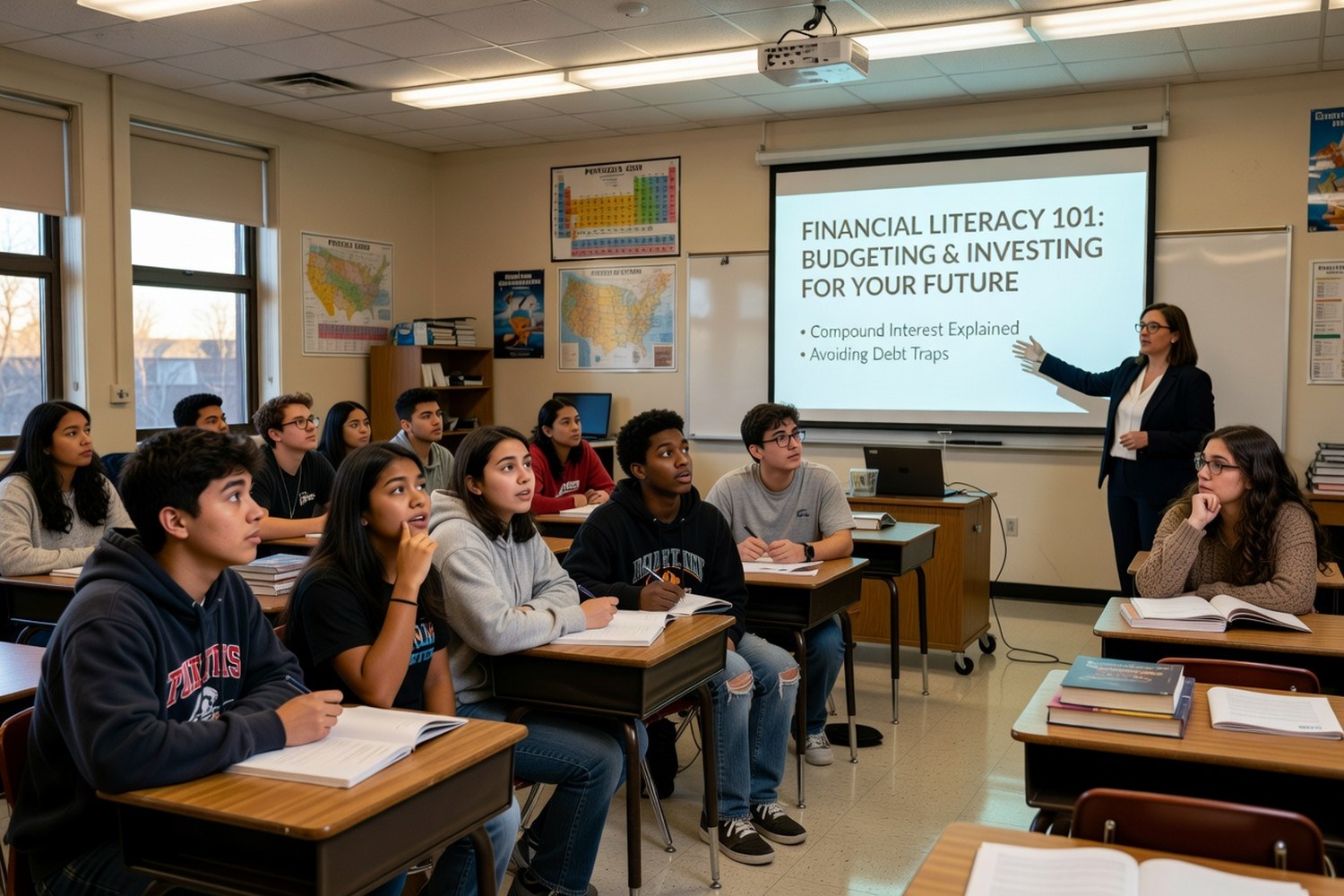
Financial Traps Freshmen Fall Into (and How to Prevent Them)
I’ve tracked the five most expensive mistakes freshmen make — and they’re all preventable with a 30-minute conversation before move-in day.
Trap 1: Accepting maximum loan amounts reflexively. Schools offer the max — $5,500 in year one. But if scholarships and savings cover most costs, your teen might only need $2,000. That $3,500 they didn’t borrow saves $1,287 in interest at 6.53% over 10 years. Teach them to calculate the gap, not accept the default.
Trap 2: Using loan refund money for non-essentials. After tuition is paid, excess loan funds get refunded to the student’s bank account. It feels like free money. It’s not — it’s debt at 6.53% compounding for years. $1,500 in unnecessary spending as a freshman costs $2,204 by the time they finish a 10-year repayment plan.
Trap 3: Credit card sign-up tables on campus. The free t-shirt costs $3. The 24.99% APR card they sign up for costs thousands if they carry a balance. Walk through the terms with your teen: what 24.99% APR actually means on a $500 balance ($125/year in interest if unpaid), how minimum payments trap you, and why store credit cards are almost always bad deals. Having this conversation before orientation is worth more than having it after the first statement arrives.
Trap 4: Ignoring interest during school. On unsubsidized loans, interest accrues from disbursement day. On $5,500 at 6.53%, that’s $30/month in interest. After four years, $1,440 in unpaid interest capitalizes into the principal — and then you’re paying interest on interest. Even $15/month during school cuts that damage in half.
Trap 5: Not filing FAFSA on time for year 2. The FAFSA must be refiled annually. About 20% of returning students miss their school’s priority deadline and lose access to institutional aid they had as freshmen. Set a recurring calendar reminder for October 1. Our FAFSA guide walks through the renewal process.
Keeping the Conversation Going Through College
The money talk isn’t a one-time event — it’s an ongoing conversation that evolves as your teen’s financial life gets more complex.
Freshman year: Monthly check-ins on budget vs. actual spending. Review the first credit card statement together. Verify FAFSA is refiled for year 2. Make sure interest-only payments are happening on unsubsidized loans.
Sophomore year: Review credit score progress together (should be 650+ if they’ve been on autopay). Discuss whether summer earnings should go toward loan principal or savings. Look at whether aggressive payoff strategies make sense for their situation.
Junior year: Start discussing post-graduation loan strategy. Run the Federal Student Aid Loan Simulator together. If they’re considering grad school, discuss how additional borrowing compounds. If they’re heading to the workforce, map out which repayment plan fits their expected salary.
Senior year: Complete exit counseling together. Choose a repayment plan proactively — don’t let them auto-enroll in Standard if they can’t afford $341/month on entry-level salary. The SAVE plan caps payments at 5% of discretionary income and may be $0/month for the first year if they’re job-hunting.
Frequently Asked Questions
At what age should I start talking to my teen about money?
Financial literacy conversations should start by age 13 to 14 with basics like saving, budgeting, and the concept of interest. By age 16, introduce credit scores and how they work. By 17 to 18, cover student loans, FAFSA filing, and real budgeting for college. Students who receive financial education before age 18 carry 24% less debt at graduation.
Should I cosign my teenager’s student loans?
Federal Direct Loans don’t require a cosigner — that’s one of their biggest advantages. Only consider cosigning for private loans as a last resort after maxing federal options. Cosigning means you’re equally responsible for the full balance. About 38% of cosigned education loans require the cosigner to make at least one payment, and the loan appears on your credit report.
How can my teen build credit before turning 18?
Add them as an authorized user on your credit card. They inherit your account’s payment history and utilization on their credit report. Choose a card with 10 plus years of perfect payments and under 10% utilization for maximum impact. By 18 they’ll have a year or more of credit history. They can also open a secured credit card at 18 with a $200 to $500 deposit.
What’s the biggest financial mistake college freshmen make?
Accepting the maximum loan offer without calculating their actual need. Schools offer the maximum eligibility by default. On a $5,500 year-one offer, a student who only needs $2,000 wastes $3,500 in unnecessary borrowing. At 6.53% over 10 years, that’s $1,287 in avoidable interest. Teaching teens to calculate the gap between costs and other aid before accepting loans prevents this.
Should my teen work during college or focus on academics?
Research from the Bureau of Labor Statistics shows students working 10 to 15 hours per week maintain higher GPAs than students working zero hours or 20 plus hours. A 12-hour per week campus job at $12 per hour earns $5,760 over a 9-month academic year — that’s nearly enough to avoid an entire year of unsubsidized borrowing, saving $2,100 in interest over 10 years.
References
- FINRA Foundation, 2026, “National Financial Capability Study,” finra.org
- Federal Student Aid, 2026, “FAFSA Application and Filing Deadlines,” studentaid.gov
- Consumer Financial Protection Bureau, 2026, “Paying for College — Resources for Families,” consumerfinance.gov
- Federal Student Aid, 2026, “Federal Student Loan Interest Rates,” studentaid.gov
- Bureau of Labor Statistics, 2026, “College Enrollment and Work Activity,” bls.gov
- Consumer Financial Protection Bureau, 2026, “Student Banking Fees and Overdraft Data,” consumerfinance.gov
- Federal Student Aid, 2026, “Loan Simulator Tool,” studentaid.gov
- National Endowment for Financial Education, 2026, “Student Loan Literacy Research,” nefe.org
- College Board, 2026, “Trends in College Pricing and Student Aid,” collegeboard.org
- Federal Student Aid, 2026, “Entrance Counseling and MPN,” studentaid.gov
Keep Reading
More on student loans and college financial planning: