
Quick Answer
To create a monthly budget that actually works, track every dollar using the 50/30/20 rule — allocating 50% to needs, 30% to wants, and 20% to savings and debt. As of July 2025, Americans who follow a written budget save an average of $200 more per month than those who do not.
Creating a monthly budget that actually works starts with one non-negotiable step: writing it down. As of July 2025, only 32% of American households maintain a detailed monthly budget, according to Gallup’s household finance survey — yet budgeters consistently report lower financial stress and higher savings rates. If you want to create a monthly budget that moves the needle, the process is more systematic than most people realize.
The stakes are real. According to the Federal Reserve’s 2024 Report on the Economic Well-Being of U.S. Households, 37% of adults could not cover a $400 emergency expense without borrowing or selling something. The Consumer Financial Protection Bureau (CFPB) cites irregular budgeting as one of the primary drivers of revolving credit card debt, which reached $1.14 trillion in early 2025.
This guide gives you a complete, step-by-step framework to create a monthly budget that fits your actual life — covering how to calculate your income, categorize spending, choose the right budgeting method, use proven tools, and adjust when things go sideways. Every step is actionable, every figure is sourced, and every strategy is designed to work in the real world.
Key Takeaways
- Only 32% of U.S. households maintain a detailed monthly budget (Gallup, 2024), leaving the majority financially exposed to unexpected expenses.
- Americans with a written budget save an average of $200 more per month compared to non-budgeters (National Foundation for Credit Counseling, 2024), compounding to over $2,400 per year.
- The Federal Reserve found that 37% of adults cannot cover a $400 emergency without borrowing (Federal Reserve Report on Economic Well-Being, 2024), a gap that structured budgeting directly addresses.
- Credit card debt in the U.S. surpassed $1.14 trillion in Q1 2025 (Federal Reserve Bank of New York, 2025), making monthly budget creation more urgent than ever.
- People who use a digital budgeting app are 3x more likely to stay on budget than those who track spending manually on paper (Intuit Financial Study, 2023).
- The 50/30/20 rule — 50% needs, 30% wants, 20% savings/debt — is the most widely recommended budgeting framework among certified financial planners (CFP Board, 2024).
In This Guide
- Why Does a Monthly Budget Matter for Your Financial Health?
- How Do You Calculate Your Real Monthly Income?
- How Do You Track and Categorize Your Current Spending?
- Which Budgeting Method Works Best for Your Situation?
- How Do You Set Realistic Financial Goals Inside Your Budget?
- What Are the Best Tools and Apps to Create a Monthly Budget?
- What Are the Most Common Budgeting Mistakes and How Do You Avoid Them?
- How Do You Adjust Your Budget When Life Changes?
- How Do You Budget on an Irregular or Variable Income?
Why Does a Monthly Budget Matter for Your Financial Health?
A monthly budget matters because it is the single most effective tool for closing the gap between what you earn and what you keep. Without a budget, spending decisions happen by default rather than by design — and default almost always favors spending over saving.
The data is unambiguous. The National Foundation for Credit Counseling’s 2024 Financial Literacy Survey found that households with a written monthly budget reported 47% higher confidence in handling a financial emergency compared to non-budgeting households. That confidence gap translates directly into better financial outcomes.
The True Cost of Not Budgeting
Untracked spending carries a compounding cost that most people underestimate. The average American household spends $1,497 per month on non-essential discretionary items, according to the Bureau of Labor Statistics Consumer Expenditure Survey. A significant portion of that spending — often 15 to 20% — is what financial planners call “invisible spend”: subscriptions, convenience fees, and impulse purchases that go unnoticed month after month.
For context on how subscription creep alone can erode a budget, our analysis of streaming service costs and subscription budget management found the average household pays for at least two streaming services they rarely use.
U.S. credit card debt hit $1.14 trillion in Q1 2025, according to the Federal Reserve Bank of New York — the highest level ever recorded. Households without a monthly budget carry an average of $6,360 more in revolving debt than budgeting households.
Budgeting and Psychological Well-Being
Beyond the numbers, budgeting reduces financial anxiety. A 2024 survey by the American Psychological Association found that 72% of adults reported money as a significant source of stress — but those with a written financial plan reported stress levels 34% lower than those without one. Knowing exactly where your money is going creates a sense of control that directly impacts mental health.
How Do You Calculate Your Real Monthly Income?
Your real monthly income is your net take-home pay — the amount deposited into your account after taxes, health insurance premiums, and retirement contributions are deducted. This is the only number that matters when you create a monthly budget, because that is the money you actually have to spend.
Handling Multiple Income Sources
If you have multiple income streams — a primary salary, freelance work, rental income, or side hustle revenue — add them all together, but apply different rules to each. For stable W-2 income, use your exact net paycheck amount. For variable income sources, use the average of your three lowest months over the past year. This conservative approach prevents you from budgeting on money that may not materialize.
Include every source: wages, self-employment income, alimony, child support, Social Security payments, and investment distributions. The IRS provides a complete list of taxable and non-taxable income types in Publication 525, which is useful for ensuring you do not overlook irregular income sources.
If you are paid biweekly (26 paychecks per year), multiply one paycheck by 26 and divide by 12 to get your true monthly income. This is more accurate than simply multiplying by 2, because two months each year will contain three paychecks — a windfall you can plan for in advance.
Accounting for Irregular Annual Expenses
Most people budget for monthly bills but forget about annual and semi-annual expenses. These include car registration fees, insurance premiums, property taxes, holiday gifts, and annual subscriptions. The fix is simple: total your known annual expenses, divide by 12, and add that amount as a monthly “sinking fund” line item in your budget. Our full-year car maintenance budget guide shows how this approach works in practice for vehicle costs alone.
How Do You Track and Categorize Your Current Spending?
Before you can create a monthly budget going forward, you need an accurate picture of where your money is currently going. Spend at least two to four weeks reviewing every transaction — bank statements, credit card statements, and cash withdrawals — before building your first budget.
The Core Spending Categories
Organize every expense into one of these master categories, which align with the frameworks used by the CFPB and most certified financial planners:
- Housing: Rent or mortgage, property taxes, HOA fees, renter’s/homeowner’s insurance
- Transportation: Car payment, fuel, insurance, maintenance, public transit
- Food: Groceries and dining out (tracked separately)
- Utilities: Electricity, gas, water, internet, phone
- Healthcare: Insurance premiums, copays, prescriptions, gym membership
- Debt Payments: Student loans, credit cards, personal loans
- Savings and Investments: Emergency fund, retirement contributions, brokerage accounts
- Personal and Discretionary: Clothing, entertainment, subscriptions, personal care

The average American household spends 33.8% of its after-tax income on housing alone, according to the Bureau of Labor Statistics Consumer Expenditure Survey (2024). Financial planners recommend keeping total housing costs at or below 28% of gross monthly income to maintain budget balance.
Identifying Spending Leaks
After categorizing, look for spending leaks — recurring charges you forgot about and discretionary categories where spending consistently exceeds your mental estimate. Research from Intuit’s financial behavior studies found that consumers underestimate their monthly dining spending by an average of $187. Groceries are underestimated by roughly $95 per month on average.
Use a spreadsheet or app to total each category. This baseline is the foundation everything else builds on — you cannot effectively create a monthly budget without it.
Which Budgeting Method Works Best for Your Situation?
The best budgeting method is the one you will actually stick to. Four methods dominate personal finance: the 50/30/20 rule, zero-based budgeting, the envelope system, and pay-yourself-first budgeting. Each suits a different personality type and financial situation.
| Method | Best For | Key Rule | Flexibility Level |
|---|---|---|---|
| 50/30/20 Rule | Beginners and moderate incomes | 50% needs / 30% wants / 20% savings+debt | High |
| Zero-Based Budget | Detail-oriented; paying off debt | Income minus expenses equals zero each month | Low |
| Envelope System | Cash spenders; overspenders | Physical or digital envelopes per category | Medium |
| Pay-Yourself-First | Savers and investors | Save/invest first; spend what remains | Very High |
The 50/30/20 Rule Explained
The 50/30/20 rule, popularized by Senator Elizabeth Warren and Amelia Warren Tyagi in their book All Your Worth, is the most recommended starting framework for people new to budgeting. Fifty percent of net income goes to needs (housing, utilities, food, transportation), 30% goes to wants (dining out, entertainment, travel), and 20% goes to savings and debt repayment beyond minimums.
The CFP Board recommends this method as a starting baseline for households earning between $40,000 and $120,000 annually. However, in high cost-of-living cities, housing alone may consume 40-50% of income, requiring a modified split such as 60/20/20.
Zero-Based Budgeting for Debt Elimination
Zero-based budgeting (ZBB) assigns every dollar of income to a specific category until the balance reaches zero. This does not mean spending everything — savings and investments are budget categories too. ZBB is particularly effective for households in debt, because it forces intentionality around every dollar. Dave Ramsey, founder of Ramsey Solutions, has promoted this method to over 13 million Baby Steps participants since 1992.
If you are working to eliminate student loan debt while building a budget, our detailed guide on aggressive student loan payoff strategies using avalanche, snowball, and hybrid methods pairs well with a zero-based budgeting approach.
“The zero-based budget is the most powerful tool I have seen for getting people out of debt, because it forces them to make a conscious decision about every single dollar before the month begins — not after the money is already gone.”
How Do You Set Realistic Financial Goals Inside Your Budget?
Realistic financial goals are specific, time-bound, and tied to a dollar amount. Vague goals like “save more money” fail because they provide no accountability. Effective goals sound like: “Save $5,000 for an emergency fund in 10 months by setting aside $500 per month automatically.”
Short-Term vs. Long-Term Goal Allocation
Within the savings portion of your budget (the 20% in a 50/30/20 framework), allocate funds across three time horizons:
- Immediate (0-12 months): Emergency fund target of 3-6 months of expenses, holiday gifts, car maintenance fund
- Medium-term (1-5 years): Down payment on a home, vehicle replacement, major travel
- Long-term (5+ years): Retirement contributions to a 401(k) or IRA, children’s education funding via a 529 plan
The CFPB recommends that an emergency fund of at least three months of essential expenses be the first savings priority before any other goal. For a household with $3,500 in monthly essential expenses, that means a $10,500 emergency fund target.
Automated savings transfers increase the likelihood of reaching a savings goal by 85% compared to manual transfers, according to research from the Behavioral Insights Team (2023). Setting up an automatic transfer the day after your paycheck arrives removes the decision entirely.
Debt Payoff as a Budget Goal
If you carry high-interest debt, debt repayment is not just a budget line item — it is your highest-priority financial goal. The average credit card APR in the U.S. reached 21.59% in Q1 2025 according to the Federal Reserve’s G.19 Consumer Credit Release. Paying an extra $100 per month toward a $5,000 balance at 21.59% APR reduces the payoff timeline from 5.8 years to 2.9 years and saves over $2,100 in interest.
Understanding how amortization affects your debt payoff timeline is essential — our breakdown of the amortization shock many borrowers are experiencing explains exactly how minimum payments can extend debt for years longer than borrowers expect.
What Are the Best Tools and Apps to Create a Monthly Budget?
The best budgeting tools in 2025 are digital apps that sync directly with your bank accounts and categorize spending automatically. Manual spreadsheets work, but they require consistent discipline that most people do not sustain beyond the first month.
| Tool | Cost | Best Feature | Best For |
|---|---|---|---|
| YNAB (You Need A Budget) | $14.99/month or $99/year | Zero-based budgeting engine | Debt elimination; detail-oriented budgeters |
| Monarch Money | $14.99/month or $99.99/year | Collaborative budgeting for couples | Households with two earners |
| Empower (Personal Capital) | Free (paid wealth management tier) | Investment tracking + net worth dashboard | Investors with brokerage accounts |
| EveryDollar | Free (Ramsey+ plan: $17.99/month) | Zero-based budgeting, beginner-friendly UI | Dave Ramsey Baby Steps followers |
| Google Sheets / Excel | Free | Fully customizable | DIY budgeters who prefer manual control |
YNAB users report saving an average of $600 in their first two months and more than $6,000 in their first year, according to internal data published by YNAB (2024). The app’s core philosophy — give every dollar a job — is essentially zero-based budgeting in a user-friendly interface.
“The single biggest predictor of whether someone stays on a budget is whether the tracking is automatic. When people have to manually log every transaction, 80% drop off within 60 days. Apps that sync with your bank eliminate that friction entirely and make the process sustainable.”
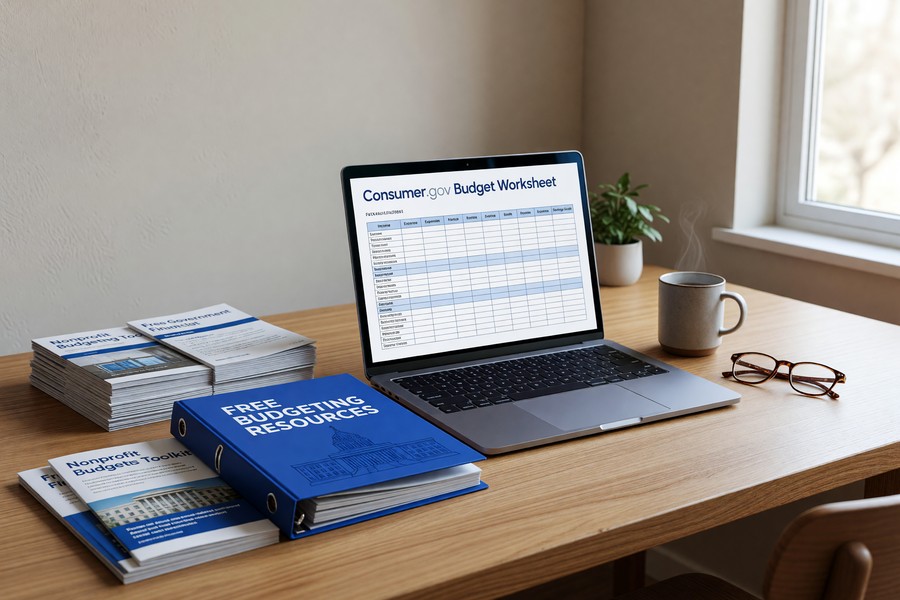
Free Government and Nonprofit Budgeting Resources
If app subscription costs are a barrier, free resources from government agencies and nonprofits are excellent alternatives. The Consumer.gov budget worksheet from the Federal Trade Commission is a straightforward, free template. The CFPB also offers a free online budget worksheet tool that requires no account creation.
What Are the Most Common Budgeting Mistakes and How Do You Avoid Them?
The most common budgeting mistake is building a budget based on ideal spending rather than actual spending history. This creates an aspirational budget that fails in the first week because it ignores real behavioral patterns.
Mistake 1: Forgetting Irregular Expenses
Car repairs, medical bills, annual subscriptions, and holiday spending are predictable in aggregate but easy to ignore month to month. Research from the Urban Institute found that households that fail to budget for irregular expenses are 3.2 times more likely to carry a credit card balance month-to-month than those who plan for them. The solution is sinking funds — dedicated savings buckets for known future expenses.
One of the most dangerous budgeting errors is treating your credit card as an emergency fund. The average penalty APR on U.S. credit cards is 29.99%, and a single $1,500 emergency charged to a card with a 29.99% APR will cost you over $450 in interest if paid back over 12 months. Build a cash emergency fund before any other savings goal.
Mistake 2: Setting the Budget Too Tight
An overly restrictive budget is just as dangerous as no budget. When people feel deprived, they experience what behavioral economists call “budget fatigue,” leading to impulsive splurges that derail weeks of progress. Certified Financial Planner (CFP) professionals consistently recommend including a modest personal discretionary category — even $50 to $100 per month in “guilt-free spending” — to make the budget psychologically sustainable.
Mistake 3: Not Reviewing the Budget Monthly
A budget created once and never reviewed quickly becomes obsolete. Prices change, income fluctuates, and life circumstances evolve. Schedule a monthly budget review — ideally on the last day of each month — to compare planned versus actual spending, adjust categories, and carry forward any surpluses or deficits.
For practical, low-effort ideas to reduce everyday costs before they require a budget overhaul, our guide to smart savings and simple ways to cut everyday costs offers category-by-category strategies.
How Do You Adjust Your Budget When Life Changes?
Your budget must change whenever your financial reality changes. The three triggers that most commonly require a full budget revision are a change in income, a major new expense (new baby, home purchase, job loss), and reaching a financial milestone (emergency fund fully funded, debt paid off).
How to Handle a Pay Increase
When income rises, the most common mistake is “lifestyle inflation” — automatically spending more without a deliberate plan. Financial planners recommend the 50/50 rule for raises: direct 50% of the net increase toward savings or debt payoff and allow the other 50% to improve quality of life. On a $500/month net raise, that means $250 goes to savings and $250 goes to lifestyle improvements.
Budgeting Through Job Loss or Income Reduction
When income drops, move immediately to a bare-bones budget — a stripped-down version covering only essential needs: housing, utilities, food, transportation, and minimum debt payments. Suspend all discretionary categories and pause non-essential savings goals (except the emergency fund) until income stabilizes. The CFPB’s financial hardship resources page lists federal and state assistance programs available during income disruptions.
Job losses and income reductions are the leading cause of financial hardship for U.S. households. According to the Federal Reserve’s 2024 economic well-being report, 17% of adults experienced a significant income drop in the prior 12 months. Having a written budget reduced the financial impact of that income drop by an average of $3,800 compared to households without one.
How Do You Budget on an Irregular or Variable Income?
Budgeting on an irregular income requires a different framework than traditional monthly budgeting. Instead of allocating a fixed income number, freelancers, self-employed individuals, and commission-based earners should use an income floor approach — budgeting only on the minimum income reliably earned, then allocating surplus as it arrives.
The Priority-Based Spending System for Variable Earners
Rank your spending categories in order of priority and fund them sequentially each month as income arrives. Category 1 covers essential needs (housing, food, utilities). Category 2 covers minimum debt payments. Category 3 covers savings goals. Category 4 covers discretionary spending. When income is low, only Categories 1 and 2 are funded. When income is high, all categories receive their full allocation.
If your income is variable because of a side hustle or gig economy work, understanding the macroeconomic forces affecting the job market matters. Our analysis of how the AI hiring cycle is reshaping income stability provides useful context for planning your income floor conservatively.
Building a Buffer Account for Variable Earners
Variable earners benefit enormously from a buffer account — a separate savings account holding one to two months of essential expenses. In high-income months, deposit surplus income into the buffer. In low-income months, draw from the buffer to cover essentials without touching the emergency fund or taking on debt. This smooths the income volatility and allows the budget to function consistently month over month.

Self-employed and gig workers make up 36% of the U.S. workforce as of 2025, according to the Bureau of Labor Statistics — yet fewer than 20% of them use a formal monthly budget designed for variable income. This gap is a primary contributor to the higher rates of financial stress reported among self-employed adults.
Real-World Example: How Marcus Built a Budget That Eliminated $14,200 in Debt in 18 Months
Marcus, 31, a mid-level marketing coordinator in Philadelphia, earned a net take-home income of $3,950 per month. He had $14,200 in credit card debt spread across three cards at APRs of 22.99%, 19.99%, and 17.99%, and no emergency fund. He had never formally tracked his spending.
After a two-week spending audit, Marcus discovered he was spending $340 per month on dining out (had estimated $150), $127 on forgotten subscriptions, and $210 on convenience delivery fees. His total discretionary spending was $677 per month — nearly 17% of his income — with no plan behind it.
Marcus adopted a zero-based budget using YNAB. He cut dining out to $120 per month, canceled $89 in unused subscriptions, and eliminated delivery fees entirely by batch-cooking on Sundays. Total monthly savings from behavioral changes: $358 per month.
He directed $200 per month to a starter emergency fund (reached $1,000 in 5 months), then applied the full $358 surplus to his highest-APR card using the debt avalanche method. With minimum payments already covering the other two cards, the 22.99% card ($4,800 balance) was eliminated in 11 months. He then rolled the payment forward to the next card.
After 18 months, Marcus had eliminated all $14,200 in credit card debt, built a $2,600 emergency fund, and increased his retirement contributions from 3% to 6% of gross income (triggering his employer’s full match). His net worth improved by approximately $18,400 over those 18 months, including both debt elimination and savings accumulation. The entire transformation began with a single spending audit and a written monthly budget.
Your Action Plan
-
Pull 60 days of bank and credit card statements
Log into every financial account — checking, savings, and all credit cards — and export or print the last 60 days of transactions. This is your baseline. Use the CFPB’s free online budget worksheet to categorize every transaction into the eight master spending categories outlined in this guide.
-
Calculate your precise monthly net income
Identify every income source and convert to a monthly net figure. For biweekly earners, multiply one paycheck by 26 and divide by 12. For variable earners, use the average of your three lowest-earning months over the past year as your budget baseline.
-
Choose a budgeting method that matches your personality
Use the comparison table in this guide to select the right method. If you are new to budgeting, start with the 50/30/20 rule. If you are in active debt payoff mode, use zero-based budgeting. If you are primarily a saver and investor, use the pay-yourself-first approach.
-
Set up your budgeting tool and link your accounts
Download YNAB, Monarch Money, or Empower, and connect all bank and credit card accounts. Alternatively, download a free Google Sheets budget template from Google’s template gallery. The goal is automatic transaction syncing so tracking requires minutes, not hours, each week.
-
Create sinking funds for known irregular expenses
List every non-monthly expense you expect in the next 12 months (car insurance renewal, holiday gifts, vacation, annual subscriptions). Total them, divide by 12, and add that amount as a monthly sinking fund line item. Use a high-yield savings account — look for accounts offering above 4.5% APY as of mid-2025 — to hold these funds productively.
-
Automate your savings transfer on payday
Set up an automatic transfer from your checking account to your savings account on the same day your paycheck arrives. Even $50 per paycheck builds momentum. Research from the Behavioral Insights Team shows automatic savers are 85% more likely to reach their savings goals than manual transferers.
-
Schedule a monthly budget review on the last day of the month
Block 30 minutes on your calendar on the last day of every month to review actual versus planned spending in each category. Note any category that exceeded its budget. Adjust the following month’s allocations based on what you learned — not on what you wish had happened.
-
Build your emergency fund before any other savings goal
Your first savings milestone is a starter emergency fund of $1,000. Once reached, shift focus to a full emergency fund of three to six months of essential expenses. Keep this money in a separate, labeled high-yield savings account at a bank different from your primary checking account to reduce the temptation to spend it casually.
Frequently Asked Questions
How much of my income should go toward housing in a monthly budget?
Financial planners recommend keeping housing costs at or below 28% of gross monthly income. This is known as the front-end debt-to-income (DTI) ratio limit used by most mortgage lenders. If housing exceeds 30% of your net income, look for opportunities to reduce other fixed expenses or increase income to rebalance the budget.
What is the best budgeting method for beginners?
The 50/30/20 rule is the best starting framework for beginners. It is simple enough to implement immediately without detailed financial knowledge. Allocate 50% of net income to needs, 30% to wants, and 20% to savings and debt repayment. Once comfortable, you can transition to a more granular method like zero-based budgeting.
How do I create a monthly budget if I live paycheck to paycheck?
Start by identifying the one or two highest spending categories where cuts are possible without impacting essential needs. Common targets are dining out, subscriptions, and convenience spending. Even a $50 per month surplus allows you to begin an emergency fund, which is the first step out of the paycheck-to-paycheck cycle. Our guide to rebuilding your finances after financial rock bottom offers a realistic framework for this situation.
How long does it take to see results from a monthly budget?
Most people see measurable results within 60 to 90 days of consistently following a monthly budget. YNAB’s internal user data shows new users save an average of $600 in their first two months. The first month is primarily a data-gathering phase — the budget becomes more accurate and effective in months two and three as you refine your category allocations based on actual spending.
Should I include my retirement contributions in my monthly budget?
Yes. Retirement contributions — whether to a 401(k), IRA, or Roth IRA — should appear as a dedicated line item in the savings portion of your budget. If your employer offers a 401(k) match, contributing at least enough to capture the full match should be a non-negotiable priority. The average employer 401(k) match is 4.7% of salary, according to Vanguard’s 2024 How America Saves report — leaving this on the table is equivalent to declining part of your salary.
What should I do if I go over budget in a category?
Going over budget in one category requires an immediate offset from another category in the same month. This is a core principle of zero-based budgeting. If you overspend on dining by $80, reduce another discretionary category — such as entertainment or clothing — by $80 that same month. Never carry a deficit forward into next month, as it compounds over time and erodes budget accuracy.
Is the envelope budgeting system still effective?
The envelope system remains highly effective, particularly for people who overspend in cash-heavy categories like groceries, dining, or entertainment. Digital versions — such as the envelope system built into EveryDollar and Goodbudget — make it practical for modern cashless spending. The envelope method is most useful as a supplementary tool within a broader budgeting framework rather than as a standalone system for all expenses.
How do I budget for debt payoff alongside other financial goals?
Prioritize debt by interest rate. Pay minimums on all debts, then direct every additional dollar toward the highest-interest balance first (the avalanche method). Once the highest-rate debt is eliminated, roll that payment to the next balance. The avalanche method minimizes total interest paid and is mathematically optimal. For context, understanding how compounding works against you in debt (and for you in savings) underscores why eliminating high-rate debt is so urgent.
Do budgeting apps share my financial data?
Most budgeting apps use read-only bank connections through aggregation services like Plaid or Finicity. They cannot initiate transactions. However, they do store your transaction data on their servers. Review the privacy policy of any app before connecting your accounts. Look for apps that offer two-factor authentication, 256-bit encryption, and a clear policy against selling user data to third parties.
How is a budget different from a financial plan?
A monthly budget manages cash flow on a month-to-month basis — income in, expenses out, savings allocated. A financial plan is a long-term strategy covering goals spanning years or decades, including retirement, education funding, estate planning, and investment allocation. A budget is the tactical execution tool; a financial plan is the strategic roadmap. Both are necessary, but the budget comes first.
Our Methodology
This guide was produced by the editorial team at The Finance Tree using a combination of primary data sources (Federal Reserve, Bureau of Labor Statistics, CFPB), independent financial research publications (NerdWallet, Bankrate, Vanguard), and analysis of major personal finance software platforms (YNAB, Monarch Money, Empower, EveryDollar). All statistics were verified against their original source documents. Budgeting app data was cross-referenced using publicly available user reports and third-party app review aggregators including G2, Trustpilot, and the App Store as of July 2025. Methodology recommendations are aligned with guidance from the CFP Board’s published standards for financial planning practice. This article does not constitute personalized financial advice. Readers are encouraged to consult a Certified Financial Planner (CFP) for advice tailored to their individual circumstances.
Sources
- Federal Reserve — 2024 Report on the Economic Well-Being of U.S. Households
- Gallup — Household Budgets: Stressed and Squeezed
- National Foundation for Credit Counseling — 2024 Annual Financial Literacy Survey
- Bureau of Labor Statistics — Consumer Expenditure Survey
- Federal Reserve — G.19 Consumer Credit Statistical Release
- Consumer Financial Protection Bureau — Free Budget Worksheet Tool
- Consumer.gov (FTC) — Making a Budget
- IRS — Publication 525: Taxable and Nontaxable Income
- Vanguard — How America Saves 2024
- Federal Reserve Bank of New York — Household Debt and Credit Report, Q1 2025
- Consumer Financial Protection Bureau — Financial Well-Being in America
- Urban Institute — Financial Vulnerability and Stability Research
- CFP Board — Research and Statistics on Financial Planning Practices
- CFPB — Financial Hardship Resources and Assistance Programs
- YNAB — The Four Rules of Zero-Based Budgeting