Student Loans

Federal vs. Private Student Loans: Which Is Right for You?

federal vs private student loans comparison guide

Key Takeaways

  • Federal student loans almost always beat private loans — lower fixed rates, flexible repayment, and forgiveness options make them the clear first choice for most borrowers.
  • Private loans have no income-driven repayment or forgiveness programs, and their variable rates can climb significantly over a 10–15 year repayment period.
  • Exhaust all federal loan options — subsidized, unsubsidized, and Graduate PLUS — before considering any private lender.
  • If you do take private loans, compare at least 3–5 lenders on APR (not just the teaser rate), fees, and hardship deferment policies before signing.

Federal Student Loans: The Basics

I’ll cut straight to it: if you have access to federal student loans, take them first. Every time. I’ve worked through enough borrower scenarios to say that without hesitation. There is no situation where a private bank loan beats a subsidized federal loan — and very few where it beats an unsubsidized one either.

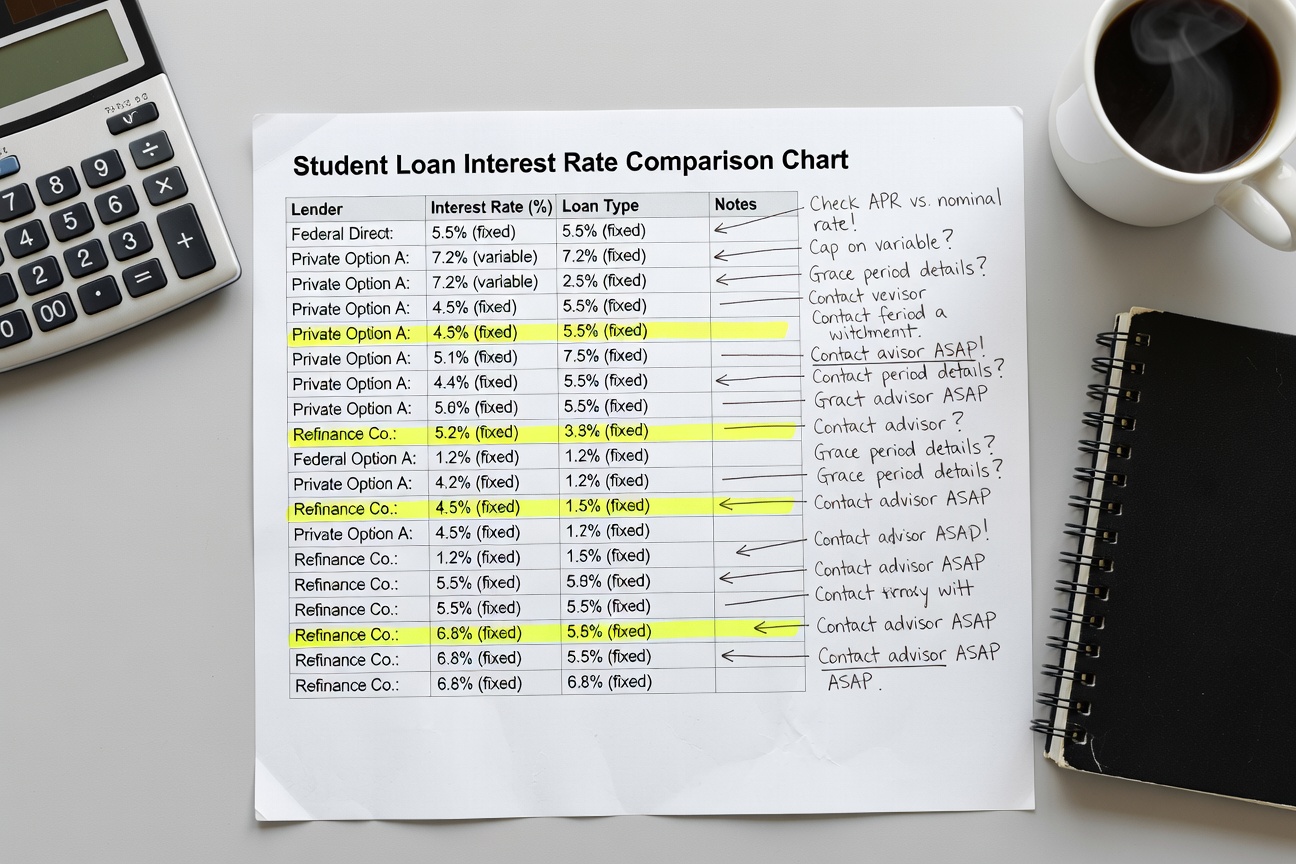
Federal student loans come directly from the U.S. Department of Education. For undergrads, the main options are Direct Subsidized Loans (the government pays your interest while you’re enrolled at least half-time), Direct Unsubsidized Loans (interest accrues from day one, but still federal protections), and PLUS Loans for graduate students or parents. The 2025–2026 rates: 6.53% fixed for undergrad Direct loans, 8.08% for grad unsubsidized, 9.08% for PLUS. Fixed means fixed — no adjustments, no surprises.

What really sets federal loans apart isn’t just the rate — it’s what happens when life gets hard. Lost your job? You can request economic hardship deferment. Income dropped? Switch to an income-driven repayment plan and your payment adjusts. Work in public service? Ten years of payments and your remaining balance is forgiven entirely, tax-free. None of that exists in the private loan world.
student loan interest rate comparison federal vs private

⚡ Pro Tip

Always file the FAFSA first — even if you think you won’t qualify for need-based aid. It’s the gateway to ALL federal loans, not just grants. Many families skip it assuming their income is too high, then end up taking private loans they didn’t need to.

Private Student Loans: The Basics

Private student loans come from banks, credit unions, and online lenders — Sallie Mae, Earnest, College Ave, Discover, and a long list of others. They exist to fill the gap when federal loans, scholarships, and grants don’t cover the full bill.

Here’s what makes them fundamentally different — and riskier. Rates are credit-based. A borrower with excellent credit might get something competitive with federal rates. A typical 18-year-old freshman with no credit history? They’ll likely pay significantly more and almost certainly need a cosigner. According to the CFPB, a large share of private student loan borrowers don’t fully understand the terms before they sign.

Variable-rate private loans deserve extra caution. They might open at 4–5% and look appealing next to federal rates. But over a 10–15 year repayment window, rate increases can push that to 11–13% or higher. The monthly payment that fit your budget at 22 might be crushing at 32.

Federal vs. Private: Side-by-Side Comparison

Federal vs. Private Student Loans — Key Differences 2026
Feature Federal Loans Private Loans
Interest Rates Fixed, set by Congress annually Fixed or variable, credit-based
Credit Check Required No (most loans) Yes — cosigner often needed
Income-Driven Repayment Yes — SAVE, PAYE, IBR, ICR No
Loan Forgiveness Yes — PSLF, IDR forgiveness No
Deferment / Forbearance Generous — hardship, unemployment, school Limited, lender-by-lender
Subsidized Interest Yes — on subsidized loans while in school No — interest accrues immediately
Bottom Line: Federal loans win on almost every dimension for borrowers who need flexibility or face any income uncertainty.

When Does a Private Loan Actually Make Sense?

Honestly? Not often. But there are real use cases. If you’ve hit your federal borrowing limits — undergrads cap out at $31,000 for dependent students over four years — and still have a genuine funding gap that no grant or scholarship can close, a private loan may be the only option.

Graduate students sometimes find that PLUS Loan rates (9.08%) are actually higher than what a creditworthy borrower can get privately. If you have a 750+ credit score or a strong cosigner, and you’re confident your career trajectory means you’ll never need IDR or PSLF, comparing private rates against PLUS makes sense. But that’s a narrow set of circumstances — and it requires you to be brutally honest about your risk tolerance and career certainty.

student completing FAFSA federal financial aid application

How to Shop for a Private Student Loan

If you’ve decided a private loan is necessary, shop like your financial future depends on it — because it does. Get rate quotes from at least 3–5 lenders. Most allow soft credit pulls that don’t affect your score. Compare APR (which includes fees), not just the advertised interest rate. Ask specifically about hardship deferment and forbearance policies — what actually happens if you lose your job or face a financial emergency?

Read the cosigner release terms carefully. Some lenders allow cosigner release after 24–36 months of on-time payments; others make it nearly impossible. And never borrow more than you need — the fact that a lender will go up to your school’s full cost of attendance is not an invitation to max it out. For broader context on what college really costs before you borrow, our breakdown of the real cost of attending university is a good starting point.

Refinancing: The Post-Graduation Option

Once you’re earning income, refinancing is worth revisiting — especially for private loans. If your credit score has improved significantly since you first borrowed, you may qualify for a much better rate. Refinancing private-to-private is generally sensible when the new terms are clearly better.

Refinancing federal loans into a private loan is a different calculation entirely — and usually the wrong one. You permanently surrender every federal protection: income-driven repayment, PSLF, economic hardship deferment, and any future federal relief programs. Federal Student Aid is clear about what borrowers give up when they leave the federal system. The rate savings need to be substantial and your life circumstances very stable to justify it.

Mistakes That Cost Borrowers the Most

Taking private loans before exhausting federal options is the single most expensive mistake I see. File the FAFSA, understand your complete federal eligibility, and only then — if there’s still an unfillable gap — consider private. Second most costly: choosing a variable-rate private loan because the opening rate looks attractive. Unless you plan to pay it off within 2–3 years, a fixed rate provides far more certainty over a decade-plus repayment period.

And don’t make the decision about private loans in isolation from your federal strategy. If you’re considering income-driven repayment for your federal debt, read our complete IDR guide first — understanding your federal options often changes the math on how much private borrowing you actually need.

⚡ Pro Tip

Thinking about refinancing federal loans into a private loan for a lower rate? Stop. You permanently lose income-driven repayment, PSLF, and forbearance protections. The interest savings rarely justify that risk — especially if your income or job situation could change.

Making Your Decision

The framework is simple: federal first, always. Fill out the FAFSA. Accept subsidized before unsubsidized. Accept unsubsidized before PLUS. Consider PLUS before private. Only look at private loans when you’ve genuinely exhausted every federal option and every scholarship, grant, and work-study opportunity. If you do go private, shop hard, borrow the minimum, and choose fixed rates. Your future self will thank you.

For the full picture on financial aid from application through repayment, our complete student financial aid primer walks through every step.


References

  1. Federal Student Aid (2026). “Federal vs. Private Loans.” studentaid.gov
  2. Consumer Financial Protection Bureau (2025). “Private Student Loans.” consumerfinance.gov
  3. Investopedia (2025). “Federal vs. Private Student Loans.” investopedia.com
  4. Federal Student Aid (2026). “Interest Rates and Fees.” studentaid.gov

Keep Reading

Key Takeaways

  • Federal student loans almost always beat private loans — lower fixed rates, flexible repayment, and forgiveness options make them the clear first choice for most borrowers.
  • Private loans have no income-driven repayment or forgiveness programs, and their variable rates can climb significantly over a 10–15 year repayment period.
  • Exhaust all federal loan options — subsidized, unsubsidized, and Graduate PLUS — before considering any private lender.
  • If you do take private loans, compare at least 3–5 lenders on APR (not just the teaser rate), fees, and hardship deferment policies before signing.

Federal Student Loans: The Basics

I’ll cut straight to it: if you have access to federal student loans, take them first. Every time. I’ve worked through enough borrower scenarios to say that without hesitation. There is no situation where a private bank loan beats a subsidized federal loan — and very few where it beats an unsubsidized one either.

Federal student loans come directly from the U.S. Department of Education. For undergrads, the main options are Direct Subsidized Loans (the government pays your interest while you’re enrolled at least half-time), Direct Unsubsidized Loans (interest accrues from day one, but still federal protections), and PLUS Loans for graduate students or parents. The 2025–2026 rates: 6.53% fixed for undergrad Direct loans, 8.08% for grad unsubsidized, 9.08% for PLUS. Fixed means fixed — no adjustments, no surprises.

What really sets federal loans apart isn’t just the rate — it’s what happens when life gets hard. Lost your job? You can request economic hardship deferment. Income dropped? Switch to an income-driven repayment plan and your payment adjusts. Work in public service? Ten years of payments and your remaining balance is forgiven entirely, tax-free. None of that exists in the private loan world.

student loan interest rate comparison federal vs private

⚡ Pro Tip

Always file the FAFSA first — even if you think you won’t qualify for need-based aid. It’s the gateway to ALL federal loans, not just grants. Many families skip it assuming their income is too high, then end up taking private loans they didn’t need to.

Private Student Loans: The Basics

Private student loans come from banks, credit unions, and online lenders — Sallie Mae, Earnest, College Ave, Discover, and a long list of others. They exist to fill the gap when federal loans, scholarships, and grants don’t cover the full bill.

Here’s what makes them fundamentally different — and riskier. Rates are credit-based. A borrower with excellent credit might get something competitive with federal rates. A typical 18-year-old freshman with no credit history? They’ll likely pay significantly more and almost certainly need a cosigner. According to the CFPB, a large share of private student loan borrowers don’t fully understand the terms before they sign.

Variable-rate private loans deserve extra caution. They might open at 4–5% and look appealing next to federal rates. But over a 10–15 year repayment window, rate increases can push that to 11–13% or higher. The monthly payment that fit your budget at 22 might be crushing at 32.

Federal vs. Private: Side-by-Side Comparison

Federal vs. Private Student Loans — Key Differences 2026
Feature Federal Loans Private Loans
Interest Rates Fixed, set by Congress annually Fixed or variable, credit-based
Credit Check Required No (most loans) Yes — cosigner often needed
Income-Driven Repayment Yes — SAVE, PAYE, IBR, ICR No
Loan Forgiveness Yes — PSLF, IDR forgiveness No
Deferment / Forbearance Generous — hardship, unemployment, school Limited, lender-by-lender
Subsidized Interest Yes — on subsidized loans while in school No — interest accrues immediately
Bottom Line: Federal loans win on almost every dimension for borrowers who need flexibility or face any income uncertainty.

When Does a Private Loan Actually Make Sense?

Honestly? Not often. But there are real use cases. If you’ve hit your federal borrowing limits — undergrads cap out at $31,000 for dependent students over four years — and still have a genuine funding gap that no grant or scholarship can close, a private loan may be the only option.

Graduate students sometimes find that PLUS Loan rates (9.08%) are actually higher than what a creditworthy borrower can get privately. If you have a 750+ credit score or a strong cosigner, and you’re confident your career trajectory means you’ll never need IDR or PSLF, comparing private rates against PLUS makes sense. But that’s a narrow set of circumstances — and it requires you to be brutally honest about your risk tolerance and career certainty.

student completing FAFSA federal financial aid application

How to Shop for a Private Student Loan

If you’ve decided a private loan is necessary, shop like your financial future depends on it — because it does. Get rate quotes from at least 3–5 lenders. Most allow soft credit pulls that don’t affect your score. Compare APR (which includes fees), not just the advertised interest rate. Ask specifically about hardship deferment and forbearance policies — what actually happens if you lose your job or face a financial emergency?

Read the cosigner release terms carefully. Some lenders allow cosigner release after 24–36 months of on-time payments; others make it nearly impossible. And never borrow more than you need — the fact that a lender will go up to your school’s full cost of attendance is not an invitation to max it out. For broader context on what college really costs before you borrow, our breakdown of the real cost of attending university is a good starting point.

Refinancing: The Post-Graduation Option

Once you’re earning income, refinancing is worth revisiting — especially for private loans. If your credit score has improved significantly since you first borrowed, you may qualify for a much better rate. Refinancing private-to-private is generally sensible when the new terms are clearly better.

Refinancing federal loans into a private loan is a different calculation entirely — and usually the wrong one. You permanently surrender every federal protection: income-driven repayment, PSLF, economic hardship deferment, and any future federal relief programs. Federal Student Aid is clear about what borrowers give up when they leave the federal system. The rate savings need to be substantial and your life circumstances very stable to justify it.

Mistakes That Cost Borrowers the Most

Taking private loans before exhausting federal options is the single most expensive mistake I see. File the FAFSA, understand your complete federal eligibility, and only then — if there’s still an unfillable gap — consider private. Second most costly: choosing a variable-rate private loan because the opening rate looks attractive. Unless you plan to pay it off within 2–3 years, a fixed rate provides far more certainty over a decade-plus repayment period.

And don’t make the decision about private loans in isolation from your federal strategy. If you’re considering income-driven repayment for your federal debt, read our complete IDR guide first — understanding your federal options often changes the math on how much private borrowing you actually need.

⚡ Pro Tip

Thinking about refinancing federal loans into a private loan for a lower rate? Stop. You permanently lose income-driven repayment, PSLF, and forbearance protections. The interest savings rarely justify that risk — especially if your income or job situation could change.

Making Your Decision

The framework is simple: federal first, always. Fill out the FAFSA. Accept subsidized before unsubsidized. Accept unsubsidized before PLUS. Consider PLUS before private. Only look at private loans when you’ve genuinely exhausted every federal option and every scholarship, grant, and work-study opportunity. If you do go private, shop hard, borrow the minimum, and choose fixed rates. Your future self will thank you.

For the full picture on financial aid from application through repayment, our complete student financial aid primer walks through every step.


References

  1. Federal Student Aid (2026). “Federal vs. Private Loans.” studentaid.gov
  2. Consumer Financial Protection Bureau (2025). “Private Student Loans.” consumerfinance.gov
  3. Investopedia (2025). “Federal vs. Private Student Loans.” investopedia.com
  4. Federal Student Aid (2026). “Interest Rates and Fees.” studentaid.gov

Keep Reading