
Key Takeaways
- Engineering, computer science, and nursing consistently produce the highest starting salaries and best debt-to-income ratios — making them the strongest ROI degrees by the numbers in 2026.
- ROI isn’t just about starting salary — total debt load, time to degree completion, and career earnings trajectory over 10–20 years determine whether a degree was actually worth the investment.
- Liberal arts and humanities degrees can produce excellent ROI when pursued at low-cost institutions or combined with professional skills — the problem is almost never the major, it’s the price paid for it.
- The “follow your passion” advice is financially sound only when combined with a clear-eyed analysis of career outcomes data, realistic debt projections, and a plan for turning the degree into marketable income.
Table of Contents
- How to Actually Calculate Degree ROI
- The Highest-Paying Degrees in 2026
- STEM: Where the Numbers Are Strongest
- Healthcare Degrees: High Earning, High Debt
- Business and Finance: Broad Range, Solid Middle
- Liberal Arts: The ROI Is About Where, Not What
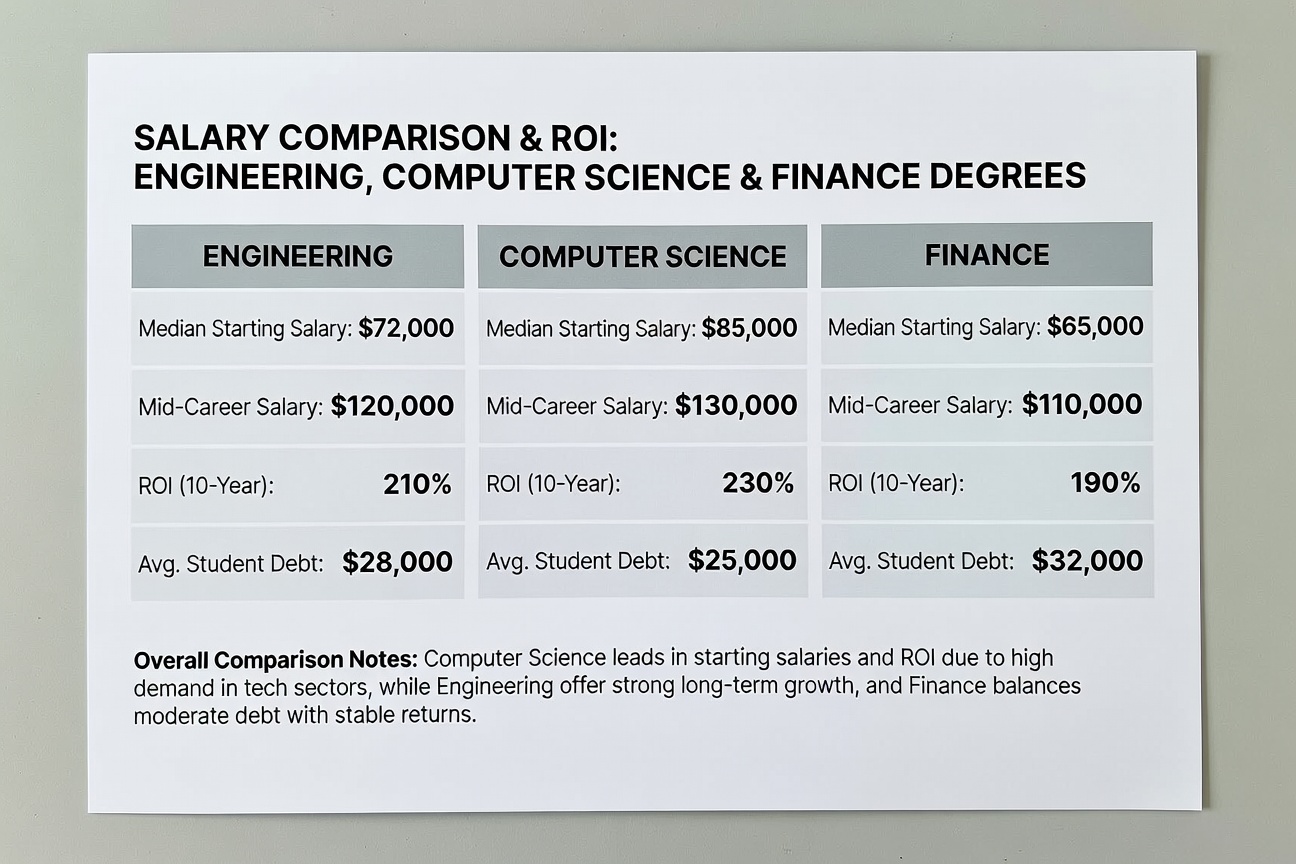
- Degree ROI Comparison Table
- Making the Right Decision for You
How to Actually Calculate Degree ROI
I spent years as an engineer before pivoting to writing about financial independence, and the single mental model I wish I’d applied more rigorously to my own education decision was return on investment. Not “what do I love?” or “what am I good at?” — those matter — but also: what will this degree actually produce financially, and does that justify the cost?
The ROI framework for a college degree has three inputs: total cost (tuition, fees, room and board, books, and opportunity cost of not working full-time), expected earnings premium over a high school diploma across a 40-year career, and time to break even on the investment. A degree that costs $80,000 and adds $15,000/year in earnings pays back in roughly 5 years before interest considerations. A degree that costs $200,000 and adds $10,000/year in earnings takes 20 years to break even — and that’s assuming you could have invested the $200,000 in something else at zero return. According to Bureau of Labor Statistics earnings data, the premium for a bachelor’s degree over a high school diploma averages about $25,000/year — but that average conceals enormous variation by field.
⚡ Pro Tip
Before choosing a major, look up the median earnings at 10 years post-graduation for that specific program at the specific school you’re considering — not national averages. The Department of Education’s College Scorecard (collegescorecard.ed.gov) shows earnings data by program and institution. A computer science degree from a regional state school often outperforms an arts degree from a prestigious private school on raw ROI — and costs a fraction as much.
The Highest-Paying Degrees in 2026
The data is consistent year over year: the highest-earning bachelor’s degrees cluster in STEM fields, with computer science and engineering at the top, followed by nursing and allied health, then business and finance. What distinguishes the top earners isn’t just starting salary — it’s the earnings trajectory. A software engineer starting at $95,000 at 22 who reaches $160,000+ by 32 has a fundamentally different lifetime earnings profile than someone starting at $45,000 who plateaus at $65,000. The compounding effect of starting high is dramatic over a 40-year career.
The Department of Education’s College Scorecard data, which tracks actual earnings of graduates by program and institution, shows median earnings 10 years after enrollment for computer science graduates consistently above $100,000 at most institutions. Engineering fields — petroleum, electrical, computer, chemical, mechanical — all show median mid-career earnings above $90,000. These fields also tend to have relatively moderate debt levels because students complete degrees in 4 years and start earning quickly.
STEM: Where the Numbers Are Strongest
Computer science and software engineering are the clear financial leaders in 2026. The combination of high starting salaries, strong job market, remote work flexibility, and continued demand growth makes CS the closest thing to a guaranteed high-ROI degree available. The field has also democratized significantly — coding bootcamps, community college transfer paths, and online degrees have created lower-cost entry routes that produce similar earnings outcomes to expensive private university CS degrees.
Engineering broadly performs well, with variation by discipline. Petroleum engineering historically leads on starting salary (often $80,000–$100,000+) but is more cyclically sensitive to energy markets. Electrical and computer engineering, chemical engineering, and mechanical engineering all show strong starting salaries in the $70,000–$90,000 range with excellent 10-year earnings trajectories. The debt-to-income ratio for most engineering graduates — particularly those who attend public universities — is among the most favorable of any degree field. For context on managing any debt you do take on for education, see our guide on federal vs. private student loans.
| Field | Median Starting Salary | Median 10-yr Salary | Avg. Debt at Graduation | Debt-to-Income Ratio |
|---|---|---|---|---|
| Computer Science | $85,000–$105,000 | $130,000–$180,000 | $28,000–$45,000 | 0.3–0.5x ✅ |
| Engineering | $72,000–$95,000 | $110,000–$160,000 | $30,000–$48,000 | 0.4–0.6x ✅ |
| Nursing (BSN) | $62,000–$75,000 | $80,000–$110,000 | $30,000–$55,000 | 0.5–0.8x ✅ |
| Business / Finance | $52,000–$70,000 | $75,000–$120,000 | $30,000–$50,000 | 0.5–0.9x ✅ |
| Education | $38,000–$48,000 | $50,000–$70,000 | $30,000–$50,000 | 0.8–1.2x ⚠️ |
| Fine Arts / Humanities | $35,000–$48,000 | $50,000–$80,000 | $28,000–$60,000 | 0.8–1.5x ⚠️ |
| Key rule: Debt-to-income ratio under 1.0x at graduation is generally manageable. Above 1.5x starts to seriously compromise long-term wealth-building. | ||||
Healthcare Degrees: High Earning, High Debt
Nursing is consistently one of the best ROI degrees available — particularly a BSN (Bachelor of Science in Nursing) from a public university. Starting salaries of $62,000–$75,000, strong job security, geographic flexibility, and relatively moderate debt loads (many nursing programs are available at community colleges and regional state schools at reasonable cost) make it an exceptional financial choice. The advanced practice nursing tracks — nurse practitioner, nurse anesthetist — produce earnings that rival or exceed many physician specialties at a fraction of the educational debt.
Medical degrees (MD/DO) are a different calculation entirely. The average medical school debt exceeds $200,000, with total education costs including undergraduate often approaching $300,000–$400,000. High physician salaries eventually justify this — but it requires a decade of training after high school before full earnings begin, and the opportunity cost of foregone earnings during residency is substantial. Medicine is a high-ROI career, but the timeline is long and the debt load is serious. Dental and pharmacy degrees follow a similar pattern of high costs with strong but time-delayed returns.
Business and Finance: Broad Range, Solid Middle
Business degrees cover an enormous range of outcomes depending on specialization, institution, and career path. Finance and accounting tend to outperform marketing and management on starting salaries. An accounting degree with a CPA credential, for instance, reliably produces $55,000–$70,000 starting salaries with strong upward trajectory — and the CPA exam provides a credential layer that makes the degree more valuable regardless of where it was earned.
MBAs are worth separate analysis. A top-20 MBA from a program like Wharton, Booth, or Kellogg produces a clear earnings premium for certain career paths (consulting, investment banking, private equity). An MBA from a lower-ranked program at full price is much harder to justify financially — the debt-to-earnings improvement ratio is often poor. If you’re considering an MBA, the employer-sponsored or part-time route (where someone else pays) is almost always financially superior to full-price full-time enrollment at a non-elite program.

⚡ Pro Tip
The debt-to-income ratio is the single most predictive financial metric for whether a degree will create or destroy wealth. A rule of thumb: total student debt at graduation should not exceed your expected first-year salary. If you’re borrowing $80,000 for a degree with a $45,000 starting salary, the math is working against you from day one. Run this calculation before committing to any program — especially graduate school.
Liberal Arts: The ROI Is About Where, Not What
Here’s the nuanced take that the “useless degree” discourse misses: liberal arts and humanities graduates who attend low-cost institutions and develop strong writing, analytical, and communication skills alongside their degree often achieve solid financial outcomes. The problem isn’t the English or philosophy major — it’s paying $200,000 for it at a private university when the same credential is available for $40,000 at a strong public school.
Liberal arts graduates who struggle financially typically share two characteristics: high debt loads from expensive institutions, and degrees pursued without deliberate skill-building alongside the major. A political science major who also develops data analysis skills, builds a professional network, and pursues relevant internships can outperform a business major who coasted through. The degree is a platform, not a guarantee. For guidance on funding any college choice efficiently, our complete financial aid guide and net price calculator guide are the right starting points.
Making the Right Decision for You
The optimal college major decision combines genuine interest and aptitude (you’ll perform better and stay in the field longer if you actually like the work) with clear-eyed ROI analysis (what does this degree actually produce financially at the institutions you’re considering, and what debt will you carry?). Neither factor alone is sufficient. A brilliant engineer who hates engineering won’t perform at their potential. A passionate artist with $180,000 in debt at a $38,000 starting salary will be financially hampered for a decade.
Run the numbers before you commit. Use the College Scorecard to look up earnings by program and school. Calculate your debt-to-expected-first-year-salary ratio. Model both an optimistic and conservative earnings scenario over 10 years. Then make the decision with full financial visibility rather than hope and assumption. That 30 minutes of research may be the highest-ROI use of time in your entire college process.
References
- Bureau of Labor Statistics (2025). “Education Pays.” bls.gov
- U.S. Department of Education (2026). “College Scorecard.” collegescorecard.ed.gov
- Federal Reserve (2025). “Returns to Education.” federalreserve.gov
- Investopedia (2025). “Best College Majors for a Career.” investopedia.com