
Student Loans

Student Loan Default: Consequences, Recovery & Fresh Start Options

student loan default consequences recovery fresh start options

Key Takeaways

  • Federal student loans go into default after 270 days of nonpayment — at that point the full balance becomes immediately due and the government can garnish wages, seize tax refunds, and intercept Social Security benefits.
  • The Fresh Start program (check current availability) and loan rehabilitation are the two main pathways out of default — both restore federal aid eligibility and can remove the default from your credit report.
  • You can avoid default entirely by requesting deferment, forbearance, or an income-driven repayment plan before you miss payments — contact your servicer before the first missed payment, not after.
  • Default is recoverable. It takes time and consistent action, but people emerge from student loan default with restored credit and full access to repayment options every day.

What Student Loan Default Actually Means

Student loan default is one of the most serious financial situations a borrower can face — but it’s also more recoverable than most people realize. Let’s start with the mechanics. Federal student loans enter default after 270 days (roughly 9 months) of nonpayment. Private loans typically default much sooner — often after 90–120 days depending on the lender’s terms.

When federal loans go into default, the entire outstanding balance — principal plus all accrued interest — becomes immediately due in full. This is called “acceleration.” You can’t just catch up on missed payments; the servicer now considers the full balance overdue. The loan gets transferred from your regular servicer to a collection agency or the Department of Education’s Default Resolution Group. From that point, the government has collection tools far more powerful than any private creditor. According to Federal Student Aid, the consequences are severe and reach into multiple areas of your financial life simultaneously.

student loan default rehabilitation call servicer resolution

⚡ Pro Tip

If you’re struggling to make payments, call your loan servicer before you miss a payment — not after. Federal loans offer economic hardship deferment, unemployment deferment, and income-driven repayment plans that can reduce your payment to $0/month if your income is low enough. A $0 IDR payment is not default — it keeps your loans in good standing and counts toward forgiveness. You have options. Use them before the situation becomes a crisis.

Consequences of Default

The consequences of federal student loan default hit fast and from multiple directions at once. Wage garnishment — the government can garnish up to 15% of your disposable pay without a court order, simply by notifying your employer. Tax refund seizure — your federal and state tax refunds can be intercepted and applied to the debt. Social Security offset — for older borrowers, up to 15% of Social Security benefits can be withheld. These collection mechanisms have no statute of limitations on federal student loans.

Beyond the collection actions: your credit score takes a severe hit, typically 100+ points. All federal financial aid eligibility — for further education — is suspended. You lose access to deferment and income-driven repayment. You may lose professional licenses in some states (a little-known but devastating consequence for healthcare workers, lawyers, and teachers). The combination of these consequences is why default should be avoided at virtually any cost — and why the options to prevent it are worth understanding thoroughly.

How to Avoid Default Before It Happens

The single most important message in this article: you have powerful options to avoid default, but you must act before it happens, not after. If you’re struggling to make payments, your options include income-driven repayment (payments as low as $0/month if your income qualifies), economic hardship deferment (pauses payments for up to 3 years), unemployment deferment, and general forbearance. None of these hurt your credit — they’re legitimate programs designed exactly for financial hardship.

Call your servicer the moment you realize a payment is going to be missed. Not after you’ve missed three. Not when you get a default notice. Before. Tell them your situation. Ask specifically about IDR enrollment or deferment. Get it set up before the payment is due. A $0 IDR payment is not failure — it’s using the federal safety net correctly. For detail on all IDR plan options, our complete income-driven repayment guide covers all current plans.

Student Loan Default Recovery Options — Rehabilitation vs. Consolidation
Feature Rehabilitation Consolidation
Default Record Removed Yes — from credit report No — remains on record
Time Required 9 consecutive monthly payments Faster — weeks to process
Wage Garnishment Stopped After rehabilitation complete Faster — at consolidation
Eligible Again: Rehabilitation Only once per loan N/A
Federal Aid Restored Yes Yes
Best Choice: Rehabilitation if you have time and want the default removed from your credit history. Consolidation if you need to stop wage garnishment quickly.

Loan Rehabilitation: The Standard Exit Path

If you’re already in default, loan rehabilitation is the primary pathway back to good standing. The process: you agree to make 9 consecutive “reasonable and affordable” monthly rehabilitation payments (calculated at 15% of your discretionary income, with a $5 minimum). After completing all 9 payments, the default status is removed from your credit report — not just marked as “paid in default,” but actually removed. Your loan is transferred back to a regular servicer and you regain access to all federal repayment options.

Rehabilitation takes roughly 9–10 months from start to finish. During that period, wage garnishment continues until rehabilitation is complete. The payment amount is often significantly lower than your regular loan payment was — some borrowers pay as little as $5/month during rehabilitation. You can rehabilitate a loan only once, so don’t complete it and then re-default. The moment rehabilitation is complete, enroll in an IDR plan immediately.

Consolidation Out of Default

The faster alternative to rehabilitation is consolidating your defaulted loans into a new Direct Consolidation Loan. This can be done in weeks rather than months, and it immediately stops wage garnishment and tax refund seizure. The catch: consolidation doesn’t remove the default from your credit report — it just resolves the default status going forward. The negative credit history from the default period remains.

To consolidate out of default, you must either enroll in an IDR plan with the new consolidated loan or make 3 consecutive voluntary, full, on-time payments on the defaulted loan before consolidating. Consolidation is the better choice when you need wage garnishment stopped immediately and can live with the credit history impact. If you have time and the credit history removal matters more, rehabilitation is worth the extra months.
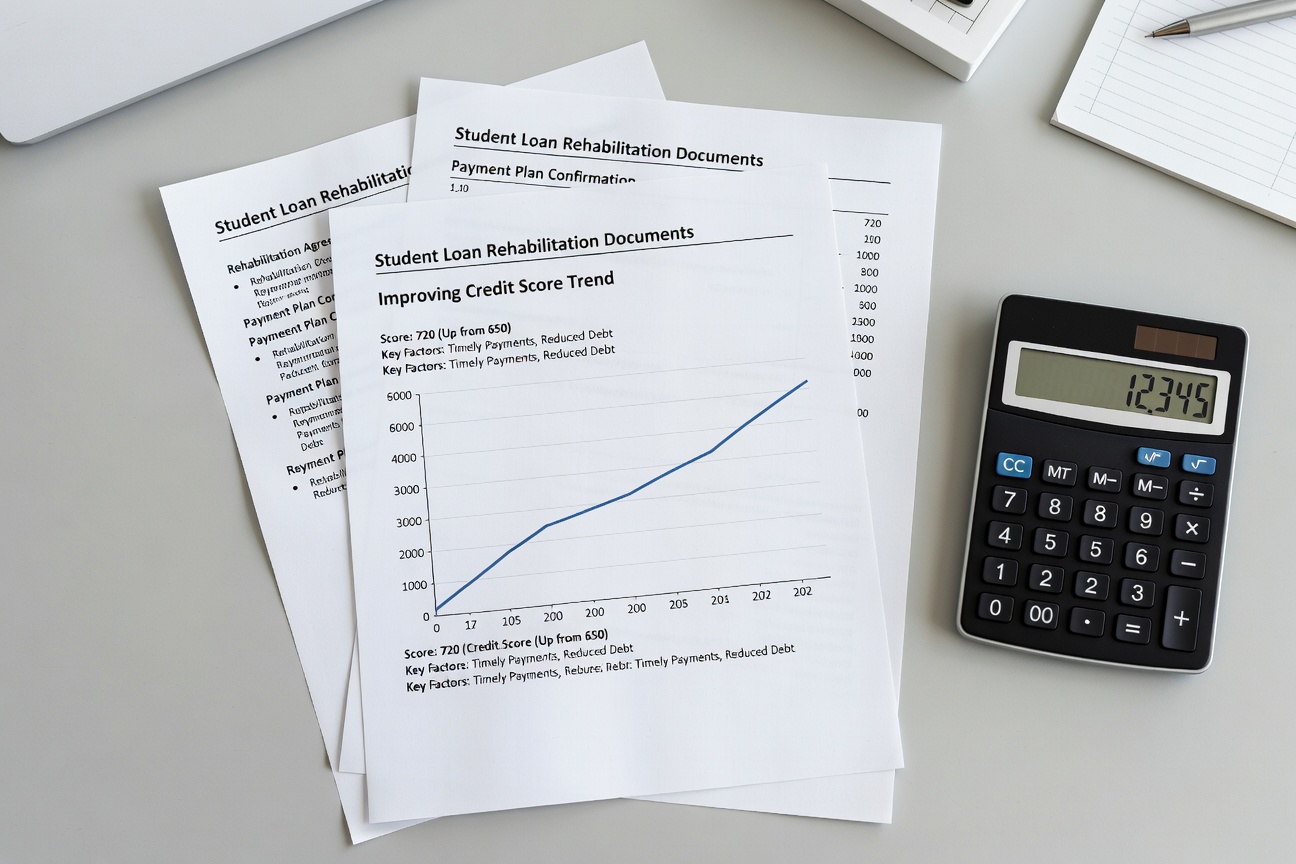
student loan default credit score recovery rehabilitation

⚡ Pro Tip

After completing loan rehabilitation, immediately enroll in an income-driven repayment plan before making any further regular payments. This prevents re-default and sets your payment at a sustainable level based on your income. Don’t complete rehabilitation and then default again six months later because the standard payment is unaffordable — that’s unfortunately common. The transition from rehabilitation to IDR should be seamless.

Rebuilding Credit After Default

Student loan default is a serious negative on your credit report, but credit recovery is absolutely achievable. After completing rehabilitation (which removes the default notation) or consolidation, your focus shifts to building positive payment history. Every on-time payment on your rehabilitated or consolidated loan, your credit cards, car loan, or other accounts adds positive history that begins to offset the damage over time.

The timeline: most borrowers who successfully exit default and maintain good payment history afterward see meaningful credit score recovery within 12–24 months. A secured credit card with a small limit can accelerate recovery by adding another positive tradeline. Keep balances low, pay on time, and let time do the work. The damage isn’t permanent — it’s time-limited, and consistent positive behavior shortens the timeline significantly. For context on building healthy credit habits alongside loan repayment, see our guide on accelerating student loan payoff.

Your Action Plan

If you’re approaching financial hardship and worried about payments: call your servicer today and request IDR enrollment or deferment. Don’t wait. If you’re already in default: contact the Default Resolution Group at Federal Student Aid, choose between rehabilitation and consolidation based on your timeline priorities, and start the process this week. If you’ve recently exited default: enroll in IDR immediately, automate your payments, and start a consistent credit rebuilding plan.

Default is serious, but it is not the end of the road. Every year, hundreds of thousands of borrowers exit default and rebuild their financial lives. The path forward is clear — it just requires taking the first step.


References

  1. Federal Student Aid (2026). “Default.” studentaid.gov
  2. Federal Student Aid (2026). “Getting Out of Default.” studentaid.gov
  3. Consumer Financial Protection Bureau (2025). “What Happens if I Default on My Student Loans?” consumerfinance.gov
  4. Investopedia (2025). “Student Loan Default.” investopedia.com

Keep Reading

Key Takeaways

  • Federal student loans go into default after 270 days of nonpayment — at that point the full balance becomes immediately due and the government can garnish wages, seize tax refunds, and intercept Social Security benefits.
  • The Fresh Start program (check current availability) and loan rehabilitation are the two main pathways out of default — both restore federal aid eligibility and can remove the default from your credit report.
  • You can avoid default entirely by requesting deferment, forbearance, or an income-driven repayment plan before you miss payments — contact your servicer before the first missed payment, not after.
  • Default is recoverable. It takes time and consistent action, but people emerge from student loan default with restored credit and full access to repayment options every day.

What Student Loan Default Actually Means

Student loan default is one of the most serious financial situations a borrower can face — but it’s also more recoverable than most people realize. Let’s start with the mechanics. Federal student loans enter default after 270 days (roughly 9 months) of nonpayment. Private loans typically default much sooner — often after 90–120 days depending on the lender’s terms.

When federal loans go into default, the entire outstanding balance — principal plus all accrued interest — becomes immediately due in full. This is called “acceleration.” You can’t just catch up on missed payments; the servicer now considers the full balance overdue. The loan gets transferred from your regular servicer to a collection agency or the Department of Education’s Default Resolution Group. From that point, the government has collection tools far more powerful than any private creditor. According to Federal Student Aid, the consequences are severe and reach into multiple areas of your financial life simultaneously.

student loan default rehabilitation call servicer resolution

⚡ Pro Tip

If you’re struggling to make payments, call your loan servicer before you miss a payment — not after. Federal loans offer economic hardship deferment, unemployment deferment, and income-driven repayment plans that can reduce your payment to $0/month if your income is low enough. A $0 IDR payment is not default — it keeps your loans in good standing and counts toward forgiveness. You have options. Use them before the situation becomes a crisis.

Consequences of Default

The consequences of federal student loan default hit fast and from multiple directions at once. Wage garnishment — the government can garnish up to 15% of your disposable pay without a court order, simply by notifying your employer. Tax refund seizure — your federal and state tax refunds can be intercepted and applied to the debt. Social Security offset — for older borrowers, up to 15% of Social Security benefits can be withheld. These collection mechanisms have no statute of limitations on federal student loans.

Beyond the collection actions: your credit score takes a severe hit, typically 100+ points. All federal financial aid eligibility — for further education — is suspended. You lose access to deferment and income-driven repayment. You may lose professional licenses in some states (a little-known but devastating consequence for healthcare workers, lawyers, and teachers). The combination of these consequences is why default should be avoided at virtually any cost — and why the options to prevent it are worth understanding thoroughly.

How to Avoid Default Before It Happens

The single most important message in this article: you have powerful options to avoid default, but you must act before it happens, not after. If you’re struggling to make payments, your options include income-driven repayment (payments as low as $0/month if your income qualifies), economic hardship deferment (pauses payments for up to 3 years), unemployment deferment, and general forbearance. None of these hurt your credit — they’re legitimate programs designed exactly for financial hardship.

Call your servicer the moment you realize a payment is going to be missed. Not after you’ve missed three. Not when you get a default notice. Before. Tell them your situation. Ask specifically about IDR enrollment or deferment. Get it set up before the payment is due. A $0 IDR payment is not failure — it’s using the federal safety net correctly. For detail on all IDR plan options, our complete income-driven repayment guide covers all current plans.

Student Loan Default Recovery Options — Rehabilitation vs. Consolidation
Feature Rehabilitation Consolidation
Default Record Removed Yes — from credit report No — remains on record
Time Required 9 consecutive monthly payments Faster — weeks to process
Wage Garnishment Stopped After rehabilitation complete Faster — at consolidation
Eligible Again: Rehabilitation Only once per loan N/A
Federal Aid Restored Yes Yes
Best Choice: Rehabilitation if you have time and want the default removed from your credit history. Consolidation if you need to stop wage garnishment quickly.

Loan Rehabilitation: The Standard Exit Path

If you’re already in default, loan rehabilitation is the primary pathway back to good standing. The process: you agree to make 9 consecutive “reasonable and affordable” monthly rehabilitation payments (calculated at 15% of your discretionary income, with a $5 minimum). After completing all 9 payments, the default status is removed from your credit report — not just marked as “paid in default,” but actually removed. Your loan is transferred back to a regular servicer and you regain access to all federal repayment options.

Rehabilitation takes roughly 9–10 months from start to finish. During that period, wage garnishment continues until rehabilitation is complete. The payment amount is often significantly lower than your regular loan payment was — some borrowers pay as little as $5/month during rehabilitation. You can rehabilitate a loan only once, so don’t complete it and then re-default. The moment rehabilitation is complete, enroll in an IDR plan immediately.

Consolidation Out of Default

The faster alternative to rehabilitation is consolidating your defaulted loans into a new Direct Consolidation Loan. This can be done in weeks rather than months, and it immediately stops wage garnishment and tax refund seizure. The catch: consolidation doesn’t remove the default from your credit report — it just resolves the default status going forward. The negative credit history from the default period remains.

To consolidate out of default, you must either enroll in an IDR plan with the new consolidated loan or make 3 consecutive voluntary, full, on-time payments on the defaulted loan before consolidating. Consolidation is the better choice when you need wage garnishment stopped immediately and can live with the credit history impact. If you have time and the credit history removal matters more, rehabilitation is worth the extra months.

student loan default credit score recovery rehabilitation

⚡ Pro Tip

After completing loan rehabilitation, immediately enroll in an income-driven repayment plan before making any further regular payments. This prevents re-default and sets your payment at a sustainable level based on your income. Don’t complete rehabilitation and then default again six months later because the standard payment is unaffordable — that’s unfortunately common. The transition from rehabilitation to IDR should be seamless.

Rebuilding Credit After Default

Student loan default is a serious negative on your credit report, but credit recovery is absolutely achievable. After completing rehabilitation (which removes the default notation) or consolidation, your focus shifts to building positive payment history. Every on-time payment on your rehabilitated or consolidated loan, your credit cards, car loan, or other accounts adds positive history that begins to offset the damage over time.

The timeline: most borrowers who successfully exit default and maintain good payment history afterward see meaningful credit score recovery within 12–24 months. A secured credit card with a small limit can accelerate recovery by adding another positive tradeline. Keep balances low, pay on time, and let time do the work. The damage isn’t permanent — it’s time-limited, and consistent positive behavior shortens the timeline significantly. For context on building healthy credit habits alongside loan repayment, see our guide on accelerating student loan payoff.

Your Action Plan

If you’re approaching financial hardship and worried about payments: call your servicer today and request IDR enrollment or deferment. Don’t wait. If you’re already in default: contact the Default Resolution Group at Federal Student Aid, choose between rehabilitation and consolidation based on your timeline priorities, and start the process this week. If you’ve recently exited default: enroll in IDR immediately, automate your payments, and start a consistent credit rebuilding plan.

Default is serious, but it is not the end of the road. Every year, hundreds of thousands of borrowers exit default and rebuild their financial lives. The path forward is clear — it just requires taking the first step.


References

  1. Federal Student Aid (2026). “Default.” studentaid.gov
  2. Federal Student Aid (2026). “Getting Out of Default.” studentaid.gov
  3. Consumer Financial Protection Bureau (2025). “What Happens if I Default on My Student Loans?” consumerfinance.gov
  4. Investopedia (2025). “Student Loan Default.” investopedia.com

Keep Reading