
Key Takeaways
- Auto loan discrimination — charging higher interest rates or denying credit based on race, national origin, sex, or other protected characteristics — is illegal under the Equal Credit Opportunity Act and the Fair Housing Act, and is actively enforced by the CFPB and DOJ.
- Dealer markup — the practice of dealers adding basis points to the lender’s offered rate and pocketing the difference — has been a primary vehicle for discriminatory pricing, and borrowers from minority communities have historically paid significantly more as a result.
- The most effective protection against discriminatory pricing is obtaining a pre-approved rate from a bank or credit union before entering a dealership, giving you an objective benchmark the dealer must beat or match.
- If you believe you’ve been the victim of auto loan discrimination, you can file complaints with the CFPB, the FTC, and your state attorney general — and in some cases pursue legal action or participate in class action settlements.
Table of Contents
- What Auto Loan Discrimination Actually Looks Like
- The Laws That Protect You
- Dealer Markup: How Discriminatory Pricing Happens
- How to Spot If You Were Overcharged
- How to Protect Yourself Before You Sign
- How to Fight Back If You Were Discriminated Against
- Auto Loan Discrimination: Your Rights at a Glance
- Walking Into Any Dealership Prepared
What Auto Loan Discrimination Actually Looks Like
Auto loan discrimination doesn’t always announce itself. It rarely looks like an explicit refusal. More often, it looks like this: two borrowers with nearly identical credit profiles walk into the same dealership on the same day, apply for financing on similarly priced vehicles — and one ends up with a rate that’s 1.5 to 2 percentage points higher than the other. The difference correlates with race or national origin, not with any objective financial factor. Over a 60-month loan on a $35,000 vehicle, that rate difference costs the higher-rate borrower $1,500 to $2,500 more in total interest.
This is not a hypothetical. It’s a pattern documented in federal enforcement actions, academic research, and CFPB supervisory findings over more than two decades. The mechanism varies: sometimes it’s direct discrimination in underwriting decisions; more often it operates through discretionary dealer markup — the practice of allowing dealers to add basis points above the lender’s offered rate and keep the difference as compensation. When that markup discretion is exercised in ways that correlate with protected characteristics, it violates federal law regardless of intent. As the CFPB’s supervisory highlights on auto finance document, fair lending violations in auto lending are among the bureau’s most consistent enforcement priorities.
⚡ Pro Tip
Before visiting any dealership, get pre-approved for an auto loan from your bank or credit union and bring the pre-approval letter with you. This does two critical things: it gives you an objective, discrimination-free rate benchmark, and it signals to the finance office that you are a prepared buyer who will notice if the dealer’s rate is significantly higher. Dealers who know you have a competing offer work harder to match or beat it — and have less opportunity to inflate the rate on an uninformed borrower.
The Laws That Protect You
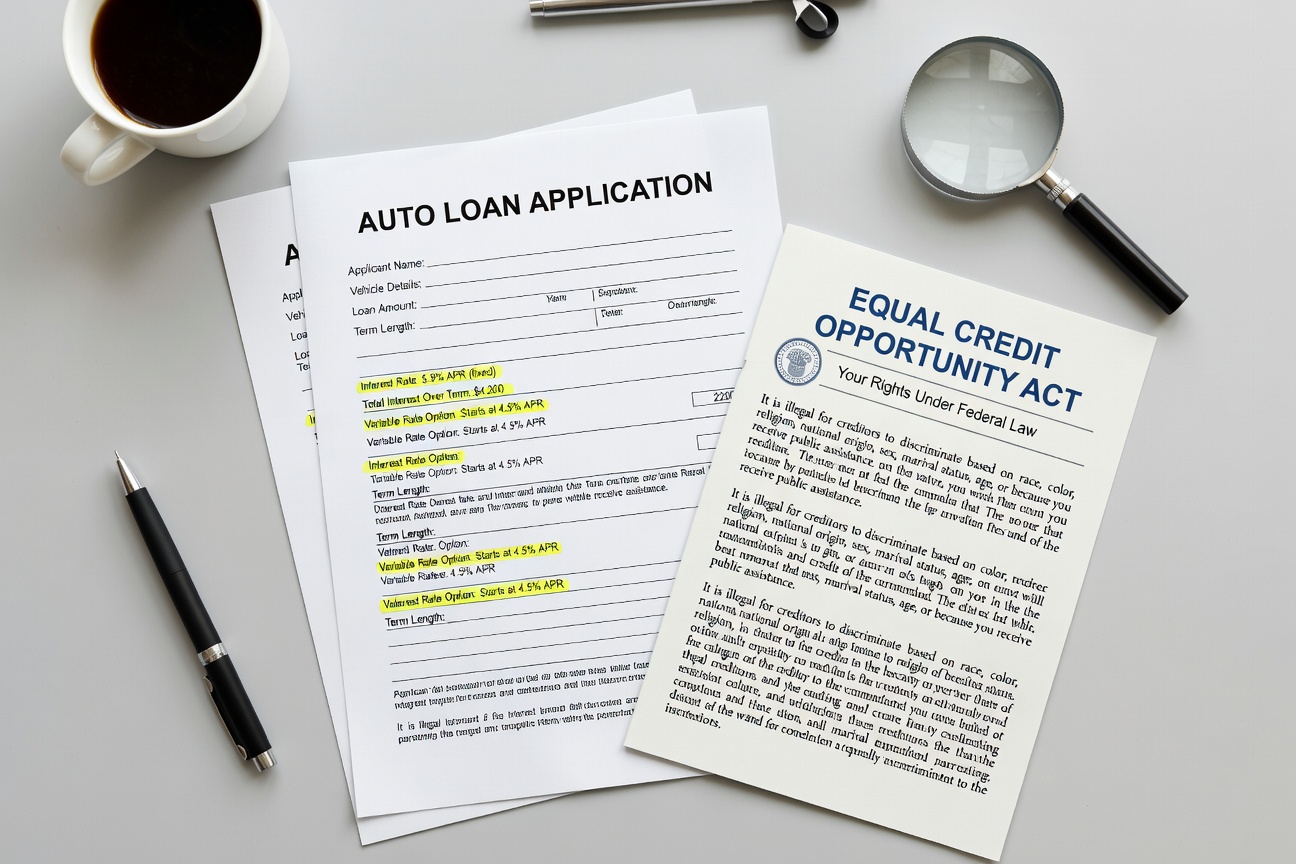
Two federal statutes form the core of auto loan discrimination law. The Equal Credit Opportunity Act (ECOA) prohibits creditors from discriminating against applicants on the basis of race, color, religion, national origin, sex, marital status, age, or receipt of public assistance income. It applies to all aspects of a credit transaction — including pricing, terms, and the decision to extend credit at all. When you’re approved for a loan but given a higher rate than your creditworthiness justifies, and that rate correlates with a protected characteristic, ECOA is the primary enforcement vehicle.
The Fair Housing Act applies when the auto loan is used to purchase a vehicle that will be used in connection with housing — a somewhat narrower application, but relevant in some manufactured housing and RV financing contexts. Together, these laws are enforced by the CFPB (which supervises large auto lenders and indirect lenders), the Department of Justice (which brings pattern-or-practice discrimination cases), and the Federal Trade Commission (which has jurisdiction over auto dealers). ECOA also gives you a right to an adverse action notice — a written explanation — if your credit application is denied or you receive less favorable terms than you applied for. You can request this notice within 60 days of the adverse action. The CFPB’s auto loan consumer resources outline these protections in accessible terms.
Dealer Markup: How Discriminatory Pricing Happens
Understanding dealer markup is essential to understanding how auto loan discrimination operates in practice. Here’s the mechanism: when a dealership arranges financing for a buyer, it submits the buyer’s credit application to one or more lenders. The lender responds with a “buy rate” — the minimum interest rate at which it will fund the loan given the buyer’s creditworthiness. The dealer is typically permitted to markup that rate — often by up to 2.5 percentage points — and keep the difference between the buy rate and the consumer’s rate as dealer compensation.
This markup discretion is entirely legal. The problem arises when it’s exercised in ways that correlate with race or national origin. A dealer finance manager who consistently adds higher markups to deals involving minority borrowers — whether through conscious bias or implicit assumptions about who will negotiate — is creating a disparate impact that violates ECOA, even if the manager never consciously intends to discriminate. Multiple major auto lenders have paid tens of millions of dollars in CFPB and DOJ settlements related to exactly this pattern. The settlement amounts, and the required corrective policies, reflect the regulators’ finding that discretionary markup had systematically disadvantaged minority borrowers at scale. For context on getting the best possible rate before markup enters the picture, see our 2026 auto loan rate guide.
How to Spot If You Were Overcharged
Identifying potential discrimination in a loan you’ve already taken requires some investigation. Start by pulling your credit reports from all three bureaus — Equifax, Experian, TransUnion — through annualcreditreport.com and noting your credit score range. Then look at your loan’s APR and compare it to published average rates for your credit tier (the CFPB and Experian both publish average auto loan rates by credit score range periodically). If your rate is significantly above the average for your credit profile — particularly by more than 1.5 percentage points — it warrants closer examination.
Ask your current lender or the dealer for the buy rate that was offered for your loan. Some will tell you; some won’t. If you can document that the buy rate was significantly lower than your contracted rate, and particularly if you have reason to believe the markup wasn’t applied consistently across borrowers of different backgrounds, that’s the foundation of a potential fair lending complaint. You can also request your full loan file from the lender under ECOA — including all documents used in the credit decision. This is a legal right.
| Issue | Governing Law | Who Enforces It | Your Action |
|---|---|---|---|
| Higher rate based on race/ethnicity | ECOA, Fair Housing Act | CFPB, DOJ, FTC | File CFPB complaint; consult fair lending attorney |
| Credit denied without explanation | ECOA | CFPB, FTC | Request adverse action notice in writing within 30 days |
| Dealer markup exceeding lender’s rate | ECOA (disparate impact) | CFPB, DOJ | Ask for buy rate disclosure; compare to your pre-approval |
| Steered to higher-cost loan product | ECOA, UDAAP | CFPB | Request all available loan options in writing |
| Credit score manipulation | FCRA, ECOA | CFPB, FTC | Pull your own credit report; dispute errors immediately |
| File complaints at: consumerfinance.gov/complaint (CFPB), ftc.gov/complaint (FTC), and your state attorney general’s office. | |||
How to Protect Yourself Before You Sign
The most effective consumer protection against auto loan discrimination is removing or limiting dealer markup discretion before you sit down in the finance office. Get pre-approved by your bank or credit union before visiting any dealership. Bring the pre-approval letter. Tell the finance manager upfront that you have outside financing and ask if they can beat the rate. This does several things simultaneously: it caps the rate you’ll accept at your pre-approval rate (the dealer must beat it to earn the financing business), it signals that you are a financially literate buyer who will notice inflated rates, and it gives you a discrimination-neutral benchmark against which to compare any dealer offer.
Also consider applying through the lender directly rather than through the dealer. Many major banks and online lenders (Capital One Auto Navigator, LightStream, PenFed Credit Union) allow you to get a pre-approval that you bring to the dealer. The dealer facilitates the sale; the financing is settled before you walk in. This bypasses dealer markup entirely. It may cost you the occasional manufacturer promotional rate — which is only available through the dealer’s captive lender — but for most transactions, direct financing at a known rate is worth the tradeoff. For the full context on negotiating auto financing see our car lease vs. buy guide.

⚡ Pro Tip
Ask the dealer’s finance office directly: “What is the buy rate from the lender, and what is the dealer markup?” You have every right to ask this question, and a legitimate dealer should answer it. Some states require disclosure of the buy rate on request. If the finance manager refuses to tell you the buy rate or becomes evasive, that’s a signal to walk away and complete your purchase through direct lender financing — bypassing the dealer’s F&I office entirely.
How to Fight Back If You Were Discriminated Against
If you believe you were the victim of auto loan discrimination — whether through a higher rate, a credit denial, or steering toward a higher-cost product — you have several enforcement avenues available. The CFPB complaint portal (consumerfinance.gov/complaint) is the most direct first step. File a detailed complaint specifying the nature of the discrimination, the lender and dealer involved, the loan terms, and your credit profile. The CFPB forwards complaints to the institution and requires a response; the complaint also becomes part of the public database that triggers supervisory attention when patterns emerge.
The FTC handles complaints against auto dealers specifically (ftc.gov/complaint). Your state attorney general’s office can investigate violations of state fair lending laws, which often provide additional protections beyond federal law. And if your situation involves significant financial harm — particularly if you can show a pattern or can identify other borrowers similarly affected — consult a fair lending attorney. Many work on contingency in discrimination cases, and class action lawsuits have resulted in substantial settlements for borrowers who were systematically overcharged. The Department of Justice Civil Rights Division’s fair lending resources document past enforcement actions and explain how to refer potential violations for federal investigation.
Walking Into Any Dealership Prepared
The practical playbook for any auto purchase in 2026: get pre-approved before you go, know your credit score and the market rate range for your tier, ask for the buy rate and document any refusal to disclose it, and never let the financing conversation be rushed. Take the contract home to read if you need to — you have every right to do so. Compare the dealer’s offered rate to your pre-approval. If the dealer rate is meaningfully higher and there’s no manufacturer promotional rate justifying it, use your pre-approval or walk away from that dealer’s financing entirely.
You have more power in this transaction than the finance office wants you to believe. The combination of a pre-approval, knowledge of your rights, and willingness to ask direct questions about rate composition is the most effective combination of protections available. Discrimination thrives on uninformed borrowers who don’t know what questions to ask. Showing up prepared eliminates most of the opportunity for it.
References
- Consumer Financial Protection Bureau (2025). “Supervisory Highlights: Auto Finance.” consumerfinance.gov
- Consumer Financial Protection Bureau (2025). “Auto Loans.” consumerfinance.gov
- Department of Justice (2025). “Fair Lending.” justice.gov
- Investopedia (2025). “Equal Credit Opportunity Act (ECOA).” investopedia.com