
Key Takeaways
- College ROI varies dramatically by region — the same degree in the same field can yield a $20,000+ annual salary difference depending on where you work after graduation.
- The Northeast and West Coast consistently produce the highest absolute post-graduation salaries, but also carry the highest cost of living — real purchasing power varies significantly.
- The Midwest and South offer compelling ROI for graduates who stay in-region: lower cost of living, lower college costs, and strong demand in key industries create excellent value propositions.
- Field of study matters more than region for most graduates — but understanding regional labor markets before choosing a school or accepting a job offer is a high-value, underused strategy.
Table of Contents
- How to Actually Measure College ROI
- Northeast: High Salaries, High Costs, High Pressure
- West Coast: Tech Premium — But It Comes at a Price
- Midwest: The Underrated ROI Sweet Spot
- South & Southeast: Growing Markets & Rising Salaries
- Regional ROI Comparison: The Numbers Side by Side
- How to Use Regional ROI in Your College Decision
- References & Keep Reading
How to Actually Measure College ROI
I’ve built a business on zero-based budgeting and making every dollar work harder. When someone tells me they chose a college because of its “reputation” or “feel,” I get a little twitchy. Those things matter — but they should never be the only inputs in a $100,000–$200,000 decision.
College ROI is the relationship between what you spend on a degree and what you earn because of it. The simplest version: total cost of degree divided by the earnings premium a degree generates over a lifetime. But that formula misses a crucial variable: where you live and work after graduation.
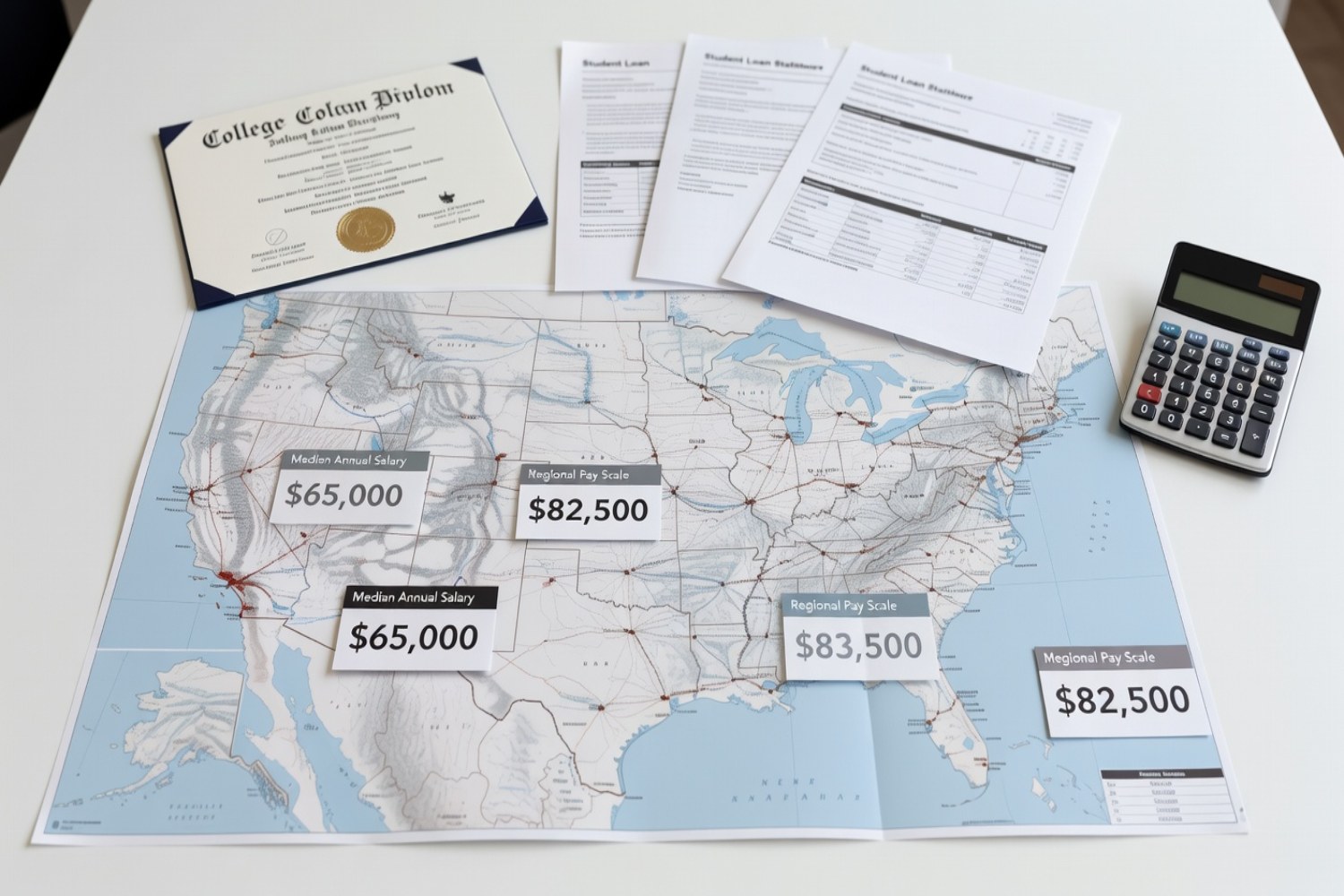
Regional labor markets set salary floors and ceilings for virtually every profession. A software engineer in San Francisco earns roughly twice what the same role pays in Memphis. A registered nurse in New York City earns 30–40% more than an identical RN in rural Kansas. These aren’t just cost-of-living adjustments — in many cases they represent genuine purchasing power differences even after accounting for regional expenses.
The BLS Occupational Employment and Wage Statistics by metropolitan area is the authoritative free data source for this analysis. Before accepting any job offer or committing to a school, spending 30 minutes with this database can be genuinely life-changing. Our breakdown of the total cost of college attendance covers the cost side of this equation in full detail.
Northeast: High Salaries, High Costs, High Pressure
The Northeast — New York, New Jersey, Connecticut, Massachusetts, Pennsylvania, Maryland, D.C. — consistently produces the highest nominal post-graduation salaries in the country. Finance, law, consulting, technology, and healthcare all pay premiums in this corridor that are difficult to match elsewhere.
A financial analyst in NYC earns a median of $95,000–$115,000 early career. The same analyst in Pittsburgh earns $65,000–$80,000. Boston’s healthcare and biotech ecosystem drives exceptional salaries for life sciences and medical professionals — often 20–30% above national median for equivalent roles.
The catch is real: cost of living in Northeast metros is extreme. Rent alone in Manhattan, Boston, or D.C. can consume 40–50% of a graduate’s gross income. After housing, New York and New Jersey state income taxes (among the highest in the nation), transportation, and basic expenses, the purchasing power advantage over Midwest or Southern cities can shrink substantially — and sometimes disappear entirely.
Who benefits most: graduates in finance, law, consulting, and tech who command salaries that scale faster than cost of living in the early career years. Those with significant student debt who need high absolute income to accelerate payoff. Those whose specific industry is geographically concentrated in the region.
⚡ Pro Tip
Use the MIT Living Wage Calculator alongside BLS salary data for any region you’re considering. It shows the actual income required to meet basic needs by county. Compare your expected starting salary against the living wage for that region — not just the nominal salary number. A $75,000 salary in a region with a $72,000 living wage leaves almost nothing for debt payoff or savings. The same $75,000 in a region with a $52,000 living wage creates meaningful financial margin.
West Coast: Tech Premium — But It Comes at a Price
The West Coast — California, Washington, Oregon — is defined for post-graduation purposes by the tech premium. Software engineers, product managers, and data scientists command some of the highest salaries anywhere in the world in the San Francisco Bay Area and Seattle. The compensation structures at major tech companies — base salary, equity, and bonuses — create total packages that dwarf comparable roles elsewhere.
But California’s housing crisis has reached a point where even six-figure salaries feel constraining. A software engineer earning $130,000 in San Francisco, paying $3,500/month for a one-bedroom apartment, facing California state income taxes above 9%, and servicing student loan debt can find their financial position surprisingly tight.
Seattle offers a compelling alternative: similar tech salaries (Amazon, Microsoft, and a dense ecosystem of tech employers), no state income tax, and housing costs below the Bay Area’s extreme levels. For tech graduates specifically, Seattle consistently ranks among the best salary-to-cost-of-living markets in the country.
Midwest: The Underrated ROI Sweet Spot
Here’s the honest assessment most coastal-oriented college counselors won’t give you: for a large number of graduates in a large number of fields, the Midwest is the highest-ROI region in the country when you measure purchasing power rather than nominal salary.
Chicago, Minneapolis, Columbus, Indianapolis, and Kansas City offer salaries that are 15–25% below coastal equivalents in many fields — but housing costs 40–60% lower, moderate state income taxes, and commutes that don’t consume two hours of every day. The math on net wealth accumulation often favors a $75,000 salary in Indianapolis over a $95,000 salary in Boston.
The Midwest also has genuine industry clusters that drive competitive salaries in specific sectors. Chicago is a major financial center — trading, banking, and fintech salaries approach New York levels. Minneapolis has significant healthcare and medical device industry concentration. Columbus and Indianapolis are rapidly growing tech hubs. According to Investopedia’s regional economic analysis, Midwest metros have seen the fastest growth in technology and professional services employment over the past five years of any U.S. region.
For graduates with student debt, the Midwest calculation is particularly compelling. Lower cost of living means more monthly income available for loan payoff. Lower housing costs make homeownership — and the equity building that comes with it — accessible earlier in a career. And in-state tuition at Midwest flagships like University of Michigan, University of Wisconsin, and Ohio State is among the best value in the country.
South & Southeast: Growing Markets & Rising Salaries
The South — Texas, Florida, Georgia, North Carolina, Tennessee, and surrounding states — has undergone a dramatic economic transformation over the past decade. Corporate relocations, tech company expansions, and population migration have created genuine salary growth in markets that previously lagged significantly behind coastal peers.
Austin, Texas is the most dramatic example. What was a mid-tier government and university town a decade ago is now a major tech hub — home to Tesla’s headquarters, major Apple and Google offices, and dozens of mid-sized tech companies. Salaries in Austin’s tech sector now approach coastal levels while housing costs, despite significant appreciation, remain well below San Francisco or Seattle.
Nashville’s healthcare industry pays near the top of national ranges for medical professionals and healthcare administrators. Raleigh-Durham’s Research Triangle is a legitimate biotech and pharmaceutical hub. Charlotte and Atlanta are major financial services centers. Miami is growing as a fintech and Latin America business gateway.
Florida’s zero state income tax is a meaningful financial benefit — the equivalent of a 3–7% salary increase compared to high-tax states, depending on income level. Texas similarly has no state income tax. For graduates in fields with strong Southern representation, these tax advantages compound significantly over a career.

Regional ROI Comparison: The Numbers Side by Side
| Region | Avg. Salary | Avg. Rent (1BR) | State Income Tax | Net Purchasing Power |
|---|---|---|---|---|
| Northeast (NYC) | $105,000 | $3,800/mo | 6–10% | Moderate |
| West Coast (SF) | $115,000 | $3,600/mo | 9–13% | Moderate |
| West Coast (Seattle) | $110,000 | $2,400/mo | 0% | Strong |
| Midwest (Chicago) | $85,000 | $1,900/mo | 4–5% | Strong |
| South (Austin/Nashville) | $88,000 | $1,800/mo | 0% (TX/TN) | Very Strong |
| Best Purchasing Power ROI | Austin/Nashville (TX, TN) and Seattle for no income tax + competitive salaries; Midwest for wealth-building via homeownership | |||
How to Use Regional ROI in Your College Decision
Here’s the framework I’d give any student or family working through the college decision right now. It takes about two hours to complete — and it could save you from a six-figure mistake.
Step 1: Identify your target industries and roles. Before comparing colleges or regions, know what you want to do. Pick two or three realistic career paths. Use the BLS Occupational Outlook Handbook to find median salaries and projected job growth for each role nationally.
Step 2: Map where those jobs actually are. Use the BLS OEWS metro-level data to find the five metro areas with the highest employment and highest wages for your target roles. This is your regional opportunity map. If software engineering is your path, the map is heavily skewed toward Seattle, Bay Area, Austin, and New York. If healthcare administration is your path, it’s far more evenly distributed.
Step 3: Calculate purchasing power in each target metro. For your target salary in each metro, subtract estimated taxes and estimated rent (use Zillow or Apartments.com for current market rents). What’s left is your actual financial margin — for loan payoff, savings, and investing. This number is more meaningful than the nominal salary.
Step 4: Choose a school that positions you for your target market. Regional schools often have far stronger employer relationships in their local metro than nationally ranked schools. A University of Texas Austin grad has exceptional network access in Texas. A University of Michigan grad is deeply connected in Midwest finance and automotive sectors. A University of Washington grad has strong ties to Seattle’s tech ecosystem. Match your school to your target market, not the other way around. The Federal Student Aid net price calculators make it possible to compare the actual cost of regional schools — run the numbers on schools in your target geography first. For an even deeper dive on controlling college costs, our guide to in-state vs. out-of-state vs. private college costs walks through the full decision framework.
⚡ Pro Tip
Don’t lock in your regional decision at 18 — but do think about it deliberately. The most financially damaging mistake I see is graduates who move to an expensive coastal city primarily for prestige or social reasons, without running the numbers on what that move costs them in net wealth accumulation over five years versus a Midwest or Southern alternative. Run the five-year comparison before you sign a lease. And if you do carry student loans into your career, our guide to aggressive student loan payoff strategies will help you eliminate them faster regardless of where you land.
References
- U.S. Bureau of Labor Statistics. (2025). “Occupational Employment and Wage Statistics by Metro Area.” BLS.gov
- U.S. Department of Education, Federal Student Aid. (2025). “Net Price Calculators.” StudentAid.gov
- Investopedia. (2025). “Regional Economic Growth.” Investopedia.com
Keep Reading: