Quick Answer
The best personal loans for bad credit in July 2025 offer APRs ranging from 18% to 36%, with loan amounts between $1,000 and $50,000. Top lenders include Upstart, Avant, and OneMain Financial, each accepting FICO scores as low as 580 — and some with no minimum score requirement.
Finding personal loans bad credit borrowers can actually qualify for is harder than most lenders advertise — but as of July 2025, a growing number of online lenders are approving applicants with FICO scores below 630. The key is knowing which lenders use alternative underwriting models, what rates to realistically expect, and how to avoid predatory terms that trap borrowers in cycles of debt.
According to the Federal Reserve’s consumer credit data, outstanding personal loan balances topped $245 billion in early 2025, with subprime borrowers (those with scores below 620) accounting for nearly 20% of all new originations. The Consumer Financial Protection Bureau (CFPB) has also flagged that borrowers with bad credit pay, on average, 12 to 15 percentage points more in APR than borrowers with good credit — making lender selection critically important.
This guide gives you a complete, data-driven breakdown of the best personal loans for bad credit in 2025 and 2026: real APR ranges, minimum credit score requirements, loan amounts, fees, and a step-by-step action plan to improve your approval odds and minimize your total borrowing cost.
Key Takeaways
- The average APR for a personal loan for bad credit borrowers ranges from 18% to 36% (Experian Consumer Credit Review, 2025), compared to 10%–14% for borrowers with good credit.
- Upstart approved borrowers with an average FICO score of 591 in 2024, using an AI-driven model that also evaluates education and employment (Upstart Annual Report, 2024).
- Personal loan origination volume reached $222 billion in 2024 (TransUnion Industry Insights Report, 2025), with subprime originations growing faster than any other credit tier.
- The CFPB found that 1 in 5 bad credit borrowers who took payday loans could have qualified for a personal installment loan instead (CFPB Research Report, 2024), underscoring the importance of shopping lenders.
- Prequalification with a soft credit pull — available at lenders like Avant and LendingPoint — lets borrowers check estimated rates without any impact on their FICO Score (Equifax, 2025).
- Secured personal loans, which require collateral, can reduce APR by 5 to 10 percentage points for bad credit applicants compared to unsecured alternatives (NerdWallet Lender Analysis, 2025).
In This Guide
- What Credit Score Is Considered “Bad Credit” for Personal Loans?
- Which Lenders Offer the Best Personal Loans for Bad Credit in 2025–2026?
- What APRs and Fees Should Bad Credit Borrowers Expect?
- How Do You Qualify for a Personal Loan with Bad Credit?
- What Types of Personal Loans Are Available for Bad Credit?
- How Do You Spot and Avoid Predatory Lenders?
- How Can You Improve Your Approval Odds Before Applying?
- What Are the Best Alternatives to Personal Loans for Bad Credit?
- How Does Taking a Personal Loan Affect Your Credit Score?
What Credit Score Is Considered “Bad Credit” for Personal Loans?
A FICO Score below 580 is universally classified as “poor” credit, while scores from 580 to 669 fall into the “fair” category — both tiers are commonly grouped together as “bad credit” by personal loan lenders. Most mainstream banks and credit unions require a minimum score of 670 to approve an unsecured personal loan without additional conditions.
According to Experian’s credit score range breakdown, approximately 16% of Americans have a FICO Score below 580, and another 18% fall in the 580–669 fair range. That means roughly one-third of U.S. adults face restricted access to standard loan products.
How Lenders Categorize Credit Tiers
Different lenders set their own internal cutoffs, but the industry standard framework — based on FICO’s official scoring model — divides scores as follows.
| Credit Tier | FICO Score Range | Typical APR Range | Lender Availability |
|---|---|---|---|
| Exceptional | 800–850 | 7%–11% | All lenders |
| Very Good | 740–799 | 10%–14% | Most lenders |
| Good | 670–739 | 13%–18% | Most lenders |
| Fair | 580–669 | 18%–28% | Specialty lenders |
| Poor | 300–579 | 28%–36% | Limited lenders |
Lenders like Upstart and LendingPoint use factors beyond the FICO Score — including income, employment history, and debt-to-income (DTI) ratio — which can help borderline applicants secure approval even with a score in the 580–600 range.
The average FICO Score in the United States hit a record high of 718 in 2024 according to Experian, but nearly 100 million Americans still have a score below 670 — qualifying them for subprime loan terms.
Which Lenders Offer the Best Personal Loans for Bad Credit in 2025–2026?
The best personal loans bad credit borrowers can access in 2025–2026 come from online-first lenders with flexible underwriting, not traditional banks. The top options include Upstart, Avant, OneMain Financial, LendingPoint, and Universal Credit — each with distinct strengths depending on your credit profile and borrowing need.
Below is a detailed comparison of the leading lenders for bad credit personal loans based on our evaluation criteria, which includes APR range, minimum credit score, loan amounts, origination fees, and funding speed.
| Lender | Min. Credit Score | APR Range | Loan Amounts | Origination Fee | Funding Speed |
|---|---|---|---|---|---|
| Upstart | 300 (no minimum) | 7.80%–35.99% | $1,000–$50,000 | 0%–12% | 1 business day |
| Avant | 580 | 9.95%–35.99% | $2,000–$35,000 | Up to 4.75% | Next business day |
| OneMain Financial | None stated | 18.00%–35.99% | $1,500–$20,000 | 1%–10% or flat fee | Same or next day |
| LendingPoint | 600 | 7.99%–35.99% | $2,000–$36,500 | 0%–8% | Next business day |
| Universal Credit | 560 | 11.69%–35.99% | $1,000–$50,000 | 5.25%–9.99% | 1–3 business days |
| Oportun | None required | 35.95%–35.99% | $300–$18,500 | Up to 12% | Same day possible |
Upstart: Best for Thin Credit Files
Upstart uses an AI-driven underwriting model that evaluates over 1,600 data points, including education, area of study, and employment history — not just credit score. This makes it particularly useful for borrowers with a short credit history or a single negative event dragging down an otherwise stable profile.
In its 2024 annual filing, Upstart reported that the average FICO Score of approved borrowers was 591, well below the cutoff most banks require. Loan amounts range from $1,000 to $50,000, with terms of 36 or 60 months.
OneMain Financial: Best for Very Low Credit Scores
OneMain Financial does not publish a minimum credit score requirement and uses a holistic review of income, expenses, and collateral options. It offers both secured and unsecured personal loans, which is rare among specialty lenders targeting the subprime market.
The tradeoff is that OneMain’s maximum loan amount of $20,000 is lower than competitors, and its floor APR of 18% applies even to its best-qualified applicants. For borrowers who cannot qualify anywhere else, however, OneMain is often the most accessible legitimate option.
Upstart reports that its model approves 27% more applicants than a traditional FICO-only model would, at 16% lower loss rates, according to the company’s 2024 Annual Report.
Avant: Best Combination of Rate and Accessibility
Avant targets the “near-prime” segment — borrowers with scores between 580 and 680 — and has funded more than $8 billion in loans since its founding. Its online application takes under five minutes, and approval decisions are typically issued in minutes, not days.
Avant charges an administration fee of up to 4.75%, which is deducted from loan proceeds at funding. Borrowers should factor this cost into their net-received amount when comparing offers.
What APRs and Fees Should Bad Credit Borrowers Expect?
Bad credit borrowers should realistically expect APRs between 18% and 36% on personal loans in 2025, with the 36% figure representing the legal cap most responsible online lenders observe. The exact rate depends on credit score, income, loan amount, and loan term — but borrowers with scores below 580 will almost always land in the upper half of any lender’s rate range.
According to NerdWallet’s 2025 personal loan rate aggregation, the average APR for borrowers with poor credit is approximately 25.3%, while borrowers with excellent credit average just 10.7% — a spread of nearly 15 percentage points.
Common Fees to Watch For
Beyond the interest rate, lenders may charge several fees that substantially increase the total cost of borrowing. Understanding these fees before signing any loan agreement is essential.
- Origination fee: A one-time charge of 1%–12% of the loan amount, deducted from proceeds or added to the balance.
- Prepayment penalty: A fee for paying off the loan early — less common among online lenders but still present at some traditional lenders.
- Late payment fee: Typically $15–$40 or 5% of the overdue payment amount.
- Returned payment fee: Charged when an ACH payment is rejected, usually $15–$30.
- Check processing fee: Some lenders charge a small fee if you choose to pay by paper check instead of autopay.
An origination fee of 10% on a $10,000 loan means you receive only $9,000 but owe interest on the full $10,000 from day one. Always calculate the total cost of borrowing — not just the monthly payment — before accepting a loan offer.
The total annual percentage rate (APR) is the most accurate cost comparison tool because it includes both the interest rate and all mandatory fees. Always compare loans using APR, never the nominal interest rate alone.
How Do You Qualify for a Personal Loan with Bad Credit?
Qualifying for a personal loan with bad credit requires meeting lender thresholds across four primary factors: credit score, income, debt-to-income (DTI) ratio, and employment status. Most bad credit lenders prioritize income and DTI equally with credit score — sometimes more so.
The debt-to-income (DTI) ratio — your monthly debt payments divided by your gross monthly income — is a critical approval factor. According to the CFPB’s borrower guidance, most lenders prefer a DTI ratio below 43%, and some bad credit lenders cap it at 50%.
What Lenders Actually Evaluate
While the FICO Score is the starting point, lenders that serve bad credit borrowers routinely look at additional factors before making a final decision.
- Gross monthly income: Most lenders require a minimum of $1,200–$2,000 per month.
- Employment status: Full-time employment is preferred, but many lenders accept self-employment, gig income, and Social Security benefits.
- Bank account history: Some fintech lenders (including Upstart and LendingPoint) analyze bank account cash flow as a proxy for financial stability.
- Payment history: A pattern of on-time utility, rent, and phone payments can offset a low score caused by older negative events.
- Outstanding derogatory marks: Active collections, recent bankruptcies (within 12 months), and unresolved judgments are the most common automatic disqualifiers.
“Borrowers with bad credit often think they have no options, but the lending landscape has changed dramatically. If you have steady income and a reasonable DTI, there are legitimate lenders willing to work with you — and prequalifying with multiple lenders in the same 14-day window counts as a single hard inquiry under FICO’s rate-shopping rules.”
The Role of a Co-Signer
Adding a co-signer with good credit — typically a score of 670 or above — can significantly improve your approval odds and lower your APR. The co-signer agrees to repay the loan if the primary borrower defaults, which reduces lender risk.
Lenders including LightStream and SoFi accept co-signers on personal loans, though the co-signer assumes full legal liability for the debt. If you pursue this route, choose someone who clearly understands the financial risk they are taking on.
What Types of Personal Loans Are Available for Bad Credit?
Bad credit borrowers can access several distinct loan structures — each with different eligibility requirements, risk levels, and costs. The primary types are unsecured personal loans, secured personal loans, credit-builder loans, and peer-to-peer loans.
Unsecured Personal Loans
Unsecured personal loans require no collateral and are the most common form offered by online lenders like Avant and LendingPoint. Approval is based entirely on creditworthiness, income, and DTI, which means bad credit applicants face higher rates and lower loan amounts than prime borrowers.
For someone rebuilding finances after a hardship, understanding how to leverage these products strategically is critical — read our in-depth analysis on rebuilding your finances after rock bottom for a practical framework that pairs well with responsible personal loan use.
Secured Personal Loans
Secured personal loans require the borrower to pledge an asset — such as a vehicle, savings account, or CD — as collateral. If the borrower defaults, the lender seizes the asset. The benefit: APRs can be 5 to 10 percentage points lower than equivalent unsecured loans (NerdWallet, 2025).
OneMain Financial and Mariner Finance are among the few major lenders that actively offer secured personal loans to subprime borrowers. These products are best suited for borrowers who have an asset to pledge and a clear repayment plan.
Credit-Builder Loans
A credit-builder loan works in reverse: the lender holds the borrowed funds in a locked savings account while you make monthly payments. Once the loan is repaid, you receive the funds. This structure eliminates default risk for the lender, making it accessible to borrowers with almost any credit profile.
Offered primarily by community banks, credit unions, and platforms like Self Financial, credit-builder loans typically range from $300 to $1,500 with terms of 12–24 months. They are ideal for borrowers who need credit repair more than immediate cash.
Borrowers who used a credit-builder loan saw an average FICO Score increase of 60 points over 12 months, according to a study published by the Consumer Financial Protection Bureau.
How Do You Spot and Avoid Predatory Lenders?
Predatory lenders targeting bad credit borrowers often advertise “guaranteed approval” or “no credit check” loans while burying triple-digit APRs in the fine print. The warning signs are consistent and identifiable before you apply.
The FTC and CFPB both maintain active enforcement records against predatory lending practices. In 2024 alone, the CFPB took action against lenders charging effective APRs exceeding 300% on installment loans marketed to subprime consumers, according to the CFPB’s enforcement action database.
Red Flags to Identify Before Signing
- “Guaranteed approval” claims: No legitimate lender guarantees approval before reviewing your application. This language is a hallmark of scam operations.
- Upfront fees before funding: Reputable lenders never require payment before disbursing loan proceeds. Advance-fee scams cost borrowers an estimated $807 million annually (FTC, 2024).
- No physical address or state license: All legitimate lenders must be licensed in each state where they operate. Verify licensure through your state’s Department of Financial Institutions.
- Pressure to decide immediately: Any lender that pressures you to accept terms before you can review them is not acting in good faith.
- APR not disclosed before funding: Federal law (the Truth in Lending Act, or TILA) requires all lenders to disclose APR before loan consummation. Refusal to disclose is illegal.
Before applying with any lender you are unfamiliar with, search their name plus “complaints” in the CFPB’s Consumer Complaint Database and verify their BBB rating. Legitimate lenders will have a visible complaint history with documented responses.
It is also worth noting that borrowers with debt concerns sometimes confuse personal loan lenders with debt relief companies — a distinction that matters. If you are facing serious debt challenges, our guide on the amortization shock hitting borrowers right now explains how loan structure affects total repayment costs in ways many borrowers do not anticipate.
How Can You Improve Your Approval Odds Before Applying?
Improving your approval odds for personal loans bad credit situations involve three proven strategies: reducing your DTI ratio before applying, disputing inaccurate credit report items, and using prequalification tools to shop without hard inquiries. Each strategy can be executed within 30 to 90 days and has a measurable impact on outcomes.
Dispute Errors on Your Credit Report
According to a landmark study by the Federal Trade Commission, 1 in 5 Americans have a material error on at least one of their three credit reports. Disputing and resolving even one error can raise your FICO Score by 25 to 100 points, depending on the severity of the inaccuracy.
You can access your reports for free at AnnualCreditReport.com — the only federally mandated free report source, maintained under the Fair Credit Reporting Act (FCRA). Review all three bureaus: Equifax, TransUnion, and Experian.
Reduce Your Debt-to-Income Ratio
Paying down existing revolving debt — particularly credit card balances — before applying for a personal loan can simultaneously lower your DTI and raise your credit utilization score, which accounts for 30% of your FICO Score. Even paying down $500 to $1,000 in credit card balance can produce a measurable score increase within 30 days.
If you are also managing student loan obligations, understanding your repayment options is critical. Our resource on aggressive student loan payoff strategies can help you prioritize which debts to tackle first for maximum financial impact.
“The single fastest way to improve your personal loan approval odds is to reduce your credit utilization below 30%. Pay down revolving balances before applying, and you may see a score increase of 20 to 40 points within a single billing cycle — which could move you from a rejection to an approval, or from a 30% APR to a 22% APR.”
Use Prequalification to Shop Safely
Prequalification uses a soft credit inquiry, which does not affect your FICO Score. It lets you see estimated APR, loan amount, and term offers from multiple lenders before committing to a formal application. Lenders offering prequalification for bad credit applicants include Avant, LendingPoint, Universal Credit, and Upstart.
Submit prequalification requests to at least three to five lenders on the same day. If you then proceed to formal applications within a 14-day window, FICO’s rate-shopping rule counts all hard inquiries as a single inquiry — minimizing score impact.

What Are the Best Alternatives to Personal Loans for Bad Credit?
If you cannot qualify for a personal loan or find the rates unacceptable, several alternatives may provide lower-cost access to funds: credit union personal loans, credit card cash advances (for small amounts), home equity products, 401(k) loans, and nonprofit emergency assistance programs.
Credit Union Payday Alternative Loans (PALs)
Payday Alternative Loans (PALs) are federally regulated small-dollar loans offered by credit unions. Under the National Credit Union Administration (NCUA) rules, PALs cap APR at 28% — far below what most payday lenders charge. Loan amounts range from $200 to $2,000, with terms of one to 12 months.
Membership in a federal credit union is required, but qualification criteria are typically more flexible than bank lending standards. Credit unions are nonprofit institutions, which structurally aligns their interests more closely with borrowers.
0% APR Credit Cards with Balance Transfer Offers
For borrowers with scores in the 580–640 range, some issuers — including Capital One and Discover — offer entry-level credit cards with introductory 0% APR periods of 12 to 15 months. If you can repay the balance within the promotional period, the effective cost is zero interest.
This approach only works for amounts small enough to realistically repay within the promotional window. Carrying a balance after the promotional period ends typically triggers APRs of 22%–29%.
Federal credit unions charge a maximum APR of 18% on standard personal loans and 28% on Payday Alternative Loans — compared to an industry average of 25.3% for bad credit personal loans at online lenders (NCUA, 2025).
If you are managing subscription costs or cutting discretionary spending to free up cash for debt repayment, our guide on streaming subscription budget management in 2026 identifies common areas where households leak $50–$200 per month that could go toward loan payments instead.
How Does Taking a Personal Loan Affect Your Credit Score?
Taking out a personal loan has both short-term negative effects and long-term positive potential on your FICO Score, depending on how you manage repayment. Understanding both dynamics helps borrowers make strategic decisions about when and how to apply.
Short-Term Effects
When you submit a formal loan application, the lender performs a hard inquiry, which typically reduces your FICO Score by 5 to 10 points temporarily. This effect diminishes within 12 months and disappears entirely from score calculations after 24 months (Equifax, 2025).
Adding a new loan also increases your total debt balance, which slightly affects your credit utilization calculation — though personal loans are installment debt, not revolving debt, and have less impact on utilization than credit card balances.
Long-Term Benefits of On-Time Repayment
Payment history is the single largest component of your FICO Score, accounting for 35% of the total score. Making 12 consecutive on-time payments on a personal loan builds a positive payment history that can meaningfully offset older negative marks.
A personal loan also improves your credit mix — the variety of credit types in your file — which accounts for 10% of your FICO Score. If you currently have only credit cards, adding an installment loan demonstrates you can manage different forms of credit responsibly.
For borrowers also dealing with student loan debt, managing multiple loan types simultaneously has compounding effects on credit profile strength. Our in-depth article on student loan shock and why millions aren’t prepared covers how overlapping debt obligations affect borrowing capacity and credit health.
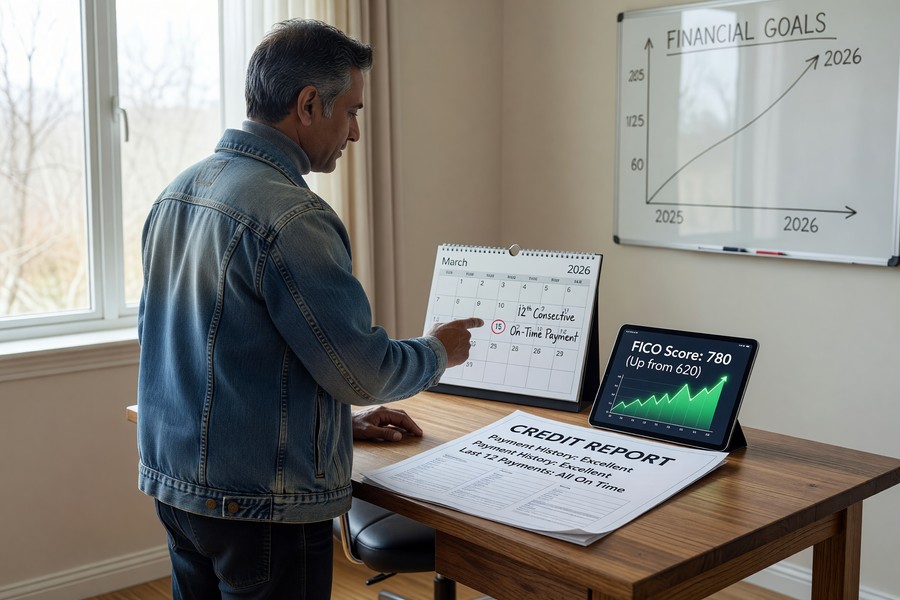
Real-World Example: Marcus Consolidates Credit Card Debt with a Bad Credit Personal Loan
Marcus, 29, had a FICO Score of 603 and $11,200 in credit card debt spread across three cards with a weighted average APR of 27.4%. His minimum monthly payments totaled $336, and at that rate he was projected to spend $9,800 in interest before paying off the balances in full over 8 years.
After prequalifying with four lenders, Marcus was approved by Avant for a $12,000 personal loan at 24.99% APR for 48 months. His new monthly payment: $393 — a modest $57 increase over minimums, but with a clear payoff date.
Total interest paid under the new loan: approximately $6,800. Total savings over paying minimums: $3,000. After 18 months of on-time payments, his FICO Score rose to 651 — enough to qualify for a car loan at a competitive rate. The 4.75% origination fee ($570) was factored into his total cost calculation from the start, making the net benefit still clearly positive.
Your Action Plan
-
Pull your credit reports from all three bureaus
Visit AnnualCreditReport.com and download your reports from Equifax, TransUnion, and Experian. Review each for errors, duplicate accounts, and accounts that should have aged off. Federal law entitles you to at least one free report per bureau per year; as of 2023, free weekly reports are available through AnnualCreditReport.com.
-
Dispute any inaccurate negative items
File disputes directly with each bureau online — Experian, TransUnion, and Equifax each have dedicated dispute portals. Under the FCRA, bureaus must investigate and respond within 30 days. Successful dispute removals can raise your score by 25–100 points.
-
Calculate your current DTI ratio
Add up all monthly minimum debt payments (credit cards, car loans, student loans), divide by gross monthly income, and multiply by 100. If your DTI is above 43%, prioritize paying down at least one revolving balance before applying. Use the CFPB’s DTI explainer for calculation help.
-
Prequalify with at least three lenders on the same day
Submit prequalification requests to Upstart, Avant, and LendingPoint at minimum — all use soft inquiries that will not affect your FICO Score. Compare the estimated APR, loan amount offered, origination fees, and monthly payment across all offers. Completing this step in one session makes comparison cleaner.
-
Calculate total cost, not just monthly payment
Use a free amortization calculator at Bankrate.com or Calculator.net to determine the total interest paid over the life of each loan offer. Add any origination fees to get the true total cost of borrowing. A lower monthly payment with a longer term often means significantly more total interest paid.
-
Verify lender licensing in your state
Before submitting a formal application, confirm the lender is licensed to operate in your state by searching your state’s Department of Financial Institutions website. You can also check the NMLS Consumer Access database for registered lenders.
-
Set up autopay on your chosen loan
Most lenders, including Avant and LendingPoint, offer an APR discount of 0.25% to 0.50% for enrolling in autopay. More importantly, autopay eliminates the risk of late payments, which carry fees and immediately harm your FICO Score — undermining the credit-building benefit of the loan.
-
Monitor your FICO Score monthly during repayment
Use Experian’s free credit monitoring or your credit card’s free FICO Score tool to track score changes monthly. Set a target score milestone — such as 650 or 670 — and track your progress. Once your score reaches 670, you will qualify for significantly better loan terms on any future borrowing need.
Frequently Asked Questions
What is the easiest personal loan to get with bad credit?
Upstart and Oportun are among the easiest personal loans to get with bad credit because neither publishes a hard minimum credit score requirement. Upstart uses AI underwriting that evaluates income, education, and employment in addition to credit history. Oportun reports accepting borrowers with no credit history at all, though its APR reaches the 36% ceiling.
Can I get a personal loan with a 500 credit score?
Yes, it is possible to get a personal loan with a 500 credit score, but options are limited. Upstart, OneMain Financial, and Oportun are the most commonly cited lenders that approve scores at or near 500. Expect an APR at or near 35.99% and a lower loan amount — typically $1,000 to $5,000 — until your credit improves.
What is the minimum credit score for a personal loan?
The minimum credit score for a personal loan varies widely by lender. Traditional banks typically require 670+, while online lenders focused on personal loans bad credit applicants — such as Avant (580) and LendingPoint (600) — have lower thresholds. Upstart and Oportun have no stated minimum, making them accessible to the widest range of borrowers.
Will applying for a personal loan hurt my credit score?
A formal personal loan application triggers a hard inquiry, which typically lowers your FICO Score by 5 to 10 points temporarily. The effect fades within 12 months. Prequalification uses a soft inquiry and has zero impact on your score — always prequalify before submitting a formal application.
How fast can I get a personal loan with bad credit?
Many online lenders disburse funds within one business day of approval. Avant, LendingPoint, and OneMain Financial all offer next-business-day funding in most cases. Upstart reports that more than 99% of its loans are funded within one business day once approved and verified.
Is a personal loan better than a payday loan for bad credit?
Yes, a personal installment loan is almost always preferable to a payday loan. The average payday loan carries an effective APR of 400% according to the CFPB’s payday loan research, compared to a maximum of 36% for the lenders featured in this guide. Installment loan terms also spread repayment across months rather than requiring a lump-sum payoff on your next payday.
Can I use a personal loan to build credit?
Yes, a personal loan can build credit effectively when repaid on time. Because payment history accounts for 35% of your FICO Score, 12 to 24 months of on-time installment payments creates a strong positive data pattern. Borrowers in the CFPB credit-builder loan study saw average score gains of 60 points over 12 months.
Do personal loans for bad credit require collateral?
Most personal loans for bad credit are unsecured and require no collateral. However, lenders like OneMain Financial and Mariner Finance offer secured options where pledging a vehicle or savings account can lower your APR by 5 to 10 percentage points. Secured loans carry the risk of asset seizure if you default.
What is the best use of a personal loan for someone with bad credit?
The highest-value uses of a personal loan for bad credit borrowers are debt consolidation, emergency expense coverage, and essential home or vehicle repairs that protect income-generating capacity. Debt consolidation from high-APR credit card debt into a lower-APR personal loan generates quantifiable interest savings. Avoid using personal loans for discretionary spending, as the high interest cost makes it an expensive financing choice.
How does auto loan discrimination connect to bad credit personal loan decisions?
Lenders that use discriminatory underwriting practices may deny or overprice loans based on factors unrelated to creditworthiness. The CFPB actively enforces against such practices. If you believe you have been unfairly denied or overcharged, our article on auto loan discrimination and your rights explains the complaint process that applies to personal loans as well.
Our Methodology
The Finance Tree evaluated personal loan lenders for bad credit applicants using a standardized scoring framework applied to data collected and verified in June–July 2025. We assessed more than 20 lenders across the following criteria: minimum and maximum APR (weighted 25%), minimum credit score requirement and underwriting flexibility (25%), loan amount range (10%), origination and ancillary fees (15%), funding speed (10%), and availability of prequalification with soft inquiry (15%).
APR ranges were verified directly from lender websites and cross-referenced against publicly available state filings where applicable. All loan amounts, fees, and minimum credit scores reflect lender disclosures current as of July 2025. Rates change frequently; we recommend verifying current terms directly with each lender before applying. We do not accept compensation for lender placement in our rankings. Lenders appearing in this guide were selected solely based on their suitability for the target borrower profile.
Sources
- Federal Reserve — Consumer Credit Statistical Release (G.19)
- CFPB — Consumer Credit Trends: Personal Loans
- Experian — What Is a Good Credit Score?
- FICO — Credit Score Education: Understanding FICO Scores
- NerdWallet — Current Personal Loan Interest Rates
- CFPB — What Is a Debt-to-Income Ratio?
- CFPB — Credit-Builder Loans Research Report
- FTC — Report on the Accuracy of Credit Reports
- CFPB — Enforcement Actions Database
- CFPB — Consumer Complaint Database
- CFPB — Payday Loans and Deposit Advance Products Research
- NMLS Consumer Access — Nationwide Mortgage and Finance Licensing
- NCUA — Payday Alternative Loans (PALs)
- TransUnion — Personal Loan Industry Insights Report 2025
- AnnualCreditReport.com — Free Credit Reports (Federally Mandated)