
Key Takeaways
- The average American spends $1,200–$2,000 per year on vehicle maintenance and repairs — but most of that cost is predictable and budgetable if you follow the manufacturer’s maintenance schedule rather than reacting to breakdowns.
- Oil changes, tire rotations, air filters, and brake inspections follow regular mileage intervals — mapping these to a monthly calendar makes it easy to anticipate costs and avoid the financial shock of deferred maintenance turning into major repairs.
- The most expensive maintenance mistake is deferred maintenance: a $150 timing belt replacement done on schedule prevents a $2,000–$4,000 engine repair when it fails unexpectedly.
- A dedicated car maintenance fund — even $80–$100/month set aside automatically — smooths out the lumpy, irregular cost profile of vehicle ownership and eliminates financial stress when service is due.
Table of Contents
- Why a Car Maintenance Budget Changes Everything
- The Real Annual Cost of Car Ownership
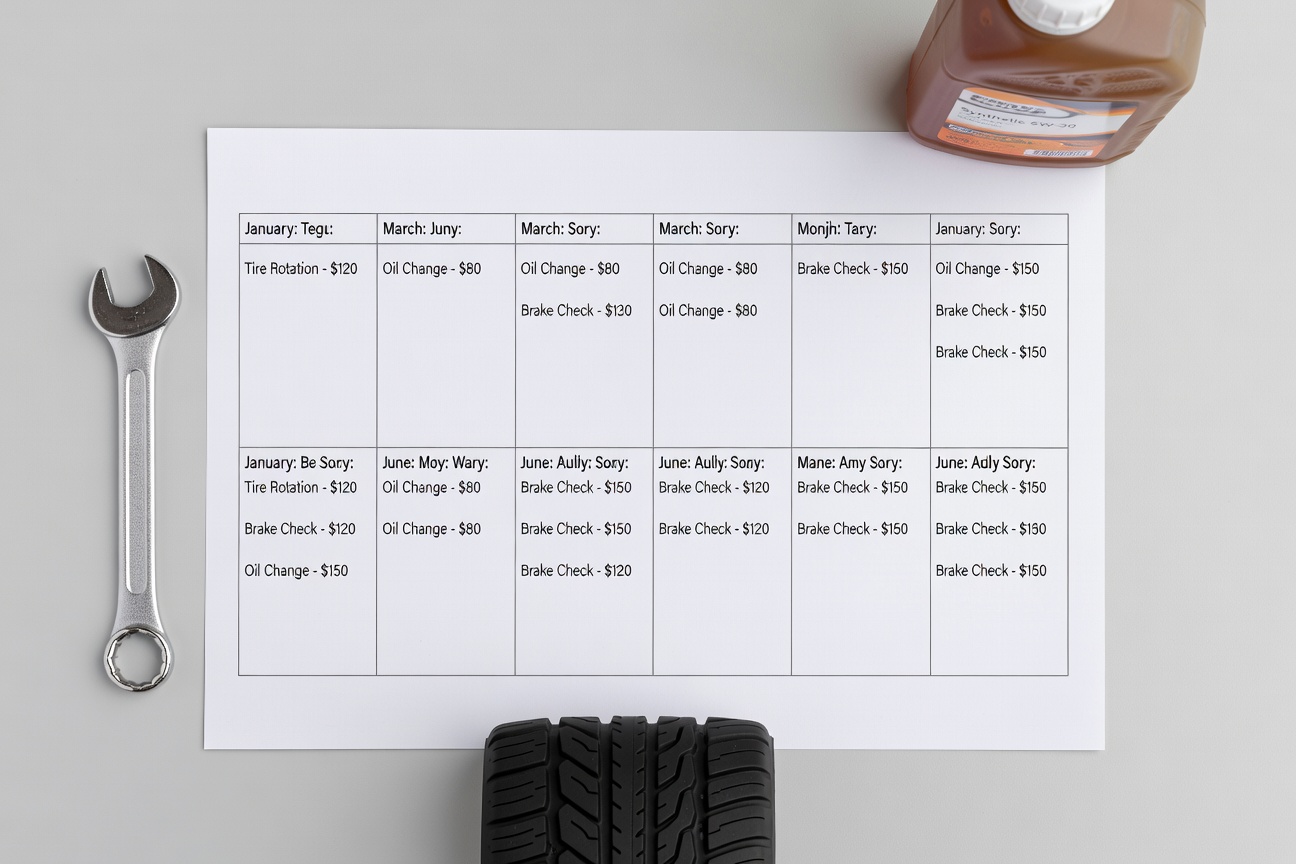
- Month-by-Month Maintenance Calendar
- Mileage-Based Maintenance Intervals
- The True Cost of Deferred Maintenance
- Setting Up Your Car Maintenance Fund
- Annual Car Maintenance Cost Breakdown
- Building Your Personalized Maintenance Budget
Why a Car Maintenance Budget Changes Everything
Here’s the honest financial truth about car ownership: most of the costs are predictable, and yet most owners treat them as surprises. Oil changes happen on a schedule. Tires wear at a known rate. Brakes have a finite life. Batteries last 3–5 years. Every one of these costs can be anticipated, scheduled, and budgeted — and yet the typical car owner hits each one as if it came out of nowhere, creating financial stress that’s entirely avoidable.
I approach my vehicles the same way I approach my investment portfolio: with a data-driven maintenance schedule and a dedicated fund that makes every service cost a non-event. The payoff isn’t just financial — a properly maintained vehicle is safer, more reliable, retains value better, and costs dramatically less over its lifetime than a neglected one. According to Bureau of Labor Statistics consumer expenditure data, vehicle maintenance and repairs represent one of the largest discretionary expense categories for most households. Getting it right matters.
⚡ Pro Tip
Pull out your owner’s manual right now and find the maintenance schedule section. Most manufacturers provide a mileage-based chart showing exactly what service is due at every interval. If your odometer is at 47,000 miles, you can see exactly what’s coming up at 50,000 (typically transmission service, spark plugs, and cabin air filter on many vehicles) and budget for it this quarter. This one 10-minute exercise converts car maintenance from unpredictable expense to scheduled cost.
The Real Annual Cost of Car Ownership
When most people calculate car ownership costs, they think about the loan payment and insurance. But the full picture includes fuel, registration and taxes, insurance, loan interest, depreciation, and maintenance. AAA’s annual “Your Driving Costs” study consistently finds that maintenance and repair costs for a typical midsize sedan run $800–$1,200 per year for a vehicle driven 15,000 miles annually. For older vehicles or those with deferred maintenance, costs can run considerably higher.
The important distinction: maintenance costs (scheduled service you control) versus repair costs (failures from neglect or age). Maintenance is almost entirely predictable and preventable through proper scheduling. Repairs are less predictable but reduced significantly by consistent maintenance. The goal of a car maintenance budget is to fund all predictable maintenance proactively and maintain a buffer for the unexpected repairs that happen to every vehicle eventually.
Month-by-Month Maintenance Calendar
Rather than tracking maintenance purely by mileage — which requires constant monitoring — it helps to build a rough calendar based on your typical annual driving. If you drive 12,000–15,000 miles per year, here’s a practical seasonal framework: January/February: Post-winter inspection — battery test, tire pressure check, wiper blade replacement if not done in fall, cabin air filter. March/April: Oil change (if due), tire rotation, brake inspection, coolant level check. May/June: Full pre-summer inspection — AC system check, tire tread depth, all fluid levels. July/August: Oil change (if due), tire rotation. September/October: Pre-winter prep — battery test and replacement if needed, wiper blades, tire inspection (consider winter tires if applicable), antifreeze concentration. November/December: Oil change (if due), brake inspection, all exterior lights check.
This calendar approach works because it ties maintenance to seasons you already track rather than requiring you to monitor your odometer constantly. Adjust the timing to your actual driving pace — if you drive significantly more or less than 12,000–15,000 miles per year, compress or expand the intervals accordingly.
| Service | Frequency | Typical Cost | Annual Budget |
|---|---|---|---|
| Oil Change (synthetic) | Every 7,500 mi / ~2–3x/yr | $70–$120 | $140–$360 |
| Tire Rotation | Every 5,000–7,500 mi | $25–$50 | $50–$150 |
| Tire Replacement (set of 4) | Every 40,000–60,000 mi | $400–$900 | $80–$225/yr amortized |
| Brake Pads (per axle) | Every 30,000–70,000 mi | $150–$300 | $60–$200/yr amortized |
| Air & Cabin Filters | Annually or every 15K mi | $40–$80 | $40–$80 |
| Wiper Blades | Annually | $25–$50 | $25–$50 |
| Battery | Every 3–5 years | $150–$250 | $30–$80/yr amortized |
| Unexpected Repairs (buffer) | Variable | Varies | $200–$500 |
| Total Annual Maintenance Budget (typical midsize vehicle) | $625–$1,645/yr | ||
Mileage-Based Maintenance Intervals
Your owner’s manual contains the most authoritative maintenance schedule for your specific vehicle — consult it rather than relying on generic advice. That said, the following intervals apply to most modern vehicles as a baseline. Oil changes: modern synthetic oil typically lasts 7,500–10,000 miles (ignore the old “every 3,000 miles” advice — it’s outdated for current formulations). Tire rotation: every 5,000–7,500 miles to equalize wear across all four tires. Brake inspection: annually or whenever you notice reduced stopping performance, squealing, or vibration.
Larger interval services that owners often overlook: transmission fluid (30,000–60,000 miles depending on vehicle), coolant flush (every 2–5 years depending on type), spark plugs (30,000–100,000 miles depending on plug type), serpentine belt (60,000–100,000 miles), and timing belt if applicable (60,000–100,000 miles — critical to do on schedule). For guidance on how these maintenance costs interact with your overall auto financing picture, our auto loan guide for 2026 covers the full ownership cost calculation.
The True Cost of Deferred Maintenance
Deferred maintenance is the most expensive financial decision most car owners make — it just doesn’t feel like a decision in the moment. Skipping a $120 oil change because cash is tight this month is understandable. But running an engine on degraded oil for 5,000 additional miles accelerates wear on every internal component. The cumulative effect of consistently deferred oil changes can take 50,000–100,000 miles off an engine’s reliable lifespan — a cost of thousands of dollars in premature engine wear.
The timing belt example is the most dramatic: on interference engines (where the valves and pistons share the same space), a timing belt that breaks at 95,000 miles instead of being replaced at the manufacturer’s recommended 90,000 interval can bend valves, destroy pistons, and total an otherwise functional engine. The preventive replacement costs $150–$400. The engine repair costs $2,000–$5,000. This math plays out repeatedly with less dramatic but equally real cost ratios across every major maintenance category. Preventive maintenance is almost always the cheaper path — it just requires paying a known cost now instead of an unknown larger cost later.

⚡ Pro Tip
Open a dedicated savings account labeled “Car Fund” and auto-transfer $80–$120 per month into it. Don’t touch it except for vehicle maintenance, registration, and unexpected repairs. When a $600 service bill arrives, you pay it from the fund without stress — because you’ve been building it all year. When the fund grows beyond $1,000–$1,500, stop contributions temporarily and resume when it drops below $500. This is the simplest possible system for eliminating automotive financial stress.
Setting Up Your Car Maintenance Fund
The mechanics of the car maintenance fund are simple: open a dedicated savings account, set up an automatic monthly transfer, and pay all vehicle maintenance costs from that account rather than from your general checking. The amount to transfer depends on your vehicle’s age, mileage, and condition — a 3-year-old vehicle under warranty might need only $60–$80/month; a 10-year-old vehicle with 120,000 miles might need $150–$200/month to cover the higher probability of repairs alongside routine maintenance.
The psychological benefit of the car maintenance fund is as valuable as the financial one. When a $700 service invoice arrives, paying it from a dedicated fund feels entirely different from being surprised by a $700 hit to your general checking account. The money was earmarked for exactly this purpose. You planned for it. It’s not an emergency — it’s the system working as designed. This reframe from “unexpected expense” to “planned cost” is the core of stress-free vehicle ownership. For context on how vehicle costs fit into your overall auto finance picture, our winter car costs guide covers seasonal budgeting specifically.
Building Your Personalized Maintenance Budget
Start with your owner’s manual: find the maintenance schedule and note every service due in the next 12 months based on your current mileage. Price each service at a local shop (or use a tool like RepairPal to get estimates by zip code). Add those costs up and divide by 12 — that’s your minimum monthly car maintenance fund contribution. Add a 30–40% buffer for unexpected repairs and you have a realistic number.
Then open the account, set up the transfer, and commit to the schedule. Keep a simple log — a note in your phone is fine — recording every service date and mileage. This record is valuable at resale (documented maintenance history increases a vehicle’s value), useful for tracking upcoming service, and satisfying in its own right as evidence that you’re treating a significant asset the way it deserves. Consistent, proactive maintenance is one of the highest-return financial habits available to any car owner.
References
- Bureau of Labor Statistics (2025). “Consumer Expenditures.” bls.gov
- AAA (2025). “Your Driving Costs.” newsroom.aaa.com
- Consumer Financial Protection Bureau (2025). “Auto Loans.” consumerfinance.gov
- Investopedia (2025). “Cost of Car Ownership.” investopedia.com