
Key Takeaways
- Federal Direct Loans carry fixed interest rates set annually by Congress — for 2025–2026, undergraduate rates are 6.53%, graduate rates are 8.08%, and Direct PLUS loans are 9.08%.
- Annual borrowing limits range from $5,500 for dependent first-year undergrads to $20,500 for graduate students, with a lifetime aggregate cap of $57,500 for undergrads and $138,500 for grad students.
- Direct Loans are the only federal student loans eligible for Public Service Loan Forgiveness (PSLF), income-driven repayment, and the SAVE plan — making them far more flexible than private alternatives.
- Repayment doesn’t begin until 6 months after you drop below half-time enrollment (the “grace period”), and $0 monthly payments under income-driven plans still count as on-time for credit reporting.
Table of Contents
- What Are Federal Direct Loans?
- The 4 Types of Direct Loans and Who They’re For
- Current Interest Rates and Borrowing Limits
- How to Apply: The FAFSA-to-Disbursement Pipeline
- Repayment Plans: Standard, IDR, and Everything In Between
- Forgiveness and Cancellation Options
- Direct Loans vs. Private Loans: The Complete Comparison
- Frequently Asked Questions
What Are Federal Direct Loans?
Federal Direct Loans are student loans issued directly by the U.S. Department of Education — not banks, not private lenders, not your school. They carry fixed interest rates of 6.53% for undergrads, flexible repayment options including $0/month plans, and access to forgiveness programs that can erase tens of thousands in debt. About 92% of all outstanding student loan debt — roughly $1.6 trillion of the $1.74 trillion total — sits in federal loans, according to Federal Student Aid data.
Here’s why this matters: Direct Loans are the only federal student loans still being issued. The old FFEL and Perkins programs are gone. If you’re borrowing federal money for college today, you’re getting a Direct Loan. And the protections built into these loans — income-driven repayment, PSLF eligibility, deferment, forbearance — are protections you lose entirely if you refinance into a private loan. That’s a one-way door, and I’ve watched too many people walk through it without understanding what they gave up.
Whether you’re a first-year undergrad or a parent financing your kid’s education, the Direct Loan program should be your first borrowing stop. Let me break down exactly how it works. If you need the broader picture, our complete financial aid playbook covers grants, scholarships, and work-study alongside loans.
The 4 Types of Direct Loans and Who They’re For
The Direct Loan program has four distinct types, and picking the right one (in the right order) can save you thousands.
Direct Subsidized Loans are the best deal in student lending. Period. Available only to undergrads who demonstrate financial need on the FAFSA, the government pays the interest while you’re in school at least half-time, during the 6-month grace period, and during deferment. On a $5,500 subsidized loan at 6.53%, that subsidy saves you roughly $1,075 over four years — money that never touches your balance. Always accept subsidized loans first.
Direct Unsubsidized Loans are available to all students regardless of need — undergrad and grad. The catch? Interest starts accruing from day one. If you don’t make interest-only payments during school ($30–$45/month on a typical loan), that interest capitalizes at repayment. Four years of capitalized interest on a $7,000 unsubsidized loan at 6.53% adds roughly $1,950 to your balance before you make your first real payment.
Direct PLUS Loans serve parents (Parent PLUS) and graduate students (Grad PLUS). These carry the steepest rate — 9.08% for 2025–2026 — and require a credit check, though the bar is much lower than private lenders. The dangerous feature? No annual cap beyond cost of attendance minus other aid. It’s easy to overborrow. Understanding your financial aid package helps you limit PLUS borrowing to what’s truly necessary.
Direct Consolidation Loans combine multiple federal loans into one with a single payment. The new rate is the weighted average of your existing rates, rounded up to the nearest eighth percent. Consolidation simplifies management but doesn’t lower your rate — and it can reset PSLF or IDR progress if done carelessly.
| Loan Type | Who’s Eligible | Rate (2025–26) | Interest Subsidy | Credit Check |
|---|---|---|---|---|
| Direct Subsidized | Undergrads with need | 6.53% | Yes — gov’t pays in school | No |
| Direct Unsubsidized | All students | 6.53% (UG) / 8.08% (Grad) | No | No |
| Direct PLUS | Parents & grad students | 9.08% | No | Yes (lenient) |
| Direct Consolidation | Multiple federal loan holders | Weighted avg of existing | N/A | No |
Federal Direct Loan types for 2025–2026. Source: Federal Student Aid. Rates as of March 2026.
Current Interest Rates and Borrowing Limits
Direct Loan rates are set each July 1 based on the 10-year Treasury note yield plus a fixed margin. Once your loan is disbursed, the rate is locked for life — it never changes regardless of the economy. That fixed-rate guarantee is one of the biggest advantages over private loans, many of which carry variable rates that can spike 3–5% over a few years.
For 2025–2026: undergraduate Direct Loans are 6.53% fixed, graduate unsubsidized loans are 8.08%, and PLUS loans are 9.08%. There’s also a 1.057% origination fee deducted from each disbursement — on a $5,500 loan, you receive $5,441.87. Small but worth budgeting for.
Annual limits for dependent first-year undergrads: $5,500 (up to $3,500 subsidized). By fourth year: $7,500. Independent students get an extra $4,000–$5,000/year in unsubsidized loans. Grad students: $20,500/year. Lifetime cap: $57,500 undergrad, $138,500 grad (including undergrad). Knowing the true cost of your specific college helps you borrow strategically rather than reflexively maxing out.
⚡ Pro Tip
You don’t have to accept the full loan amount your school offers. If your aid package includes $7,500 in Direct Loans but you only need $4,000 after scholarships and savings, borrow just $4,000. That $3,500 you didn’t borrow saves $1,287 in interest at 6.53% over 10 years. Contact your financial aid office to reduce your loan amount before disbursement. The StudentAid.gov repayment estimator shows exactly what each borrowing level costs.
How to Apply: The FAFSA-to-Disbursement Pipeline
Getting a Direct Loan follows a specific pipeline. Timing matters — some aid is first-come, first-served.
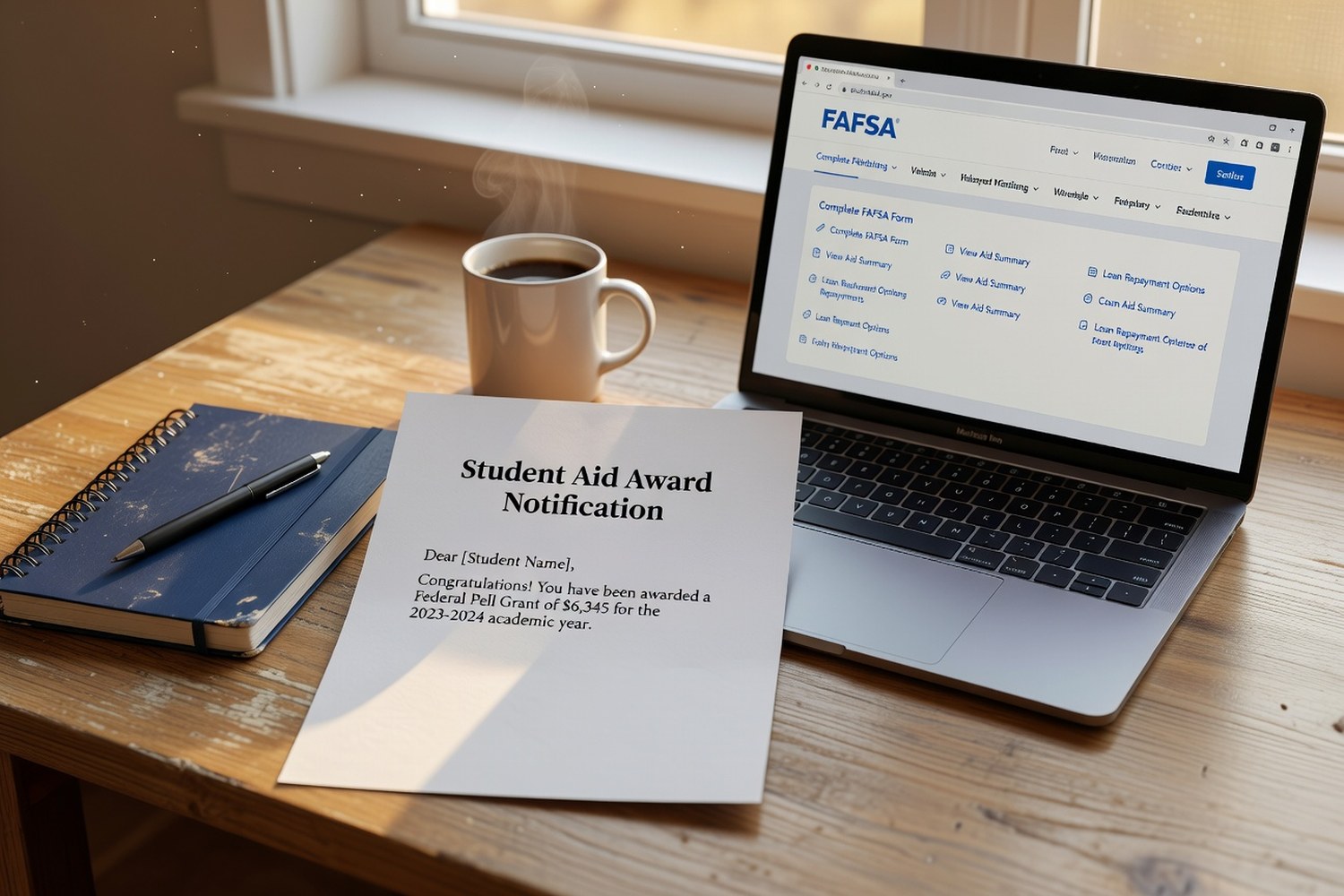
Step 1: File the FAFSA. Opens October 1 each year. File as early as possible. You’ll need tax info, Social Security number, and an FSA ID. Processing takes 3–5 days. Our FAFSA guide covers every field.
Step 2: Review your aid offer. Your school packages Direct Loans as part of your financial aid offer. Accept subsidized first (free interest subsidy), then unsubsidized for the gap. Decline what you don’t need.
Step 3: Complete entrance counseling + sign the MPN. First-time borrowers must do entrance counseling (~30 minutes) and sign a Master Promissory Note on StudentAid.gov. The MPN covers 10 years of future disbursements.
Step 4: Funds disburse. Your school applies the money to tuition/fees and refunds any excess. Timing: first 1–2 weeks of the semester. First-time, first-year borrowers face a mandatory 30-day delay on the first disbursement — plan your cash flow accordingly.
Repayment Plans: Standard, IDR, and Everything In Between
This is where Direct Loans separate from everything else. You get 8+ repayment options, and you can switch between them at any time, for free.
Standard Repayment (10 years): Fixed payments. Cheapest in total interest. On $30,000 at 6.53%: $341/month, $10,959 total interest. Simple, fast — but the highest monthly payment.
SAVE Plan: The most generous income-driven plan. Payments capped at 5% of discretionary income for undergrad (10% grad). Can be $0/month if income is low enough — and $0 payments count for credit reporting and PSLF. Forgiveness after 20 years (undergrad) or 25 years (grad). Borrowers with $12,000 or less get forgiveness after just 10 years.
IBR, PAYE, ICR: Older IDR plans at 10–20% of discretionary income. ICR is the only option for Parent PLUS after consolidation. Our IDR comparison guide breaks down when each makes sense.
| Plan | Payment Cap | Forgiveness Timeline | PSLF Eligible | Best For |
|---|---|---|---|---|
| Standard | Fixed (÷120 months) | N/A (paid in full) | Technically, but nothing to forgive | High earners, fast payoff |
| SAVE | 5% UG / 10% grad | 20–25 years (10 if ≤$12K) | Yes | Most borrowers — lowest payments |
| IBR | 10–15% | 20–25 years | Yes | FFEL consolidation borrowers |
| ICR | 20% | 25 years | Yes | Only option for Parent PLUS (post-consolidation) |
Federal Direct Loan repayment plan comparison. Source: Federal Student Aid. Verified March 2026.
Forgiveness and Cancellation Options
Direct Loans unlock every federal forgiveness program. This is the single most valuable feature — and the one you permanently lose if you refinance into a private loan.
PSLF: Remaining balance forgiven tax-free after 120 qualifying payments while working full-time for government or nonprofit. Over $69 billion discharged for 1 million+ borrowers. Only Direct Loans qualify. Our PSLF guide covers every step.
IDR Forgiveness: Any remaining balance after 20–25 years of income-driven payments. Under SAVE, balances of $12,000 or less qualify after just 10 years. The forgiven amount may be taxable after the current exclusion expires (through 2025).
TPD Discharge: Total and permanent disability discharges your federal loans. Requires VA, Social Security, or physician documentation. About 500,000 borrowers have received this discharge.
Closed School Discharge: If your school closes while enrolled or within 180 days of withdrawal, loans for that school are discharged. Over $28 billion processed since 2021.
⚡ Pro Tip
If you have old FFEL loans (originated before July 2010), consolidate them into a Direct Consolidation Loan immediately — even with no urgent need. FFEL loans can’t access PSLF, SAVE, or several other benefits. Consolidation is free, takes 30–60 days, and your new weighted-average rate is within 0.125% of your current rate. Use the Federal Student Aid Loan Simulator to model the impact before you pull the trigger.
Direct Loans vs. Private Loans: The Complete Comparison
I’ll make this simple: exhaust every dollar of Direct Loan eligibility before considering private loans. The protections are worth more than any rate difference for 95% of borrowers.
Direct Loans offer fixed rates (6.53–9.08%), income-driven repayment as low as $0/month, deferment/forbearance, and forgiveness programs worth tens of thousands. Private loans may offer lower rates for excellent credit (some at 4–5%), but they come with variable rates that can climb to 14%+, no IDR, no forgiveness, and more aggressive default consequences.
The only scenario where private wins: high-income borrowers with 760+ credit who plan aggressive 5-year repayment and want zero involvement with forgiveness. For everyone else — federal beats private on risk-adjusted terms. If you default on a private loan, the consequences are different but still severe.
Frequently Asked Questions
What’s the difference between subsidized and unsubsidized Direct Loans?
With subsidized loans, the government covers interest while you’re in school at least half-time, during the grace period, and during deferment. Unsubsidized loans accrue interest from day one. On a $5,500 loan at 6.53% over four years of school, the subsidy saves roughly $1,075. Only undergrads with demonstrated financial need on the FAFSA qualify for subsidized loans.
Can I get a Direct Loan with bad credit?
Direct Subsidized and Unsubsidized Loans have no credit check whatsoever — your FICO score is irrelevant. PLUS Loans require a credit check, but the bar is lenient: you’re only denied for “adverse credit history” like a 90-day delinquency, default, or bankruptcy within the past 5 years. Even if denied, you can appeal with an endorser or extenuating circumstances documentation.
How much can I borrow per year in Direct Loans?
Dependent undergrads: $5,500 in year 1, $6,500 in year 2, $7,500 in years 3 and beyond. Independent undergrads get an additional $4,000 to $5,000/year in unsubsidized loans. Graduate students: $20,500/year. PLUS loans cover remaining costs with no fixed cap. Lifetime aggregate limits are $57,500 for undergrads and $138,500 for grad students including undergrad debt.
Do Direct Loan payments start immediately?
No. Repayment begins 6 months after you graduate, leave school, or drop below half-time. This grace period applies to Subsidized and Unsubsidized loans. PLUS loans technically enter repayment at disbursement, but you can request an in-school deferment. Making even $25 to $50/month in interest payments during school saves $1,500 to $3,000 over the full repayment term on a typical $20,000 balance.
Can I use Direct Loan money for living expenses?
Yes. Funds can cover any expense in your school’s cost of attendance: tuition, fees, room, board, books, supplies, transportation, and personal expenses. If the loan exceeds tuition and fees, the school refunds the difference. Budget carefully — borrowing for lifestyle expenses is allowed but adds to your long-term debt burden at 6.53% interest compounding over years.
References
- Federal Student Aid, 2026, “Direct Loan Program Overview,” studentaid.gov
- Federal Student Aid, 2026, “Interest Rates and Fees,” studentaid.gov
- Federal Student Aid, 2026, “Federal Student Loan Portfolio Data,” studentaid.gov
- Federal Student Aid, 2026, “Repayment Plans,” studentaid.gov
- Federal Student Aid, 2026, “Entrance Counseling,” studentaid.gov
- Consumer Financial Protection Bureau, 2026, “Student Loan Resources,” consumerfinance.gov
- Internal Revenue Service, 2026, “Student Loan Interest Deduction,” irs.gov
- Federal Student Aid, 2026, “Loan Simulator Tool,” studentaid.gov
- U.S. Department of Education, 2026, “PSLF Data,” studentaid.gov
- Consumer Financial Protection Bureau, 2026, “Paying for College Guide,” consumerfinance.gov
Keep Reading
More on student loans and college financing: