
Key Takeaways
- A strong contract is the single most important financial protection available to freelancers and creative professionals — it defines scope, sets payment terms, establishes intellectual property ownership, and gives you legal standing when clients don’t pay.
- Kill fees, late payment clauses, and IP assignment terms are the three most financially consequential contract elements that most freelancers either skip or accept on the client’s terms without negotiating.
- Intellectual property rights default to the creator under copyright law — but “work for hire” contracts transfer ownership to the client entirely. Understanding which you’re signing changes the long-term value of your work.
- Non-payment is the most common financial problem freelancers face, and a contract with a clear payment schedule, late fee clause, and explicit non-payment remedies dramatically improves collection outcomes.
Table of Contents
- Why Contracts Are a Financial Tool, Not Just Legal Paperwork
- Payment Terms: The Clauses That Protect Your Income
- Scope Creep: Defining What You’re Actually Selling
- Kill Fees: Getting Paid When Projects Die
- Intellectual Property: Who Owns What You Create
- Non-Payment: Your Options When a Client Ghosts
- Key Contract Clauses Every Creative Needs
- Building Your Contract System
Why Contracts Are a Financial Tool, Not Just Legal Paperwork
Here’s a framing shift that changed how I think about contracts: a contract isn’t primarily a legal document — it’s a financial protection system. It defines exactly what you’re selling, what you’ll be paid, when you’ll be paid, and what happens when things go sideways. Freelancers who don’t use contracts aren’t just taking legal risks; they’re making specific financial choices that consistently produce lower income, more payment disputes, and more scope creep than their contracted peers.
The creative industries have a non-payment problem that’s well-documented. Surveys of freelancers consistently find that a significant percentage have experienced clients who refused to pay, paid late, or paid less than the agreed amount. The single variable that most predicts whether a non-payment situation is recoverable is whether there was a signed contract. Without one, you’re pursuing payment based on verbal agreements and email threads — enforceable in theory, but difficult and expensive in practice. According to the SBA’s guidance on managing business finances, proper contractual documentation is foundational to financial health for any small business or freelance operation.
⚡ Pro Tip
Always require a deposit before starting any project — 25–50% of the total fee is standard. A deposit does two things: it filters out clients who aren’t serious, and it means you’re never doing work entirely on credit. If a client refuses to pay any deposit, that’s important information about how the payment relationship will go. The deposit conversation also establishes upfront that you expect to be paid, which sets the right tone for the entire engagement.
Payment Terms: The Clauses That Protect Your Income
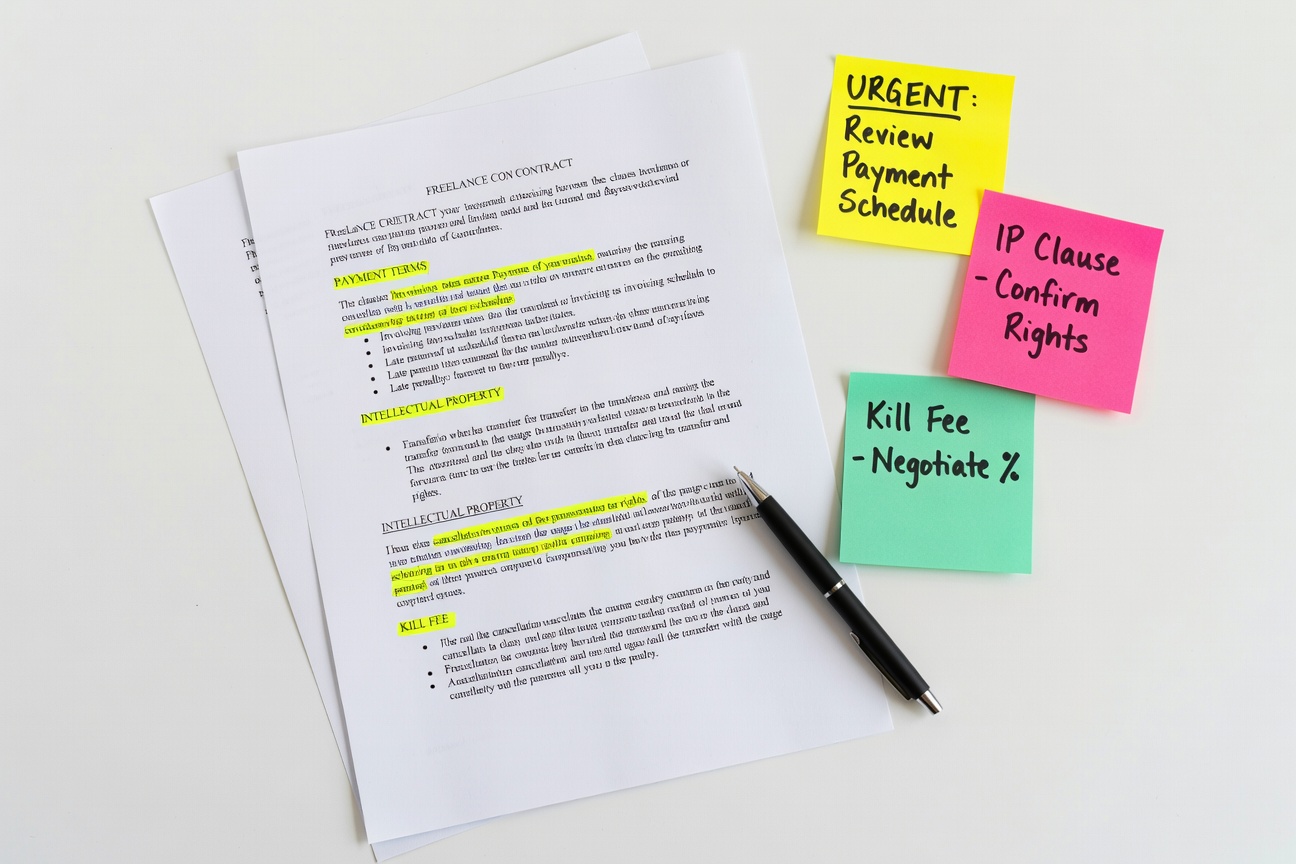
Payment terms are the financial core of any freelance contract. The most important elements: a deposit (25–50% of the total fee due before work begins), milestone payments for larger projects (tied to specific deliverables, not calendar dates), a final payment due upon delivery or approval, and a late payment fee for overdue invoices. Each of these serves a specific function in protecting your income.
Net payment terms deserve special attention. “Net 30” means the client has 30 days after invoice to pay. “Net 60” or “Net 90” — which large corporations often demand — means you’ve essentially extended them a 2–3 month interest-free loan on every project. For freelancers with cash flow constraints, this can be genuinely damaging. You’re entitled to negotiate these terms. “Due on receipt” or “Net 15” is standard for many freelance contexts and entirely reasonable to request. If a client insists on Net 60 or longer, factor that into your pricing — longer payment terms should mean higher fees to compensate for the time-value of money you’re extending. For broader context on managing irregular income including freelance earnings, our guide on quarterly estimated taxes for self-employed earners is essential reading.
Scope Creep: Defining What You’re Actually Selling
Scope creep — the gradual expansion of project requirements beyond the original agreement without corresponding increase in payment — is one of the most consistent income drains in creative work. It almost always happens in the absence of a clearly defined scope, and it almost always happens incrementally: one small request here, one extra revision there, until you’ve done 150% of the original project for 100% of the original fee.
The contract solution is precise scope definition: list exactly what deliverables are included, specify how many rounds of revisions are covered, and define explicitly what triggers a change order — a separate written agreement and additional payment for work outside the original scope. Your change order clause doesn’t need to be adversarial; it just needs to be clear. Something like: “Two rounds of revisions are included. Additional revisions are billed at [hourly rate]. Any changes to project scope require a written change order before additional work begins.” When a client asks for something outside scope, you simply reference the clause and issue a change order. The conversation becomes routine rather than confrontational.
Kill Fees: Getting Paid When Projects Die
A kill fee is a contractual provision guaranteeing partial payment when a client cancels a project after work has already begun. It’s one of the most financially important and most frequently omitted contract clauses in creative work. Projects get cancelled — budgets disappear, companies get acquired, priorities shift, clients change their minds. Without a kill fee, you do work, the project dies, and you receive nothing for the time and creative effort already invested.
Standard kill fee structures: a percentage of the total project fee based on how far along the work was when cancelled (25% if cancelled before first draft, 50% at first draft, 75% after revisions, 100% if cancelled after final delivery). Some contracts use a flat kill fee percentage (50% of total fee regardless of stage). The specific structure matters less than simply having one. When negotiating a kill fee clause, frame it to the client as mutual protection — it clarifies for both parties what happens if circumstances change, which is a professional framing that most clients accept readily. Resistance to a kill fee clause from a client is itself informative about how they approach financial commitments.
| Clause | What It Does | Without It |
|---|---|---|
| Payment Schedule | Defines deposit, milestone, and final payment amounts and due dates | Payment disputes; “net 90” creep; total non-payment |
| Late Payment Fee | Adds 1.5–2% monthly interest on overdue invoices | Clients have zero incentive to pay on time |
| Scope Definition | Precisely defines deliverables, revisions, and what triggers a change order | Unlimited unpaid revisions; scope creep |
| Kill Fee | Guarantees partial payment if client cancels after work has begun | Zero compensation for work completed on cancelled projects |
| IP Ownership | Specifies whether work is licensed or fully transferred (work for hire) | Ambiguous ownership; client assumes full transfer |
| Credit / Attribution | Ensures your name appears on published work for portfolio and reputation | Client can publish work without attribution |
| Dispute Resolution | Specifies how disagreements are resolved (mediation, arbitration, jurisdiction) | Expensive litigation in client’s preferred venue |
| Rule: If it’s not in the contract, it didn’t happen. Verbal agreements and email threads don’t have the same legal standing as a signed contract. | ||
Intellectual Property: Who Owns What You Create
Intellectual property ownership is where the financial stakes of contract terms extend far beyond the immediate project fee. Under U.S. copyright law, creative work is owned by its creator from the moment of creation — unless it qualifies as “work for hire” or is explicitly assigned to another party in a written agreement. This means that by default, when you create a logo, write copy, design a website, or photograph a product, you own the copyright and the client receives a license to use it.
Work for hire is the critical exception. Under the Copyright Act, work qualifies as work for hire in two scenarios: it’s created by an employee within the scope of employment, or it’s created by an independent contractor for specific uses (compilation, translation, certain audiovisual works, etc.) pursuant to a written work-for-hire agreement. If a client’s contract contains “work for hire” language, they’re claiming full copyright ownership — not just a license to use the work. You retain nothing: no right to include it in your portfolio without permission, no residual licensing income, no ability to reuse elements in future work.
The financial implications are significant. A work-for-hire arrangement should command a higher fee than a licensed arrangement, because you’re transferring significantly more value. Many freelancers sign work-for-hire contracts without understanding the distinction and effectively undersell themselves. Read the IP section of every contract carefully. If you’re licensing rather than transferring, specify the scope of the license — exclusive or non-exclusive, duration, territory, permitted uses. If you’re doing work for hire, price accordingly. The U.S. Copyright Office’s FAQ on work for hire explains the legal framework clearly.

⚡ Pro Tip
If you’ve delivered work and aren’t being paid, send a formal demand letter via certified mail — not just email — before escalating to small claims court or a collections attorney. The formality of a physical letter often produces payment when emails have been ignored. State the amount owed, the due date, and that you will pursue legal remedies if payment is not received within 14 days. Most non-payment situations resolve at this stage.
Non-Payment: Your Options When a Client Ghosts
Despite a strong contract, non-payment happens. Here’s the escalation ladder. First: send a polite follow-up email as soon as payment is one day late. Many late payments are administrative oversights. Second: if no response in a week, send a formal invoice reminder with the late fee calculation included. Third: if still unpaid at 30 days past due, send a formal demand letter via certified mail. This step alone resolves most non-payment situations — the physical letter signals you’re serious in a way emails don’t.
If the demand letter doesn’t produce payment: small claims court is the most accessible formal option for amounts typically up to $5,000–$10,000 (limits vary by state). Filing is inexpensive, no attorney required, and courts often rule quickly in favor of contractors with signed contracts and documented delivery. For larger amounts, a collections attorney or civil suit may be warranted — though the cost-benefit calculation depends on the amount owed. As a last resort, reporting non-payment to business credit bureaus can affect the client’s commercial credit. Freelancers who document their work thoroughly — project files, email confirmations, delivery receipts, signed contracts — are in a far stronger position in any of these scenarios. Managing your taxes on any recovered income is also important — see our guide on taxable windfalls and unexpected income reporting.
Building Your Contract System
The goal is a contract system that runs automatically: standard template you send to every new client, clear process for change orders, consistent invoicing with late fee language, and a documented follow-up procedure for overdue payments. You shouldn’t need to think hard about any of this for a typical project — it should be routine infrastructure.
Start with a base template — the Graphic Artists Guild, the Authors Guild, and various freelance organizations publish template contracts for their respective disciplines. Customize it to your work type and typical project structure, then have it reviewed once by a contracts attorney (a one-time cost of $200–$500 that pays for itself quickly). Tools like HelloSign, DocuSign, or Bonsai make getting contracts signed electronically fast and friction-free. The system takes a few hours to set up and then runs itself — protecting your income on every project automatically. For managing the financial side of freelance income including tax planning, our guide on rebuilding financial stability has applicable frameworks for anyone navigating irregular income.
References
- U.S. Copyright Office (2025). “Work for Hire FAQ.” copyright.gov
- SBA (2025). “Manage Business Finances.” sba.gov
- Bureau of Labor Statistics (2025). “Contingent and Alternative Employment Arrangements.” bls.gov
- Investopedia (2025). “Freelance Economy.” investopedia.com