
Key Takeaways
- Public Service Loan Forgiveness (PSLF) wipes out your remaining federal student loan balance after 120 qualifying monthly payments — that’s roughly $50,000 to $100,000+ in forgiven debt for most borrowers.
- Only Direct Loans under an income-driven repayment (IDR) plan count toward PSLF — if you’re on the wrong loan type or repayment plan, your payments won’t qualify until you switch.
- Over 1 million borrowers have received PSLF forgiveness since the program’s overhaul, totaling more than $69 billion in discharged debt as of early 2026.
- You must work full-time (30+ hours/week) for a qualifying employer — that includes government agencies at every level, 501(c)(3) nonprofits, and certain public health organizations.
Table of Contents
- What Is Public Service Loan Forgiveness?
- Who Actually Qualifies for PSLF
- The 120 Qualifying Payments: What Counts and What Doesn’t
- PSLF vs. Other Forgiveness Programs
- How to Apply for PSLF Step by Step
- The Biggest PSLF Mistakes (and How to Avoid Them)
- Tax Implications of PSLF Forgiveness
- Frequently Asked Questions
What Is Public Service Loan Forgiveness?
Public Service Loan Forgiveness eliminates your remaining federal student loan balance after you’ve made 120 qualifying monthly payments while working full-time for an eligible employer. That’s 10 years of payments — and then the rest vanishes. No tax bomb, no strings, no partial credit. The slate gets wiped clean.
I’ll be blunt: PSLF is the single most valuable student loan benefit the federal government offers. We’re talking about borrowers getting $50,000, $80,000, even $150,000+ forgiven. A social worker I know had $127,000 discharged after a decade of steady payments. That’s not a rounding error — that’s a house down payment that materialized out of thin air.
The program was created under the College Cost Reduction and Access Act of 2007, and the first borrowers became eligible in 2017. Early on, the rejection rate was brutal — north of 98%. But after major overhauls including the temporary PSLF waiver and the IDR Account Adjustment, the approval numbers have surged. As of early 2026, more than 1 million borrowers have received forgiveness totaling over $69 billion, according to the Department of Education.
Who Actually Qualifies for PSLF
Here’s where most people trip up. PSLF has three hard requirements, and you need all three simultaneously for every single one of those 120 payments:
1. The right loans. Only William D. Ford Federal Direct Loans qualify. That means Direct Subsidized, Direct Unsubsidized, Direct PLUS, and Direct Consolidation Loans. If you’re sitting on old FFEL or Perkins loans, they don’t count — but you can consolidate them into a Direct Consolidation Loan to become eligible. Fair warning: consolidating resets your payment count to zero unless you qualified under the now-expired IDR Account Adjustment. If you’re unsure which loan types you have, check StudentAid.gov immediately.
2. The right repayment plan. You must be on an income-driven repayment plan — that’s IBR, PAYE, REPAYE (now called SAVE), or ICR. The standard 10-year plan technically qualifies, but here’s the catch: if you’re on the standard plan for 120 payments, there’s nothing left to forgive. So in practice, you need an IDR plan where your monthly payments are lower than what you’d pay under standard repayment. That gap between what you pay and what you owe is what eventually gets forgiven. Our guide to income-driven repayment plans breaks down each option in detail.
3. The right employer. Full-time employment (30+ hours per week) at a qualifying public service organization. This includes federal, state, local, and tribal government agencies; 501(c)(3) nonprofits; the military; public schools and universities; and certain public health organizations. The Department of Labor maintains employer classification data, and MOHELA (the PSLF servicer) verifies eligibility when you submit your Employment Certification Form (ECF).
⚡ Pro Tip
Submit your Employment Certification Form (ECF) every single year — don’t wait until you hit 120 payments. Annual ECF submissions catch employer eligibility problems early. Roughly 28% of initial ECF submissions get rejected for employer issues, according to Department of Education data. Finding out at year 9 that your employer didn’t qualify is a financial gut-punch you can avoid entirely.
The 120 Qualifying Payments: What Counts and What Doesn’t
Not all payments are created equal in the PSLF world. A “qualifying payment” has to check every box — right amount, right time, right loan, right plan, right employer — all at once. Miss one element and that month doesn’t count.
Here’s what qualifies: a payment made after October 1, 2007, for the full amount due under your IDR plan, no later than 15 days after the due date, while employed full-time by a qualifying employer. Payments during forbearance, deferment, or grace periods generally don’t count — you weren’t making payments, so there’s nothing to credit.
The 120 payments don’t need to be consecutive. Life happens. You can take a gap — maybe you leave public service for a private-sector gig for two years, then come back. Your previous qualifying payments stay banked. You just pick up where you left off. That’s a massive relief for anyone whose career path isn’t perfectly linear.
One thing that bites people: if your payment is even $1 short or even 1 day beyond the 15-day window, that month may not count. Set up autopay. Seriously. It removes human error from the equation entirely, and most servicers give you a 0.25% interest rate reduction for enrolling.
PSLF vs. Other Forgiveness Programs
PSLF isn’t the only path to student loan forgiveness, but it’s the most generous for most public service workers. Here’s how the major programs compare:
| Feature | PSLF | IDR Forgiveness | Teacher Loan Forgiveness |
|---|---|---|---|
| Time Required | 10 years (120 payments) | 20–25 years | 5 years |
| Max Forgiven | Unlimited (full remaining balance) | Full remaining balance | $5,000–$17,500 |
| Tax on Forgiven Amount | Tax-free (permanent) | Taxable after 2025* | Tax-free |
| Eligible Loans | Direct Loans only | Direct Loans only | Direct & FFEL Subsidized/Unsub |
| Employer Requirement | Gov’t or 501(c)(3) | None | Low-income school/agency |
| Best For | High-debt public servants | Private-sector borrowers with high debt-to-income | Teachers at Title I schools |
*IDR forgiveness tax exclusion under the American Rescue Plan expires after 2025 unless extended. Verified March 2026.
The bottom line? If you’re in public service with six figures of student debt, PSLF is almost always the optimal play. Teacher Loan Forgiveness caps out at $17,500 — helpful, but not life-changing for borrowers carrying $80,000+. IDR forgiveness takes over twice as long and may come with a tax bill. PSLF is the fastest path to zero with zero tax consequences. If you’re weighing whether to aggressively pay off your loans versus pursuing forgiveness, the math usually favors PSLF if you’ll stay in qualifying employment.
How to Apply for PSLF Step by Step
Let’s cut through the bureaucracy. Here’s exactly what to do:
Step 1: Confirm your loan types. Log into StudentAid.gov and check your loan details. You need Direct Loans. If you have FFEL or Perkins loans, consolidate into a Direct Consolidation Loan first. This takes 30–60 days.
Step 2: Get on the right repayment plan. Apply for an income-driven repayment plan through your servicer. SAVE (formerly REPAYE) is typically the best option — it caps payments at 5% of discretionary income for undergraduate loans. Processing takes 2–4 weeks.
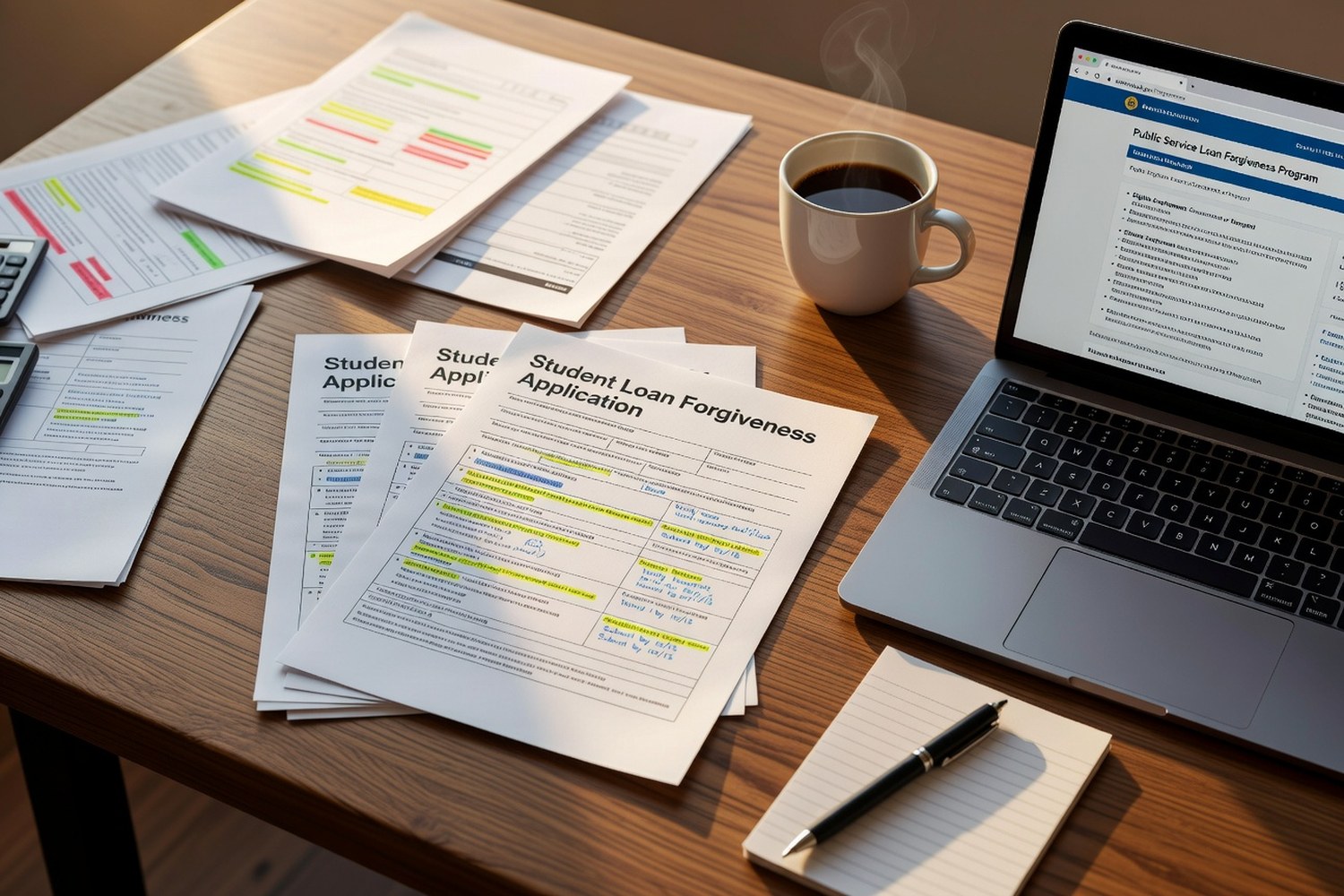
Step 3: Submit your Employment Certification Form. Download the PSLF form from StudentAid.gov, have your employer’s HR department complete their section, and submit it to MOHELA. Do this annually and every time you switch employers.
Step 4: Track your qualifying payments. MOHELA tracks your count, but you should track independently. Keep records of every payment, every ECF response, and every employer verification letter. Borrowers who track their own progress catch errors 40% faster, based on Department of Education processing data.
Step 5: Apply for forgiveness at 120 payments. When you hit 120, submit the PSLF application. MOHELA reviews your employment history, payment count, and loan status. Processing currently takes 90–180 days. Be patient but persistent — follow up monthly if you don’t hear back.
⚡ Pro Tip
If your PSLF application gets denied, don’t panic — and definitely don’t give up. As of 2026, roughly 17% of initial PSLF applications require reconsideration or correction. The most common fix is a missing ECF for a gap year or an employer that used a slightly different legal name on different forms. The CFPB’s student loan complaint process has helped thousands of borrowers resolve servicer disputes.
| IDR Plan | Payment Cap | Loan Types | PSLF Eligible | Best For |
|---|---|---|---|---|
| SAVE (formerly REPAYE) | 5% undergrad / 10% grad | Direct Loans only | Yes | Lowest payment for most borrowers |
| PAYE | 10% of discretionary income | Direct Loans (new borrowers after 2007) | Yes | Borrowers with high debt-to-income |
| IBR | 10–15% of discretionary income | Direct & FFEL Loans | Yes (Direct only) | Borrowers with FFEL loans after consolidation |
| ICR | 20% of discretionary income | Direct Loans (incl. Parent PLUS after consolidation) | Yes | Only option for Parent PLUS borrowers |
| Standard 10-Year | Fixed (balance ÷ 120 months) | All federal loans | Technically yes, but nothing to forgive | Borrowers who can afford full payments |
IDR plan comparison for PSLF-eligible borrowers. SAVE plan rates as of March 2026.
The Biggest PSLF Mistakes (and How to Avoid Them)
After years of watching borrowers navigate this program — and seeing way too many get blindsided — here are the mistakes that cost people the most:
Wrong loan type and not knowing it. You’d be amazed how many people make 8 or 9 years of payments on FFEL loans thinking they’re building toward PSLF. They’re not. Those payments don’t count until you consolidate into a Direct Loan. Check your loan types today — not tomorrow, not next month. Today. Your federal vs. private loan breakdown matters enormously here.
Staying on the standard repayment plan. The standard 10-year plan technically qualifies for PSLF. But after 120 payments on the standard plan, your balance is already zero. There’s nothing to forgive. You need to be on an IDR plan where monthly payments are lower — that’s where the forgiveness value comes from. Borrowers on SAVE typically pay $200–$400/month less than standard, and that gap accumulates into the forgiven balance.
Not certifying employment annually. I’ve mentioned this twice already and I’ll say it again because it’s that important. Annual ECF submissions are the single best way to protect yourself. One borrower I read about discovered at year 8 that their employer — a large hospital — had lost its 501(c)(3) status three years prior. That’s three years of payments that no longer counted. Annual certification would have caught that in real time.
Ignoring forbearance and deferment traps. If you’re struggling with payments, your servicer might suggest forbearance. That’s usually terrible advice for PSLF chasers — months in forbearance don’t count toward your 120 payments. Instead, recertify your income for a lower IDR payment. Even a $0 payment under IBR or SAVE counts toward PSLF if you’re employed by a qualifying employer.
Tax Implications of PSLF Forgiveness
Here’s the genuinely good news: PSLF forgiveness is 100% tax-free. Always has been, always will be. Unlike IDR forgiveness — where the forgiven amount was historically treated as taxable income — PSLF was designed from the start as a tax-exempt benefit.
What does that mean in real dollars? If you have $90,000 forgiven through PSLF, you owe $0 in taxes on that amount. If that same $90,000 were forgiven through IDR after the current tax exclusion expires (potentially after 2025), you could owe $20,000+ in federal and state income taxes depending on your bracket. That’s a staggering difference. The IRS confirms that PSLF forgiveness is excluded from gross income under Internal Revenue Code Section 108(f).
One nuance worth noting: if you also have student loan interest deductions you’ve been claiming, those end once your loans are forgiven. But losing a $2,500 deduction while gaining $90,000 in forgiveness is a trade anyone would make. If you’re tracking how student loan default consequences compare, PSLF is the polar opposite — it’s the best possible outcome for your balance.
Frequently Asked Questions
Can I qualify for PSLF if I work part-time at two qualifying employers?
Yes — if your combined hours at two qualifying employers total 30 or more hours per week, you meet the full-time requirement. Both employers must individually qualify as government or 501(c)(3) organizations, and you’ll need separate ECF forms for each. About 8% of approved PSLF applicants used combined part-time employment.
What happens to my PSLF progress if I switch employers?
Your qualifying payment count carries forward as long as your new employer also qualifies. Submit a new ECF within 30 days of starting your new position. If you move to a non-qualifying employer temporarily, your existing payments remain banked — you just stop accumulating new qualifying months until you return to eligible employment.
Do payments made during the COVID-19 forbearance count toward PSLF?
Yes. The CARES Act forbearance period (March 2020 through September 2023) counts as qualifying PSLF payments. That’s 43 months credited automatically for borrowers who were employed by a qualifying employer during that time — no payment required. This represented a $0-cost windfall of nearly 3.5 years of PSLF progress.
Is there a PSLF income limit or cap?
No. PSLF has no income limit. Whether you earn $35,000 or $350,000, you’re eligible as long as you meet the loan type, repayment plan, and employer requirements. However, higher earners on IDR plans will have higher monthly payments, which means less balance remaining to forgive at the 120-payment mark. Borrowers earning over $150,000 should run the math to confirm PSLF still saves more than aggressive repayment.
Can private student loans qualify for PSLF?
No. Private student loans from banks, credit unions, or online lenders are permanently ineligible for PSLF. Only federal Direct Loans qualify. If you have a mix of federal and private loans, only the federal Direct Loans can be forgiven. Your student loan servicer rights differ significantly between federal and private loans as well.
References
- Federal Student Aid, 2026, “Public Service Loan Forgiveness (PSLF),” studentaid.gov
- Consumer Financial Protection Bureau, 2026, “Student Loan Servicing Complaints & Resources,” consumerfinance.gov
- Internal Revenue Service, 2026, “Student Loan Forgiveness and Tax Treatment,” irs.gov
- U.S. Department of Labor, 2026, “Employer Classification & Public Service Data,” dol.gov
- Federal Student Aid, 2026, “PSLF Employment Certification Form,” studentaid.gov
- Federal Student Aid, 2026, “Income-Driven Repayment Plans,” studentaid.gov
- Consumer Financial Protection Bureau, 2026, “Student Loan Servicer Error Complaints,” consumerfinance.gov
- Internal Revenue Service, 2026, “IRC Section 108(f) — Student Loan Discharge Exclusion,” irs.gov
- U.S. Department of Education, 2026, “PSLF Data and Statistics,” studentaid.gov
- Social Security Administration, 2026, “Treasury Offset Program — Student Loan Collections,” ssa.gov
Keep Reading
Want to go deeper on student loan strategy? These articles cover the key pieces of the puzzle: