
Key Takeaways
- Direct PLUS Loans carry the highest federal rate at 9.08% for 2025–2026 plus a 4.228% origination fee — making a $30,000 PLUS loan cost $16,860 more in interest than the same amount in Direct Subsidized loans over 10 years.
- Parent PLUS has no annual cap beyond cost of attendance minus other aid — the average balance is $28,778, up 48% in a decade. Overborrowing is the #1 risk with PLUS loans.
- PLUS requires a credit check, but the standard is lenient: only “adverse credit history” (90-day delinquency, default, bankruptcy within 5 years) triggers denial. About 89% of applicants are approved.
- Parent PLUS debt cannot be transferred to the student and the only income-driven option is ICR (20% of discretionary income) after consolidation — far less generous than SAVE’s 5% cap on regular Direct Loans.
Table of Contents
- What Is a Direct PLUS Loan and Who Is It For?
- Parent PLUS vs. Grad PLUS: The Critical Differences
- The PLUS Loan Credit Check: What Triggers Denial
- How to Apply for a PLUS Loan Step by Step
- The True Cost of PLUS Loans vs. Other Federal Options
- Repayment Options and the ICR Workaround
- Smarter Alternatives to PLUS Loans
- Frequently Asked Questions
What Is a Direct PLUS Loan and Who Is It For?
A Direct PLUS Loan covers the gap between what other financial aid provides and what college actually costs — and at 9.08% fixed APR with a 4.228% origination fee, it’s the most expensive way to borrow federal money. On a $30,000 PLUS loan over 10 years, you’ll pay $14,490 in interest alone. That same $30,000 in Direct Subsidized loans at 6.53% costs $10,959 in interest — a $3,531 difference for the identical principal amount.
PLUS loans serve two groups: parents borrowing on behalf of dependent undergrads (Parent PLUS) and graduate or professional students borrowing for their own education (Grad PLUS). According to Federal Student Aid data, the average Parent PLUS balance is $28,778 — up 48% over the past decade. The average Grad PLUS balance is even higher at $82,000+ for medical and law students.
I want to be direct about something: PLUS loans should be your last federal option. Not your first, not your default — your last. They exist to fill the remaining gap after you’ve maxed out subsidized loans, unsubsidized loans, grants, scholarships, and work-study. Our complete guide to Direct Loans covers the cheaper options you should exhaust before touching PLUS.
Parent PLUS vs. Grad PLUS: The Critical Differences
Same name, same rate, very different consequences. Understanding which one you’re dealing with prevents expensive mistakes.
| Feature | Parent PLUS | Grad PLUS |
|---|---|---|
| Borrower | Biological or adoptive parent | Graduate/professional student |
| Whose credit report | Parent’s — permanently | Student’s |
| Transferable to student? | No — never | N/A (already student’s) |
| IDR plans available | Only ICR (20%) after consolidation | SAVE, IBR, PAYE, ICR |
| PSLF eligible | Only after consolidation + ICR | Yes (all IDR plans) |
| Average balance | $28,778 | $82,000+ (med/law) |
Parent PLUS vs. Grad PLUS comparison. Source: Federal Student Aid. Verified March 2026.
The biggest trap with Parent PLUS: the debt is the parent’s. Permanently. If your child promises to make the payments and doesn’t — or can’t — you’re on the hook. Your credit takes the hit. Your wages can be garnished. Your Social Security can be offset. And unlike your child’s Direct Loans, you can’t access the generous SAVE plan (5% of discretionary income). Your only IDR option is ICR at 20% — four times higher as a percentage. Think very carefully before signing. Understanding what’s actually in that financial aid package helps you see whether PLUS is truly necessary.
The PLUS Loan Credit Check: What Triggers Denial
PLUS is the only federal student loan that requires a credit check — but the standard is far more lenient than what banks or credit card companies use. The Department of Education doesn’t look at your FICO score, credit utilization, or debt-to-income ratio. They only check for “adverse credit history,” which means:
Current delinquency of 90+ days on any debt. Defaulted on any federal loan in the past 5 years. Bankruptcy discharge, foreclosure, or tax lien in the past 5 years. That’s it. About 89% of Parent PLUS applicants are approved, according to Federal Student Aid. You can have a 580 FICO score with $40,000 in credit card debt and still get approved — as long as nothing is 90 days late and you haven’t defaulted or filed bankruptcy recently.
If you are denied, you have two appeal options. First: get an endorser (essentially a cosigner) who doesn’t have adverse credit history. Second: document “extenuating circumstances” — the denial was caused by a one-time event like a medical emergency or job loss, and you’ve since recovered. About 15% of denied applicants successfully appeal. If the parent is denied and doesn’t appeal, the student becomes eligible for additional unsubsidized Direct Loans ($4,000–$5,000 extra per year), which carry the lower 6.53% rate.
⚡ Pro Tip
If a parent has adverse credit history, getting denied for a PLUS loan is actually a strategic advantage in some cases. The denial unlocks an additional $4,000–$5,000/year in unsubsidized Direct Loans for the student at 6.53% instead of the parent borrowing at 9.08%. On $20,000 borrowed over 4 years, the rate difference saves $4,400 in interest. Some financial aid advisors quietly recommend that parents with borderline credit apply for PLUS knowing they’ll be denied — specifically to unlock the student’s higher unsubsidized limits.
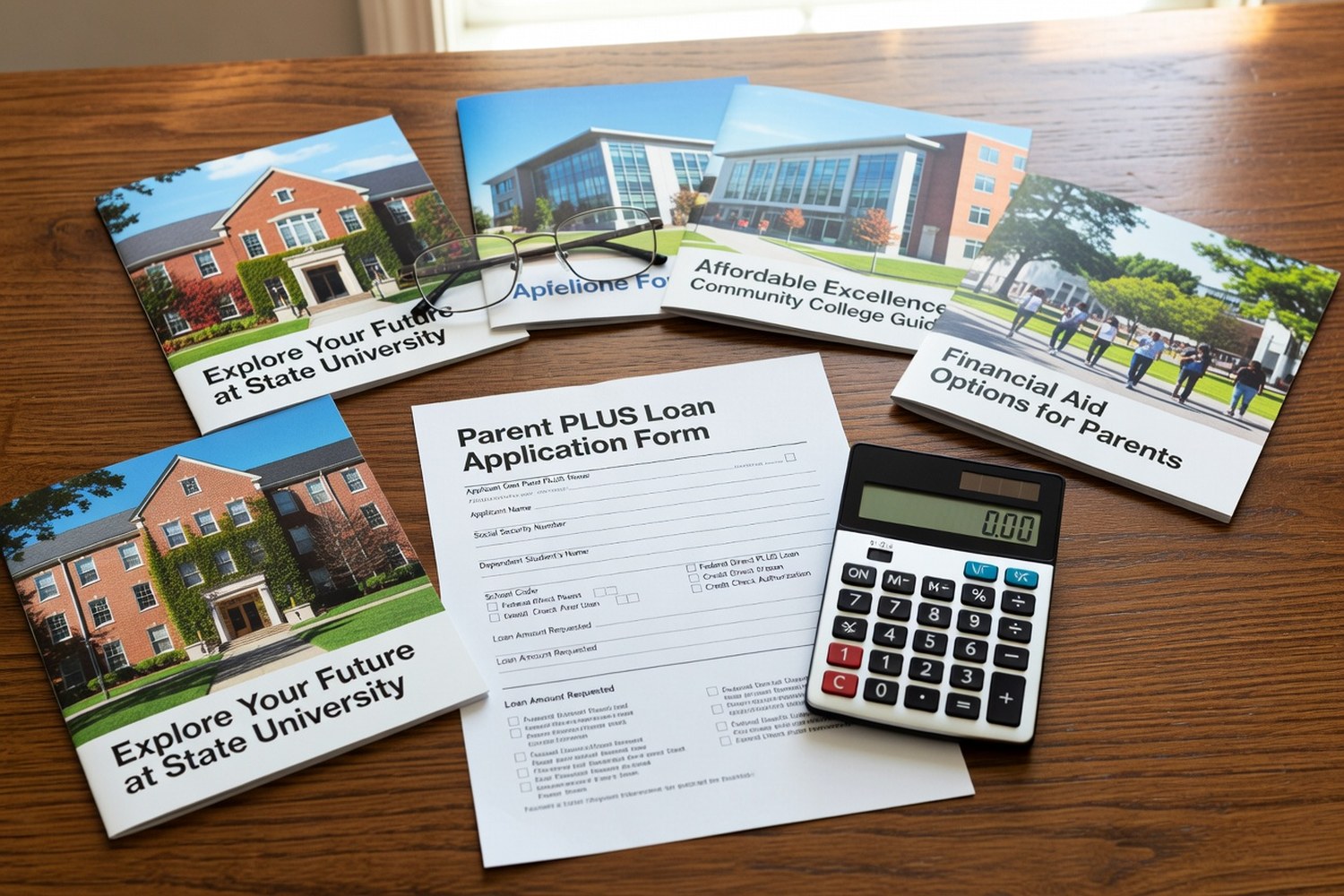
How to Apply for a PLUS Loan Step by Step
The PLUS application process is separate from the regular Direct Loan process — you don’t get PLUS automatically from the FAFSA.
Step 1: File the FAFSA first. Both Parent PLUS and Grad PLUS require a completed FAFSA. The student must be enrolled at least half-time. Our FAFSA guide covers every step.
Step 2: Apply on StudentAid.gov. Log in with the borrower’s FSA ID (the parent’s for Parent PLUS, the student’s for Grad PLUS). Select “Apply for a Direct PLUS Loan.” Choose the school and loan period. The credit check runs immediately — results in 1–3 minutes.
Step 3: Sign the Master Promissory Note. If approved, sign the PLUS MPN on StudentAid.gov. This is separate from the regular Direct Loan MPN. It covers all PLUS loans at one school for up to 10 years.
Step 4: School certifies and disburses. Your school confirms enrollment and cost of attendance, then disburses the funds. Timing: typically 1–2 weeks after the loan period begins. The 4.228% origination fee is deducted from each disbursement — on a $10,000 PLUS loan, you receive $9,577.20. Budget for the difference.
The True Cost of PLUS Loans vs. Other Federal Options
Let me lay out the numbers so the cost difference is impossible to ignore.
| Loan Type | Rate (2025–26) | Origination Fee | Monthly on $30K/10yr | Total Interest | Total Cost |
|---|---|---|---|---|---|
| Direct Subsidized | 6.53% | 1.057% | $341 | $10,959 | $40,959 |
| Direct Unsubsidized | 6.53% (UG) / 8.08% (Grad) | 1.057% | $341–$365 | $10,959–$13,825 | $40,959–$43,825 |
| Direct PLUS | 9.08% | 4.228% | $381 | $14,490 | $44,490 |
| PLUS vs. Subsidized difference | +2.55% | +3.171% | +$40/month | +$3,531 | +$3,531 |
Federal loan cost comparison on $30,000 over 10-year standard repayment. Source: Federal Student Aid. Rates as of March 2026.
That $3,531 gap is just on $30,000. Parents who borrow $60,000 in PLUS for a 4-year degree are paying $7,000+ more in interest than the same amount in regular Direct Loans would cost. And remember — that interest compounds on a balance the parent can never transfer to the child. Understanding true college costs before borrowing helps you determine whether PLUS is genuinely necessary or whether choosing a less expensive school avoids the need entirely.
Repayment Options and the ICR Workaround
Here’s where Parent PLUS borrowers get the worst deal in federal lending. Regular Direct Loan borrowers can access SAVE (5% of discretionary income), IBR (10–15%), and PAYE (10%). Parent PLUS borrowers? Their only income-driven option is ICR — Income-Contingent Repayment — at 20% of discretionary income. That’s 2–4x higher than what regular borrowers pay under IDR.
And you can’t even access ICR directly with a PLUS loan. You must first consolidate your Parent PLUS into a Direct Consolidation Loan. Then — and only then — can you enroll in ICR. The consolidation doesn’t change your rate (it becomes the weighted average rounded up), but it does reset any progress toward PSLF or forgiveness timelines. For parents in public service, that reset can be devastating if not planned carefully.
For Grad PLUS borrowers, the picture is much better. Because Grad PLUS is in the student’s name, it’s eligible for all IDR plans including SAVE. Grad students in public service can pursue PSLF with full access to the 5–10% income caps. Our IDR plan comparison helps you choose the right plan for your specific situation.
⚡ Pro Tip
Parents in government or nonprofit jobs: consolidate your Parent PLUS into a Direct Consolidation Loan and enroll in ICR immediately. Even though ICR payments at 20% are higher than SAVE’s 5%, they still qualify for PSLF after 120 payments. On a $50,000 Parent PLUS balance, PSLF forgiveness after 10 years of ICR payments could erase $25,000–$40,000 in remaining balance — tax-free. The Loan Simulator shows your exact forgiveness projection. Start ICR counting now even if your payments are high — every month counts toward 120.

Smarter Alternatives to PLUS Loans
Before signing a PLUS MPN, seriously evaluate these alternatives that could save your family $5,000 to $30,000 over the repayment period:
Let the student borrow more in their own name. If a parent is denied PLUS (or intentionally doesn’t apply), the student gets access to additional unsubsidized Direct Loans: $4,000–$5,000 extra per year at 6.53% instead of the parent’s 9.08%. On $20,000 total, the student’s lower rate saves $4,400 in interest. Yes, the student carries the debt — but they also get access to SAVE, PSLF, and all forgiveness programs. The parent doesn’t.
Private loans with a cosigner. For parents with 750+ credit scores, private lenders offer fixed rates of 5–7% — 2–4% below PLUS. On $30,000, that’s $2,100–$4,800 in interest savings. The trade-off: private loans have no IDR, no PSLF, and limited forbearance. This only makes sense if the family plans aggressive repayment within 7–10 years. Our federal vs. private comparison covers the full trade-off.
Choose a less expensive school. The blunt option nobody wants to hear. If the gap between financial aid and cost is $15,000+/year requiring PLUS loans, an equally good school at $8,000/year less eliminates the need entirely. Our in-state vs. out-of-state analysis shows how school choice drives total debt more than any other factor.
Home equity line of credit (HELOC). Homeowner parents may access rates of 7–9% through a HELOC — comparable to PLUS but with tax-deductible interest (up to $100,000 of home equity debt interest is deductible). This requires sufficient home equity and discipline to repay. It’s not for everyone, but for asset-rich, cash-poor families, it’s worth the conversation with your tax advisor.
Frequently Asked Questions
What credit score do I need for a Parent PLUS loan?
There’s no minimum FICO score requirement. The Department of Education checks only for “adverse credit history”: 90-day delinquency on any debt, federal loan default, bankruptcy discharge, or foreclosure within the past 5 years. About 89% of applicants are approved. You can have a 550 FICO score and still qualify if nothing meets the adverse criteria.
Can I transfer my Parent PLUS loan to my child?
No. Parent PLUS debt is legally the parent’s obligation and cannot be transferred to the student under any circumstances. The loan stays on the parent’s credit report permanently. Any agreement between parent and child for the student to make payments is informal and unenforceable — if the child stops paying, the parent is fully liable.
Is there a limit on how much I can borrow with PLUS loans?
The only limit is the student’s cost of attendance minus other financial aid received. There’s no annual or lifetime dollar cap. On a $65,000 per year cost of attendance with $20,000 in other aid, you can borrow $45,000 in PLUS per year — $180,000 over four years. This lack of a cap is the primary overborrowing risk with PLUS loans.
Can Parent PLUS loans be forgiven?
Yes, but the path is limited. Parent PLUS must be consolidated into a Direct Consolidation Loan, then enrolled in ICR (20% of discretionary income). After 25 years of ICR payments, the remaining balance is forgiven (potentially taxable). Parents in public service can pursue PSLF after 120 ICR payments for tax-free forgiveness. Total and Permanent Disability discharge also applies to Parent PLUS.
Should I take a Parent PLUS loan or cosign a private student loan?
If your credit score is above 750 and you plan to repay within 7 to 10 years, private loans at 5 to 7% save $2,100 to $4,800 on $30,000 versus PLUS at 9.08%. If you might need IDR or PSLF, PLUS is safer despite the higher rate because it retains federal protections. If your credit is below 700, PLUS is likely your only option since private lenders require strong credit for competitive rates.
References
- Federal Student Aid, 2026, “Direct PLUS Loans for Parents,” studentaid.gov
- Federal Student Aid, 2026, “PLUS Loan Credit Check Requirements,” studentaid.gov
- Federal Student Aid, 2026, “Federal Student Loan Portfolio Data,” studentaid.gov
- Federal Student Aid, 2026, “Income-Contingent Repayment Plan,” studentaid.gov
- Federal Student Aid, 2026, “PLUS Loan Interest Rates and Fees,” studentaid.gov
- Consumer Financial Protection Bureau, 2026, “Parent PLUS Loan Risks,” consumerfinance.gov
- Federal Student Aid, 2026, “Direct Consolidation Loans,” studentaid.gov
- Federal Student Aid, 2026, “Loan Simulator — PLUS Repayment Projections,” studentaid.gov
- Internal Revenue Service, 2026, “Student Loan Interest Deduction,” irs.gov
- Consumer Financial Protection Bureau, 2026, “Student Loan Complaint Portal,” consumerfinance.gov
Keep Reading
More on federal student loans and college financing: