
Quick Answer
For the 2024 tax year (filed in 2025), the standard deduction is $14,600 for single filers and $29,200 for married couples filing jointly. Most taxpayers benefit from taking the standard deduction. Itemizing saves more only when your deductible expenses — mortgage interest, state taxes, charitable gifts — exceed those thresholds. As of July 2025, roughly 90% of filers choose the standard deduction.
The choice between standard deduction vs itemizing is one of the most consequential decisions on your federal tax return. The IRS sets the standard deduction amount each year, and for 2024 it sits at $14,600 for single filers — a figure that makes itemizing worthwhile only for taxpayers with unusually large deductible expenses. Understanding which path lowers your taxable income more directly reduces how much you owe.
The Tax Cuts and Jobs Act of 2017 nearly doubled the standard deduction, permanently shifting the math for most American households. This guide breaks down how each method works, who benefits from itemizing, and exactly how to calculate which option saves you more money on your 2024 return.
Key Takeaways
- The 2024 standard deduction is $14,600 for single filers and $29,200 for married couples filing jointly, per IRS inflation adjustment guidance.
- Approximately 90% of U.S. taxpayers now take the standard deduction, according to Tax Policy Center research on itemization rates post-TCJA.
- The State and Local Tax (SALT) deduction cap of $10,000 — introduced by the Tax Cuts and Jobs Act — limits a major itemizable expense for high-tax-state residents, as confirmed by IRS TCJA summaries.
- Itemizers can deduct mortgage interest on up to $750,000 of qualified loan debt, down from $1 million before 2018, per IRS Publication 936.
- The 2025 standard deduction rises to $15,000 for single filers and $30,000 for married filing jointly, per IRS 2025 inflation adjustments.
In This Guide
- What Is the Standard Deduction and How Does It Work?
- What Does It Mean to Itemize Deductions?
- Standard Deduction vs Itemizing: How Do the Numbers Compare?
- Who Should Actually Consider Itemizing?
- How Did the Tax Cuts and Jobs Act Change This Decision?
- How Do You Decide Which Method to Use?
- Frequently Asked Questions
What Is the Standard Deduction and How Does It Work?
The standard deduction is a flat dollar amount that reduces your taxable income without requiring you to track or document individual expenses. You simply claim it on your return and your taxable income drops by the full amount. No receipts, no schedules, no calculation — it is the simplest path available to most filers.
The IRS adjusts the standard deduction annually for inflation. For the 2024 tax year, the amounts are $14,600 (single), $29,200 (married filing jointly), and $21,900 (head of household). These figures apply to the return you file by April 2025.
Additional Standard Deduction for Age and Blindness
Taxpayers aged 65 or older, or those who are legally blind, qualify for an additional standard deduction on top of the base amount. For 2024, that bonus is $1,550 per qualifying condition for married filers and $1,950 for single or head-of-household filers, per IRS Publication 501 on filing status and deductions.
This addition can meaningfully increase the threshold itemizers need to clear. A married couple both aged 65 or older, for example, gets a combined standard deduction of $32,300 — a very high bar to beat through itemizing.
Before the Tax Cuts and Jobs Act took effect in 2018, only about 30% of taxpayers took the standard deduction. Today that number has flipped to roughly 90%, representing the largest single shift in how Americans file their taxes in decades.
What Does It Mean to Itemize Deductions?
Itemizing means listing your individual deductible expenses on Schedule A of Form 1040 and deducting their total instead of the standard amount. You choose itemizing only when your qualifying expenses add up to more than your standard deduction — otherwise you are voluntarily paying higher taxes.
The major categories of itemizable deductions include mortgage interest, state and local taxes, charitable contributions, and qualifying medical expenses. Each category has its own rules and limitations, and the IRS requires documentation for all of them.
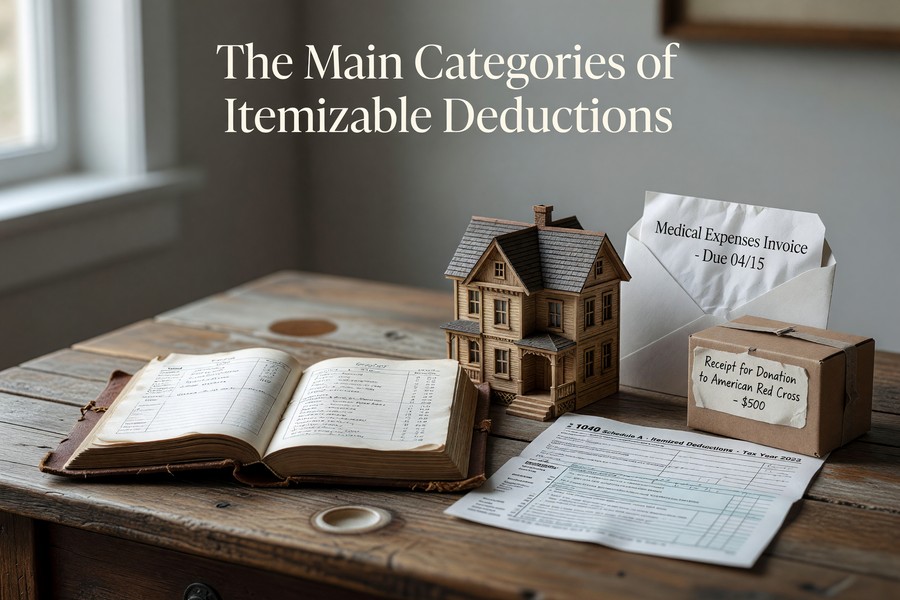
The Main Categories of Itemizable Deductions
Mortgage interest is typically the largest driver of itemizing. Homeowners can deduct interest paid on up to $750,000 of acquisition debt on a primary or secondary home. For loans originated before December 16, 2017, the old $1 million limit still applies, per IRS Publication 936 on home mortgage interest.
State and local taxes (SALT) — including property taxes and either state income tax or sales tax — are deductible up to a combined $10,000 cap. Charitable contributions to qualifying 501(c)(3) organizations are deductible, generally up to 60% of your adjusted gross income. Medical expenses exceeding 7.5% of your adjusted gross income can also be deducted.
Standard Deduction vs Itemizing: How Do the Numbers Compare?
The most direct way to evaluate standard deduction vs itemizing is to calculate your total itemizable expenses and compare them to your standard deduction amount. If your itemized total falls short, take the standard deduction — it is always the higher value by default in that scenario.
The table below illustrates how the math works across common filer situations for the 2024 tax year.
| Filing Status | 2024 Standard Deduction | Itemizing Makes Sense If Expenses Exceed |
|---|---|---|
| Single | $14,600 | $14,601 |
| Married Filing Jointly | $29,200 | $29,201 |
| Head of Household | $21,900 | $21,901 |
| Married Filing Separately | $14,600 | $14,601 |
| Single, Age 65+ | $16,550 | $16,551 |
| MFJ, Both Age 65+ | $32,300 | $32,301 |
The dollar difference between your itemized total and your standard deduction is what actually reduces your tax bill. If you are in the 22% bracket and itemize $5,000 more than your standard deduction, you save $1,100 in additional federal tax — a meaningful but not automatic win.
According to Tax Policy Center analysis, only about 10% of U.S. tax filers now itemize deductions — down from roughly 30% before the Tax Cuts and Jobs Act doubled the standard deduction in 2018.
Who Should Actually Consider Itemizing?
You should consider itemizing if your total qualifying expenses reliably exceed your standard deduction. In practice, this typically applies to high-income homeowners in high-tax states, taxpayers with large charitable giving histories, or those who faced significant medical costs during the year.
For most renters, young filers, and middle-income households, the standard deduction wins by a wide margin. There is no benefit to itemizing unless your Schedule A total is demonstrably higher.
Profiles That Frequently Benefit from Itemizing
A homeowner with a $600,000 mortgage at 7% interest pays roughly $42,000 in interest in year one — far exceeding any standard deduction threshold. Adding $10,000 in SALT and $5,000 in charitable gifts pushes their itemized total to $57,000, producing a massive advantage over the $29,200 standard deduction for a married couple.
High earners in states like California, New York, or New Jersey face top state income tax rates above 9%. Even capped at $10,000 for SALT, those filers often have enough combined deductions to justify Schedule A. If you are unsure whether itemizing applies to you, reviewing your prior-year tax return is a useful first step — and understanding how broader tax decisions affect your overall financial picture can help you think about smart ways to reduce everyday financial drag as well.
“The standard deduction is one of the most underappreciated simplifications in the tax code. For the vast majority of filers, it delivers a larger deduction with zero documentation burden. Itemizing requires precision — if you are not tracking your mortgage interest, property taxes, and charitable receipts throughout the year, you may miss deductions or make errors that trigger scrutiny.”
How Did the Tax Cuts and Jobs Act Change This Decision?
The Tax Cuts and Jobs Act (TCJA) of 2017 fundamentally restructured the standard deduction vs itemizing calculation for most Americans. It nearly doubled the standard deduction, capped the SALT deduction at $10,000, and eliminated several previously popular itemized deductions entirely — including unreimbursed employee expenses and tax preparation fees.
Those changes took effect for the 2018 tax year and are currently set to expire after 2025. Congress is actively debating whether to extend TCJA provisions, and any changes could shift the calculus again for millions of filers. Staying current on tax law changes is part of sound personal financial planning, much like tracking how economic indicators affect your broader investment decisions.
What the TCJA Eliminated from Schedule A
Before 2018, taxpayers could deduct miscellaneous expenses exceeding 2% of their AGI, including unreimbursed work costs, union dues, and investment advisory fees. The TCJA eliminated this category entirely for tax years 2018 through 2025, per IRS TCJA guidance.
The home equity loan interest deduction was also narrowed. Interest on home equity loans is now deductible only if the funds were used to buy, build, or substantially improve the home — not for paying off credit cards or financing other purchases. These changes reduced itemizing’s attractiveness for middle-class filers who previously benefited from multiple smaller deductions.
The TCJA’s individual provisions — including the higher standard deduction — are scheduled to sunset after December 31, 2025. If Congress does not act, the standard deduction will revert to pre-2018 levels (adjusted for inflation), potentially making itemizing relevant again for millions of filers who currently do not consider it.
How Do You Decide Which Method to Use?
The decision between standard deduction vs itemizing comes down to a single comparison: add up your qualifying expenses on Schedule A, then compare that total to your standard deduction. Whichever is larger reduces your taxable income more — and that is the one you take.
Start by gathering four documents: your mortgage interest statement (Form 1098), your property tax records, your state income tax withholding summary, and your charitable donation receipts. These four sources cover the majority of itemizable expenses for most households.
A Practical Three-Step Process
First, total your potential itemized deductions. Use the actual numbers from your documents — do not estimate. Second, compare that total to your filing-status standard deduction. Third, choose the higher number and file accordingly. If the totals are within $1,000 of each other, factor in the time cost of completing Schedule A versus taking the standard deduction automatically.
Tax preparation software from providers like TurboTax, H&R Block, and FreeTaxUSA typically calculates both options and recommends the better one automatically. The IRS Free File program offers no-cost guided preparation for eligible filers, which includes this automatic comparison. Understanding how these decisions compound over time connects directly to broader concepts like how compounding works in your favor when you consistently optimize your tax position year after year.
One final note: if you are married filing separately, both spouses must use the same method. If one spouse itemizes, the other must itemize too — even if their itemized total is lower than their standard deduction. This rule can significantly disadvantage some couples, per IRS Publication 17.

Consider bunching deductions — concentrating two years of charitable gifts or elective medical procedures into one tax year to push your Schedule A total above the standard deduction threshold. Then take the standard deduction the following year. This strategy can produce a larger combined deduction over a two-year period than spreading expenses evenly each year.
The standard deduction vs itemizing question also intersects with other financial decisions. For example, understanding how tax liens work — something covered in our guide on tax liens and what happens when you owe the IRS — underscores why optimizing your deduction strategy before a tax problem arises is so valuable. And if you have significant student debt, your tax filing approach can affect income-driven repayment calculations, which is worth reading about alongside our analysis of why millions of borrowers are unprepared for student loan obligations.
Frequently Asked Questions
Can I switch between the standard deduction and itemizing each year?
Yes. You can choose whichever method reduces your tax bill the most on each year’s return. There is no requirement to use the same method in consecutive years. Your choice is made independently each filing season based on that year’s expenses and deduction limits.
What happens if my itemized deductions are only slightly higher than the standard deduction?
If the difference is small — say, a few hundred dollars — you should factor in the time and potential cost of completing Schedule A. For most filers, the simplicity of the standard deduction is worth a minor dollar difference. Only itemize if the tax savings clearly justify the added complexity.
Is the mortgage interest deduction still worth it?
It depends on your loan balance and interest rate. Mortgage interest is deductible on loans up to $750,000, and for new homeowners with large balances, it remains the primary reason to itemize. However, as your loan balance decreases over time and you pay less interest, the deduction shrinks — making the standard deduction more competitive in later years.
Do both spouses have to itemize if filing separately?
Yes. IRS rules require that both spouses use the same deduction method when filing separately. If one spouse itemizes, the other cannot take the standard deduction — they must also itemize, even if their itemized amount is lower. This is a critical rule to check before choosing married-filing-separately status.
Does the standard deduction apply to state taxes too?
Not necessarily. Each state sets its own deduction rules. Some states conform closely to federal law, while others have entirely different standard deduction amounts or allow itemizing independently of your federal choice. Check your specific state’s Department of Revenue guidance for accurate figures.
What is the standard deduction for 2025?
For the 2025 tax year (filed in April 2026), the standard deduction is $15,000 for single filers and $30,000 for married couples filing jointly, per IRS 2025 inflation adjustments. These figures are higher than 2024 due to annual cost-of-living adjustments.
Can self-employed people take the standard deduction?
Yes. Self-employed individuals can take the standard deduction on their personal return just like any other filer. However, business expenses are deducted separately on Schedule C — they are not part of the standard deduction vs itemizing calculation at all. The two deduction systems operate independently.
Sources
- IRS — Tax Inflation Adjustments for Tax Year 2024
- IRS — Tax Inflation Adjustments for Tax Year 2025
- IRS Publication 501 — Dependents, Standard Deduction, and Filing Information
- IRS Publication 936 — Home Mortgage Interest Deduction
- IRS Publication 17 — Your Federal Income Tax
- Tax Policy Center — Who Itemizes Deductions?
- IRS Free File — Do Your Federal Taxes for Free
- IRS Tax Topic 501 — Should I Itemize?